GG-2026-012
Giles Corey Curse and Apparition Legend
- Phenomenon Apparitions & Spirits, Folklore & Cultural Encounters
- Documentation
Rating C
- A — Strong dossier: several independent sources plus primary evidence (original media, records, measurements) a researcher could use without interviewing anyone.
- B — Well documented: multiple independent witnesses with at least some contemporary primary material, or one witness with substantial primary corroboration (photos, recordings, contemporaneous notes, documents).
- C — Multi-source but soft: several witnesses or a long run of reports, but mostly testimony and after-the-fact secondary sources (newspapers, folklore collections, later interviews). Little or no primary physical evidence. Regional legend clusters such as the Bridgewater Triangle land here.
- D — Thin: single witness (or one household), little or no support beyond the account. Normal for a sincere personal experience.
- E — Incomplete or not yet assessed. Every new submission starts here until staff have read it.
- Evidence & media 1 item
- Status Historic
- Location Salem, Massachusetts · regional placement
- Occurred 19 September 1692
Regional marker representing Salem for the Giles Corey curse and apparition tradition. This pin does not identify an established apparition location, death site, or burial place.
This file is placed as a region or body of water, not a single exact event location.
Activity period
- Earliest claimed event 19 September 1692
- Earliest documented report Unknown
- Latest documented report Unknown
- Pattern Recurring
Summary
The Giles Corey curse and apparition legend is Salem folklore built on the death of Giles Corey, who was pressed to death during the 1692 witch trials. Local tradition says his spirit appears before disasters and that a dying curse doomed generations of Salem sheriffs to misfortune. Corey’s execution is historical fact; the curse and ghost stories remain unverified folklore.
Background
Giles Corey was an English-born farmer in the Massachusetts Bay Colony. During the 1692 witchcraft crisis he and his wife, Martha Corey, were accused. Unlike most of the accused, he refused to plead guilty or not guilty. Under English practice then in force, a trial could not go forward without a plea. Authorities applied peine forte et dure — pressing, the gradual loading of heavy stones on the prisoner’s body — to compel compliance.
Surviving accounts say he endured days of crushing pressure without pleading. Tradition holds that when pressed to submit he answered with the line later made famous: “More weight.” He died on September 19, 1692. Because he never entered a plea, his estate was not forfeited to the colony after a conviction in the way a guilty verdict would have allowed; it remained available to his heirs.
The curse story grew after his death. Later folklore has him cursing Sheriff George Corwin, the office of sheriff, or Salem itself in his final moments. Variants disagree on the wording; a common modern form is “I curse you and Salem.” No contemporary court record confirms that such a curse was spoken. The tale is deep in Salem lore and is often retold as if it were documented fact; the legal record does not carry those exact last words.
The best-known branch of the legend focuses on Salem’s sheriffs: that successive holders of the office suffered illness, blood disorders, heart disease, sudden death, or other misfortune. The story drew modern attention when former sheriff Robert E. Cahill reportedly linked his own serious health problems to a pattern among predecessors. Individual sheriffs did fall ill and die — as people do. The stronger claim, that every sheriff in the line met unusual heart or blood misfortune because of Corey, rests mainly on anecdote, recollection, and local tradition rather than a systematic historical study. Treat it as folklore interpretation, not a demonstrated demographic pattern.
Separate from the sheriff curse is the ghost: for generations, stories place Corey’s apparition near sites tied to his pressing, burial, or land, often as an omen before fires, unrest, or other local crises. Details shift from version to version; many alleged sightings weaken as one pushes back toward contemporary evidence. Unlike the execution, the ghost is carried by oral tradition, tourism telling, and paranormal accounts more than by 1692 documents.
Corey’s public memory also shifted. In life he was not a simple folk hero — records show legal trouble, a hard reputation, and an earlier case involving the beating death of an indentured farm worker. After 1692, refusal to plead, endurance under pressing, and the “More weight” story turned him into a symbol of resistance to the witchcraft courts. The curse and ghost legends feed on that later image: a historical victim reimagined as a force seeking justice from beyond the grave.
Link this file to the Salem witchcraft crisis umbrella when both are published; Corey’s death is one documented episode inside that larger 1692–93 record.
Witness statement
No statement on file.
Evidence & media
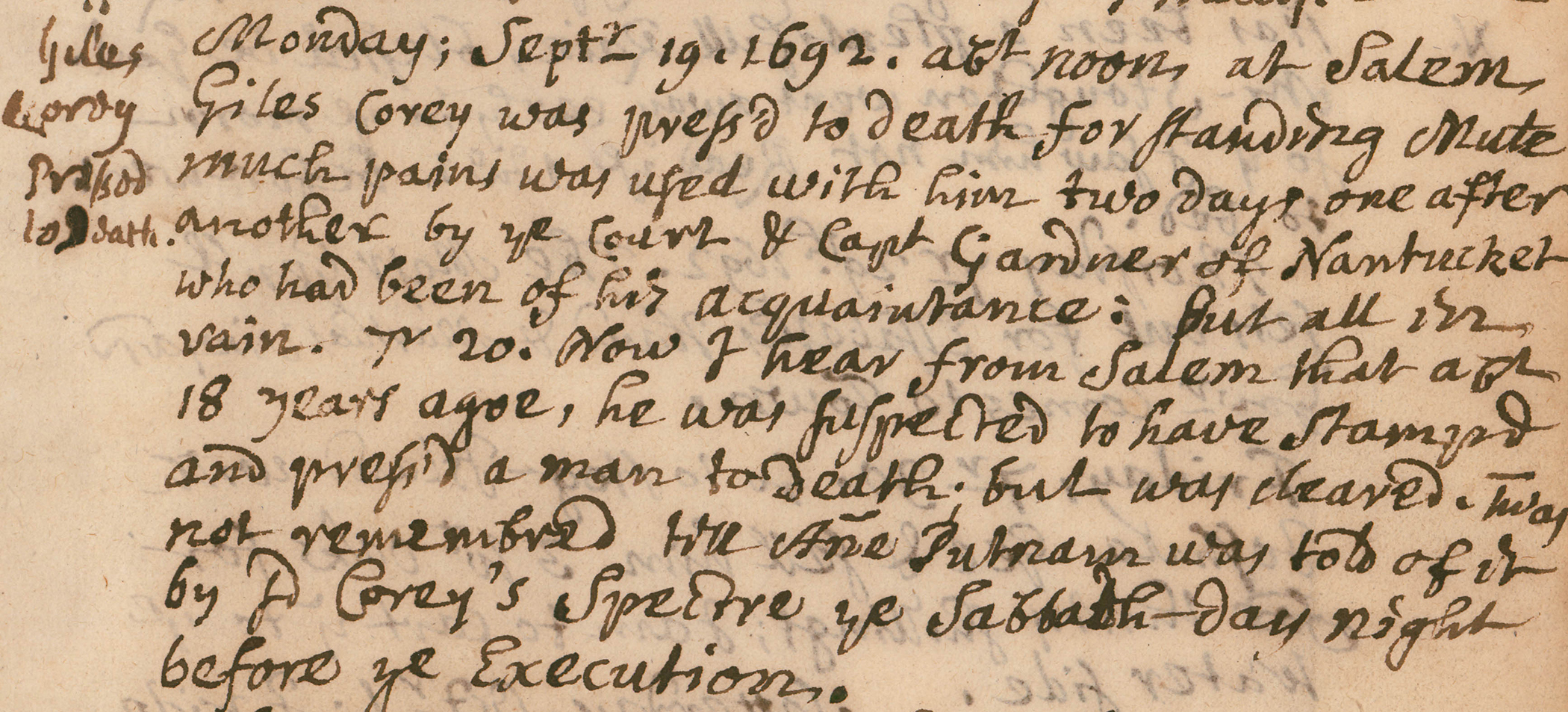 Samuel Sewall diary entry for 19 September, 1692
Investigation timeline
- 2026-09-22 — Historical file submitted.
- 2026-09-22 — Historical file accepted and published.
Research notes
Historical research: A Historical Martyr and a Folklore Ghost
Giles Corey shows the archive’s hard line between a well-documented event and a later supernatural tradition.
Well supported: Corey lived; he was accused in 1692; he refused to plead; he was pressed to death; he died on September 19, 1692; that death became one of the trials’ most famous episodes; a durable curse-and-ghost folklore grew around it; and later culture cast him as a symbol of resistance.
Not established: that he spoke the popular curse lines; that Salem sheriffs suffered a supernatural run of misfortune; that his ghost appears before disasters; or that any Corey apparition has independent contemporary documentation.
No contemporary source confirms the curse. Apparition and sheriff-curse material lives mainly in later tradition. Even if a health pattern among sheriffs could be shown in records, correlation alone would not prove a curse. Ghost reports are retrospective and anecdotal.
Classification: historical figure / curse folklore / apparition legend — strong on the pressing, soft on the paranormal. Primary trail for the man and the punishment; folklore for the curse and ghost. Status: historical event confirmed; paranormal claims unverified.
The legend endures because it joins a real injustice to the wish for symbolic payback. The execution is history. The curse and the ghost are how later generations remembered it — worth preserving as folklore, not as verified haunting.
Open research questions
A specific gap in the file. An accepted source, research note, or further-reading link closes it.
Determine the earliest traceable published source claiming that Giles Corey cursed Sheriff George Corwin or the town of Salem at the time of his death.
Propose evidence & media, a source citation, further reading, a research note, a correction, a related case, or a series link. Staff review before anything is added. An accepted correction does not replace the file by itself.