GG-2026-037
Marfa Lights
- Phenomenon Folklore & Cultural Encounters
- Documentation
Rating B
- A — Strong dossier: several independent sources plus primary evidence (original media, records, measurements) a researcher could use without interviewing anyone.
- B — Well documented: multiple independent witnesses with at least some contemporary primary material, or one witness with substantial primary corroboration (photos, recordings, contemporaneous notes, documents).
- C — Multi-source but soft: several witnesses or a long run of reports, but mostly testimony and after-the-fact secondary sources (newspapers, folklore collections, later interviews). Little or no primary physical evidence. Regional legend clusters such as the Bridgewater Triangle land here.
- D — Thin: single witness (or one household), little or no support beyond the account. Normal for a sincere personal experience.
- E — Incomplete or not yet assessed. Every new submission starts here until staff have read it.
- Evidence & media 2 items
- Status Active
- Location Marfa, Texas · regional placement
Regional marker representing the Marfa and Mitchell Flat area associated with the Marfa Lights. The reported lights appear across a broad landscape and are not associated with one fixed location.
This file is placed as a region or body of water, not a single exact event location.
Activity period
- Earliest claimed event 1883
- Earliest documented report 1957
- Latest documented report Ongoing
- Pattern Ongoing
Summary
The Marfa Lights are recurring reports of unexplained lights seen south of U.S. 90 near Marfa, Texas. Local tradition traces the phenomenon to the nineteenth century, often citing ranch hand Robert Reed Ellison's alleged 1883 sighting near Paisano Pass. However, the story appears in later retellings rather than in Ellison's surviving 1937 memoir. The earliest known newspaper account appeared in 1945. Modern investigations have shown that many lights visible from the official viewing area can be explained by vehicle headlights on U.S. 67 and related atmospheric effects. A smaller number of observations recorded away from that highway remain the subject of debate and study.
Background
Marfa sits in Presidio County on the northern edge of the Chihuahuan Desert. The modern viewing area is located along U.S. 90 approximately nine miles east of town, overlooking Mitchell Flat toward the Chinati Mountains. Witnesses commonly describe white, yellow, orange, or red lights that brighten, fade, split apart, merge together, or disappear entirely. These descriptions reflect how the lights appear to observers rather than measured properties of the phenomenon itself.
Stories of unusual lights in the region are often connected to the late nineteenth century. The most frequently repeated account involves ranch hand Robert Reed Ellison, who was later said to have mistaken a mysterious light near Paisano Pass for an Apache campfire in 1883. According to later family recollections, Ellison spoke about lights he could not explain and believed they resembled distant campfires. However, researchers examining his 1937 memoir found no mention of the incident. Similar stories are attached to other early settlers and ranchers, including O. W. Williams, though many of these accounts were preserved through local tradition rather than contemporary written records.
The earliest currently known newspaper account appeared in February 1945, when the San Angelo Times published a story about a recurring “ghost light” in the Marfa area. A 1957 article in Coronet magazine brought wider attention to the phenomenon. The Handbook of Texas also notes that military pilots training in the region during World War II reportedly searched for the lights from the air without identifying a clear source, helping establish the Marfa Lights as a long-running regional mystery.
In 2003, Texas and federal funding helped transform the old roadside pull-off into the modern Marfa Mystery Lights Viewing Center. The land was donated by Clayton Williams, grandson of O. W. Williams. The site serves as a viewing platform and interpretive stop but is not staffed as a permanent observatory.
One of the most influential modern investigations took place in May 2004, when students from the University of Texas at Dallas Society of Physics Students spent four nights monitoring the area with cameras, traffic counters, and support vehicles. Investigators concluded that many of the lights visible southwest of the viewing center corresponded closely with traffic moving along U.S. 67 between Marfa and Presidio. Headlights appeared as isolated points of light at great distance, and the movement of vehicles matched the motion reported for many commonly observed Marfa Lights. Journalist Michael Hall, writing for Texas Monthly in 2006, reported observing the same relationship between visible lights and roadway traffic.
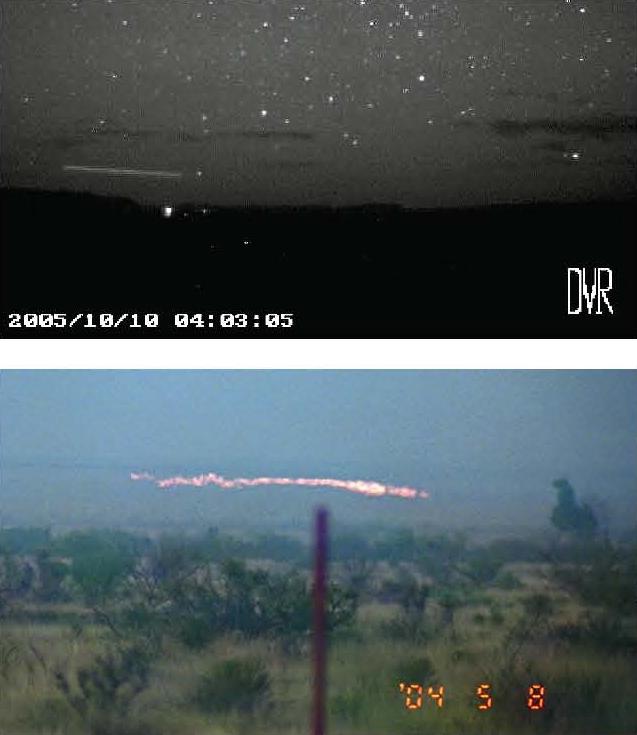
Not all researchers consider the highway explanation sufficient for every reported sighting. James Bunnell, a retired aerospace engineer, agreed that many lights visible from the viewing center are likely vehicle headlights. After his own sighting in 2000, however, he established camera stations on nearby ranches aimed away from both the Chinati Mountains and U.S. 67. In his book Night Orbs, Bunnell presented photographs of lights that he argued did not follow the highway pattern and occurred in different parts of the landscape. He estimated that such events were relatively uncommon and occurred only on a limited number of nights each year.
Bunnell proposed that geological and atmospheric conditions might contribute to the phenomenon, including a hypothesis involving charged particles and local geology. While such ideas have generated discussion, no single explanation has gained broad acceptance for every reported observation.
Today, the Marfa Lights remain one of the most famous ghost-light traditions in North America. Research has demonstrated that many lights commonly seen from the viewing area can be accounted for by distant vehicle traffic and related visual effects. At the same time, some observers argue that a smaller set of reports remains unexplained. As a result, the Marfa Lights occupy a space between folklore, local history, scientific investigation, and continuing debate.
Witness statement
No statement on file.
Evidence & media
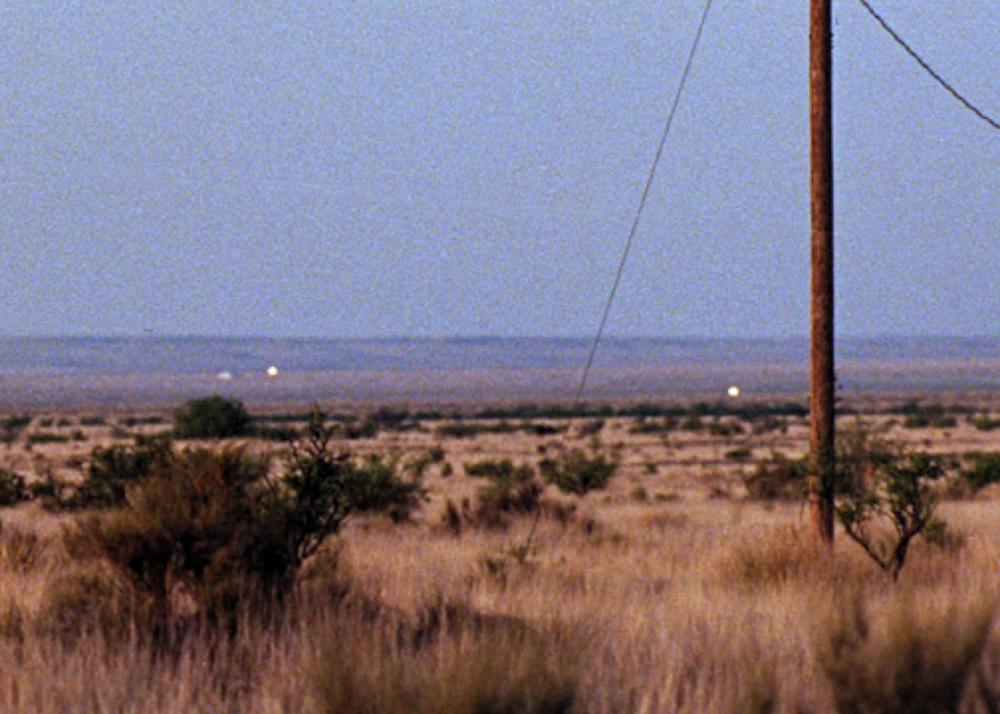
Marfa Lights Edson Hendricks Ml 25.Jpg Mstar Enh
The two bright circular white lights are Marfa Lights, probably a few hundred yards away. The leftmost light is due to vehicle headlights traveling north toward Marfa on Route 67 from Presidio. Photograph by Edson C. Hendricks.
Truthisoutthere 0019
Taken by James Bunnell
Further reading
Continue exploring — Wikipedia, documentaries, podcasts, museum pages. Not treated as proof, and not independently verified by this archive.
Investigation timeline
- 2026-09-23 — Historical file submitted.
- 2026-09-24 — Historical file accepted and published.
Assigned GG-2026-037
Research notes
Historical research: The park lights follow U.S. 67; the off-highway lights are still unclear
The nightly display from the U.S. 90 pull-off has been checked against the road. In May 2004 the Texas-Dallas students matched the lights southwest of the park to traffic on U.S. 67, and a headlight flash they controlled appeared as a Marfa light. Hall’s binocular watch in 2006 did the same. That part of the file is identified.
The 1883 story cannot do the work the plaque asks of it. Ellison told his family. His 1937 memoir does not mention the lights. The first known print account is the February 1945 San Angelo Times story, when cars were already on the Presidio road. Family memory can be older than the highway. It is not a contemporary note from a year without automobiles.
What remains is the smaller set Bunnell recorded with cameras aimed off U.S. 67. He has published those frames and offered a natural guess, plasma turned aside by the rock under Mitchell Flat. Guesses that start from quartz, piezoelectricity, or the Solitario are other people’s readings. None of them was measured on the 2004 trip, and none of them has been tied to a particular frame. The highway lights are accounted for. Those other recordings are not.
Historical research: Unidentified Atmospheric Plasma and Geo-Electromagnetic Phenomena
Observed continuously since at least 1883 near Mitchell Flat, east of Marfa, Texas, the Marfa Lights appear as glowing, floating orbs that move, merge, divide, and vanish unpredictably across the desert landscape.
While a significant percentage of modern sightings have been conclusively attributed to automobile headlights reflecting across temperature inversion layers along U.S. Route 67, a residual percentage of historical and instrumentally recorded sightings remain unexplained by conventional optics. The academic research question focuses on natural atmospheric plasma formation. Geophysicists and anomalous researchers analyze whether piezoelectric charges generated by tectonic stress in the region's quartz-rich volcanic rock, combined with thermal convection currents, generate low-temperature, long-lasting plasma balls (similar to ball lightning). The case remains an active intersection between physical geophysics and anomalous light phenomena.
Open research questions
A specific gap in the file. An accepted source, research note, or further-reading link closes it.
Locate documentation for Robert Reed Ellison's claimed 1883 observation that predates later retellings, and determine when the Ellison account first entered the written historical record.
Propose evidence & media, a source citation, further reading, a research note, a correction, a related case, or a series link. Staff review before anything is added. An accepted correction does not replace the file by itself.