GG-2026-045
Phoenix Lights
- Phenomenon UFOs/UAPs
- Documentation
Rating B
- A — Strong dossier: several independent sources plus primary evidence (original media, records, measurements) a researcher could use without interviewing anyone.
- B — Well documented: multiple independent witnesses with at least some contemporary primary material, or one witness with substantial primary corroboration (photos, recordings, contemporaneous notes, documents).
- C — Multi-source but soft: several witnesses or a long run of reports, but mostly testimony and after-the-fact secondary sources (newspapers, folklore collections, later interviews). Little or no primary physical evidence. Regional legend clusters such as the Bridgewater Triangle land here.
- D — Thin: single witness (or one household), little or no support beyond the account. Normal for a sincere personal experience.
- E — Incomplete or not yet assessed. Every new submission starts here until staff have read it.
- Evidence & media 3 items
- Status Historic
- Location Phoenix and surrounding areas, Arizona · regional placement
- Occurred 13 March 1997
Regional marker using downtown Phoenix as a public reference point for the March 13, 1997 sighting wave. Witness reports occurred across multiple Arizona communities and flight paths rather than at a single exact location.
This file is placed as a region or body of water, not a single exact event location.
Activity period
- Earliest claimed event 13 March 1997
- Earliest documented report 13 March 1997
- Latest documented report 13 March 1997
- Pattern Historic wave
Summary
On the night of 13 March 1997, people from the Nevada line through Phoenix to Tucson reported lights in the sky, in two waves that do not match each other. Around 8 p.m., witnesses described a V or a boomerang of lights moving southeast, silent, with a dark shape they said hid the stars. Around 10 p.m., a row of amber lights stood south of Phoenix and went out one by one behind the Sierra Estrella. Those later lights were filmed. In July 1997 the Maryland Air National Guard said A-10s training on the Barry M. Goldwater Range had dropped high-intensity parachute flares there that night, and had dumped the rest before returning to Davis-Monthan Air Force Base in Tucson. Governor Fife Symington, who had mocked the reports that June, wrote in 2007 that he had seen the earlier V, and that it was not the flares.
Background
The Phoenix Lights incident occurred on the evening of March 13, 1997, and is generally understood as two separate events that took place a few hours apart. The distinction matters because the two sets of sightings involved different witnesses, different evidence, and potentially different explanations.
The first reports began shortly before 8:00 p.m. Witnesses in Nevada and northern Arizona described a formation of lights moving southeast across the sky. Reports continued through Prescott, the Phoenix area, and toward Tucson. Most witnesses described five to seven amber or white lights arranged in a V-shaped or boomerang formation. Many said the lights appeared attached to a single dark object that blocked out the stars behind it. Others saw only the lights themselves. The formation was frequently described as silent and moving slowly across the landscape.
People who believed they were directly beneath the object often estimated its size as enormous, sometimes hundreds of feet across. Such estimates were based on nighttime observations without visible structure or known distance, making the object's actual dimensions impossible to determine from witness testimony alone. Unlike the later Phoenix Lights event, very little video footage exists of this first pass.
The images that brought the story national attention were recorded around 10:00 p.m. South of Phoenix, numerous witnesses filmed a row of bright amber lights appearing above the Sierra Estrella Mountains. The lights remained visible for several minutes and seemed to wink out one by one. Local television stations broadcast the footage, and by June the recordings had received national media coverage.
As attention grew, investigators sought an explanation for the videotaped lights. Initial inquiries found that aircraft based at Davis-Monthan Air Force Base had already returned before the lights appeared. Further investigation identified a flight of A-10 aircraft from the Maryland Air National Guard's 175th Fighter Wing operating on the nearby Barry M. Goldwater Range. Military officials stated that the aircraft had been dropping high-intensity illumination flares during training exercises and had released remaining flares before returning to base. Parachute flares can appear stationary at great distance and disappear gradually as they descend behind terrain. The military explanation closely matched the time, location, and appearance of the lights recorded south of Phoenix.
That explanation, however, addressed the 10:00 p.m. lights rather than the earlier formation reported across Arizona. Debate has continued over whether the first event involved military aircraft flying in formation, a single large object, misperceptions of ordinary lights, or something else entirely. No video from the first pass has been tied to a measured object or verified wingspan.
One of the most notable witnesses was Fife Symington, then governor of Arizona. In June 1997, Symington held a press conference in which a staff member dressed as an alien was brought before reporters, a moment that became one of the most famous episodes associated with the case. A decade later, however, Symington publicly stated that he had personally witnessed the earlier V-shaped formation and believed it was different from the later flare event. He described seeing a large, silent, delta-shaped object pass over the Phoenix area and argued that what he observed could not be explained by flares.
Other observers reached different conclusions. Retired Air Force pilot James McGaha argued that both the early formation and the later lights could be explained by military aircraft and flare activity. Witnesses who reported seeing a solid dark object in the first event generally disagreed.
Today, the Phoenix Lights remain one of the best-known UFO cases in American history. The 10:00 p.m. lights south of Phoenix are widely associated with military flare drops over the Barry M. Goldwater Range. The earlier V-shaped formation reported across Arizona is less easily resolved and remains the subject of ongoing debate. Whether those first sightings involved aircraft, a single large object, misidentification, or another explanation remains unresolved.
Witness statement
No statement on file.
Evidence & media
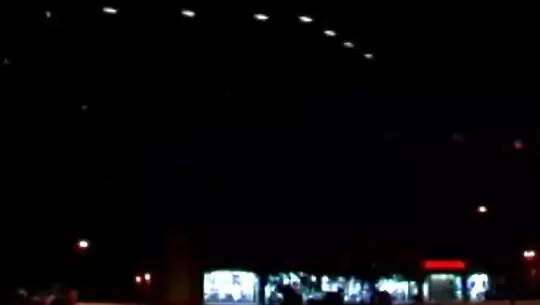
636229502332893938-lynnketeiphoenixlightshost
Phoenix, AZ - March 1997
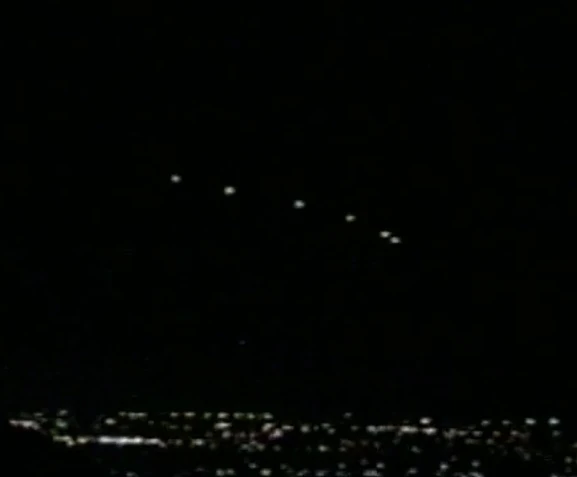
Phoenix Mystery Lights4 Actual
Phoenix, AZ - March 1997
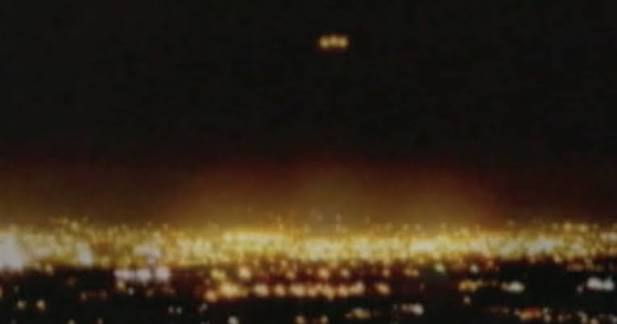
images
Phoenix, AZ - March 1997
Further reading
Continue exploring — Wikipedia, documentaries, podcasts, museum pages. Not treated as proof, and not independently verified by this archive.
Investigation timeline
- 2026-09-24 — Historical file submitted.
- 2026-09-25 — Historical file accepted and published.
Assigned GG-2026-045
Research notes
Historical research: Mass Eyewitness Observation and Anomalous Atmospheric Phenomena
The Phoenix Lights incident serves as a prominent case study in cognitive psychology, optical perception in nocturnal environments, and the sociology of mass witness phenomena.
Academic analysis evaluates the event by separating sensory data into distinct observational categories:
From an optical and psychological perspective, researchers study the challenges of estimating the size, speed, and altitude of ungrounded light sources against a featureless night sky. The human visual system frequently relies on Gestalt principles of grouping, wherein isolated lights moving in synchronized trajectories are perceived as a single, solid structure—a phenomenon known as perceptual completion. Skeptical models argue that this cognitive effect, combined with localized atmospheric refraction and low-frequency engine sound suppression, accounts for reports of a unified "wedge" craft.
Conversely, social scientists and anomalous-phenomena analysts focus on the high consistency among independent witness statements collected prior to widespread media coverage. The simultaneous observation across multiple municipalities by individuals with aviation experience provides a robust dataset. Consequently, academia views the event as a dual phenomenon: a thoroughly documented deployment of military illumination flares alongside an unsolved, multi-state observational event that continues to inform research into human perception and nocturnal aerial tracking.
Historical research: The 10 p.m. tapes are the flares; the earlier V was not that drop.
Keep the night in two pieces. The videos, the Estrella ridge, and the Maryland Guard’s July 1997 statement belong to the 10 p.m. row. High-intensity flares on parachutes, dropped over the Goldwater Range and dumped before the flight back to Tucson, look from the city like a line of amber lights that go out one at a time. That part of the file is identified.
The earlier reports are a wedge of lights moving from the north, through Phoenix, toward Tucson, around 8 p.m. The flare drop does not start in Henderson or Paulden. A flight of the same A-10s did land at Davis-Monthan about 8:30 p.m. after coming from the Phoenix side, and a helicopter unit reported A-10s along Interstate 10. That is the ordinary reading of the first pass: several jets, seen as lights, the bodies too dark to separate. Witnesses who say they were underneath describe silence, a single dark shape, and stars gone between the lights. Bright lights hide stars by glare. A formation can be heard or not, depending on altitude and where the listener stands. Those reports were not filmed the way the 10 p.m. row was filmed.
Symington’s costume on 19 June was a joke, the same day he had promised an investigation. His 2007 account is that he saw the delta while looking for the distant lights, and that he has never accepted the flares as that object. He is a witness to the first pass, writing a decade later. He is not a measurement of it, and he does not put the videotaped row back in doubt. The flares are the tapes. The V is still a formation of lights whose airframes nobody photographed.
Open research questions
A specific gap in the file. An accepted source, research note, or further-reading link closes it.
Determine whether surviving FAA, military, or air-operations records can establish a more precise timeline for the reported formation sightings and subsequent light displays across Arizona on March 13, 1997.
Propose evidence & media, a source citation, further reading, a research note, a correction, a related case, or a series link. Staff review before anything is added. An accepted correction does not replace the file by itself.