GG-2026-050
Enfield Poltergeist
- Phenomenon Physical & Poltergeist Activity
- Documentation
Rating B
- A — Strong dossier: several independent sources plus primary evidence (original media, records, measurements) a researcher could use without interviewing anyone.
- B — Well documented: multiple independent witnesses with at least some contemporary primary material, or one witness with substantial primary corroboration (photos, recordings, contemporaneous notes, documents).
- C — Multi-source but soft: several witnesses or a long run of reports, but mostly testimony and after-the-fact secondary sources (newspapers, folklore collections, later interviews). Little or no primary physical evidence. Regional legend clusters such as the Bridgewater Triangle land here.
- D — Thin: single witness (or one household), little or no support beyond the account. Normal for a sincere personal experience.
- E — Incomplete or not yet assessed. Every new submission starts here until staff have read it.
- Evidence & media 4 items
- Status Historic
- Location Enfield, England · exact location withheld
- Occurred 31 August 1977
This case is associated with private or restricted property. Do not trespass, disturb residents, remove artifacts, or conduct an investigation without explicit permission.
Activity period
- Earliest claimed event 31 August 1977
- Earliest documented report 31 August 1977
- Latest documented report 1979
- Pattern Historic wave
Summary
Beginning in August 1977, a council house in Enfield, North London, became the center of one of Britain's most intensively investigated poltergeist cases. The reported activity, much of it associated with 11-year-old Janet Hodgson and her sister Margaret, included unexplained knocking, moving and thrown objects, apparent disturbances of furniture, and a harsh voice that claimed to belong to a former resident. Neighbors, journalists, police, and investigators from the Society for Psychical Research witnessed portions of the activity. The case remains controversial because the children were also caught deliberately producing some incidents, while several witnesses maintained that other events occurred under circumstances they could not explain.
Background
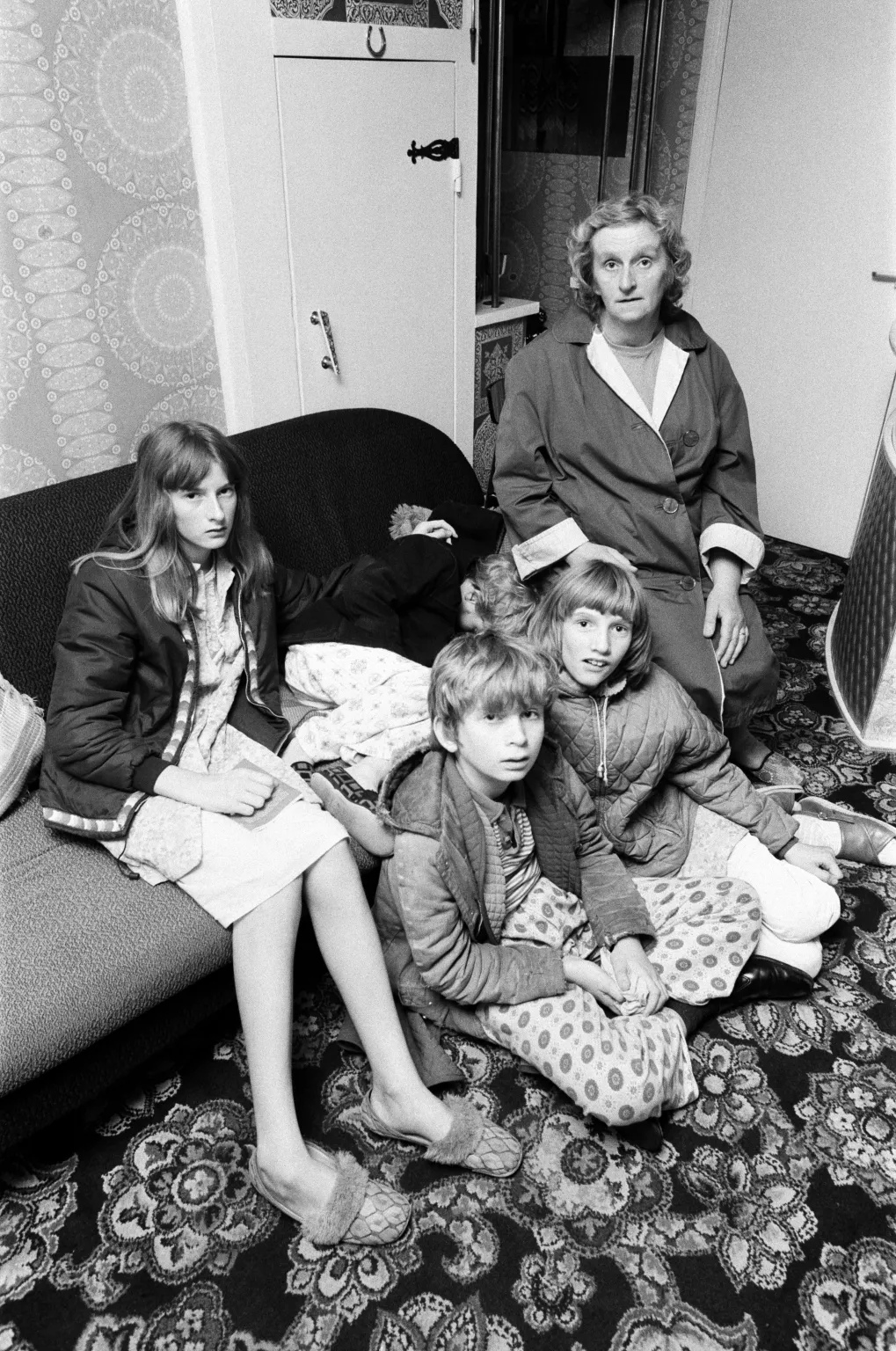
The Enfield case began at a council house in north London occupied by Peggy Hodgson and her four children. The first widely documented episode occurred on the evening of August 31, 1977, when the family reported unexplained noises and movement inside the house. Neighbor Vic Nottingham was called in after the family became alarmed, heard knocking himself, and was unable to locate an obvious source. Police were subsequently contacted.
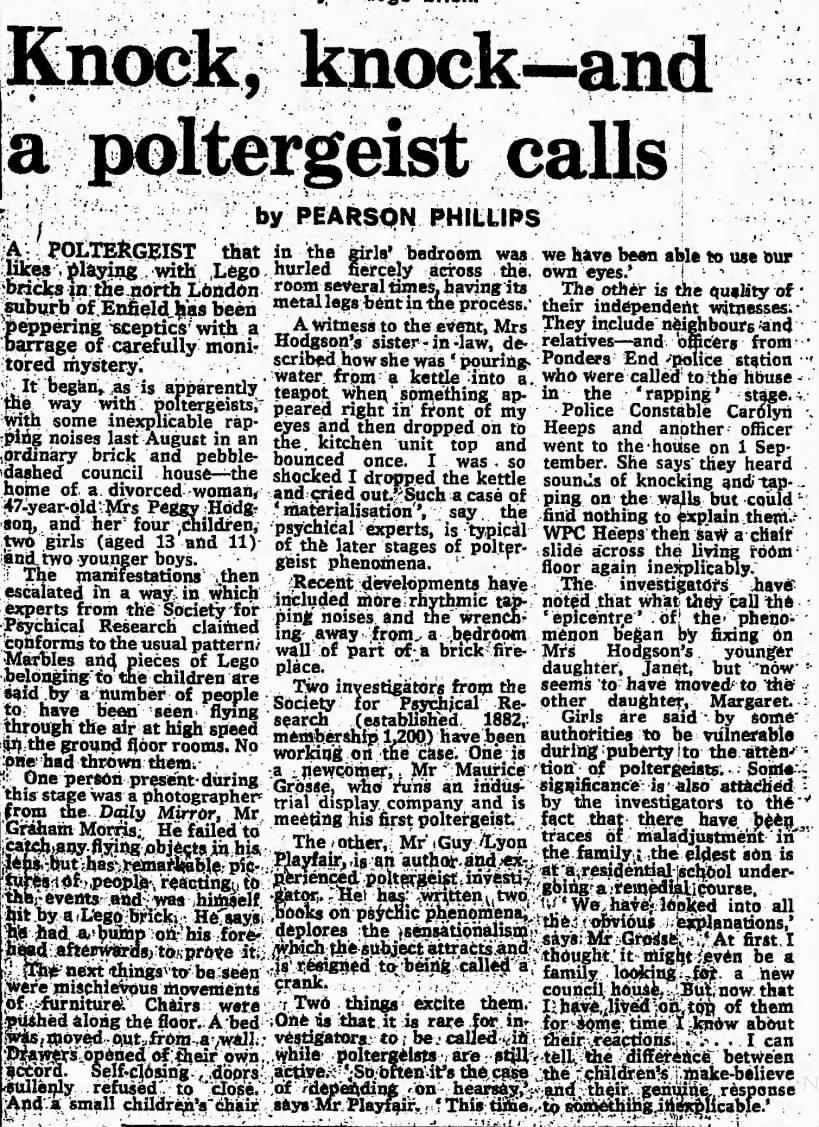
A police constable who attended the house later provided a written statement describing unexplained knocking and an incident in which a chair appeared to move across the living-room floor. The officer examined the chair but reported finding no explanation for the movement. The statement is one reason the earliest phase of Enfield attracted more serious attention than a simple family ghost story might otherwise have received: at least one apparently independent witness reported observing something unusual before the case had become a national media phenomenon.
Within days, the case reached the press. Daily Mirror journalists and photographers visited Green Street after neighbor Peggy Nottingham contacted the newspaper. Reports expanded to include small objects apparently flying or being thrown inside the house, and photographer Graham Morris said he was struck by a piece of Lego while covering the story. The resulting publicity brought the case to the attention of the Society for Psychical Research.
The SPR connected the family with Maurice Grosse, an inventor and relatively recent Society member who began investigating the case in September. Guy Lyon Playfair joined Grosse shortly afterward. Together they repeatedly visited the house over more than a year, accumulating a substantial collection of recordings, notes, photographs, and witness testimony. One historical review credits the pair with approximately 180 visits and more than 180 hours of recorded material.
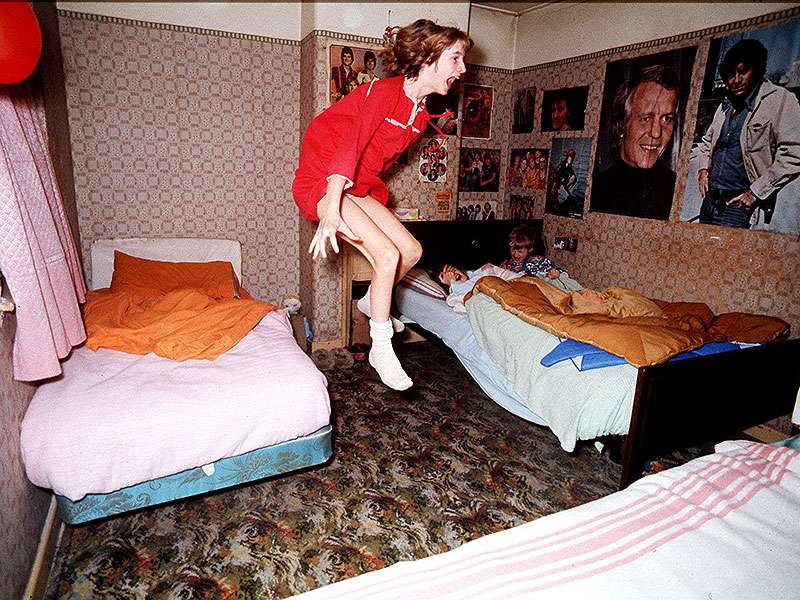
Reports during the investigation included persistent knocks, moving furniture, thrown toys and household objects, small fires, doors and drawers opening unexpectedly, and claims that Janet was sometimes lifted or thrown from her bed. Photographs showing Janet apparently airborne became among the most famous images associated with the case. Their interpretation remains disputed: supporters of the case regarded them as evidence of unusual movement, while skeptical investigators argued that the photographs were consistent with Janet jumping from the bed.
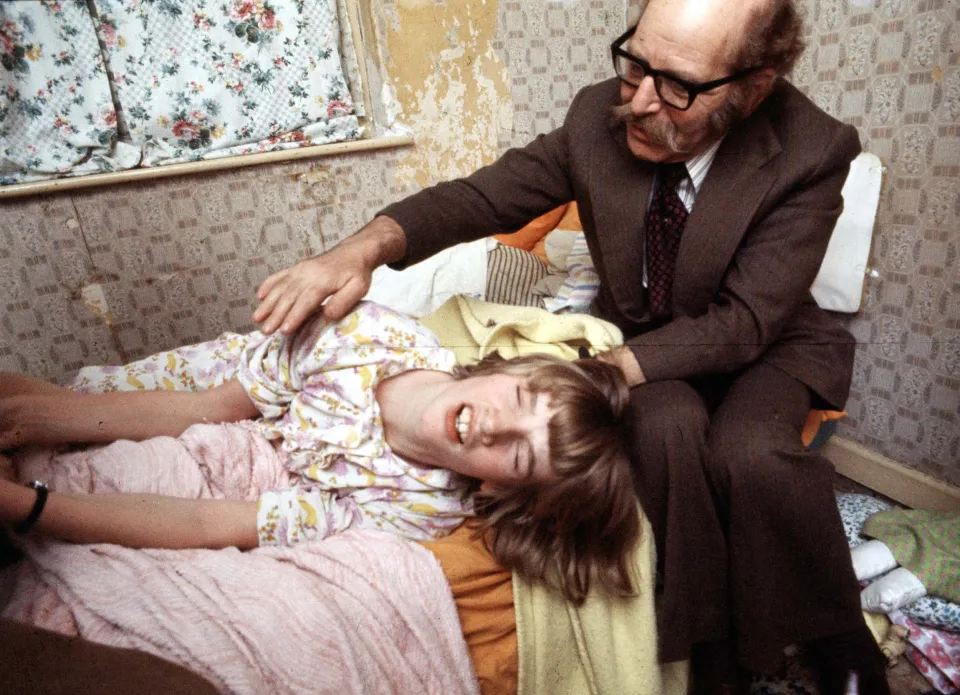
Late in 1977 the case developed another distinctive feature. A rough, male-sounding voice began speaking through Janet, at times identifying itself as “Bill Wilkins.” The voice supplied information about a former resident who had reportedly died in the house. Years later, a relative of that former resident said elements of the description corresponded with the circumstances of the death. That later corroboration became an important part of the paranormal interpretation of the case, although it does not establish how Janet acquired the information or that the voice represented the deceased man.
Grosse and Playfair experimented with ways of determining how the voice was being produced and sought opinions from outside specialists. Debate centered on whether Janet was deliberately creating the sound through an unusual form of vocal production. The voice became one of Enfield's most discussed pieces of evidence precisely because it was physically associated with Janet rather than an independently located disembodied sound.
At the same time, evidence of deliberate trickery emerged. The Hodgson children were caught producing some phenomena themselves, and skeptical observers argued that the known deception undermined confidence in the rest of the case. Anita Gregory and John Beloff, both associated with the Society for Psychical Research, were among those who remained unconvinced by the paranormal interpretation. The existence of trickery is therefore not a later invention by outside debunkers; it was part of the controversy while the investigation was underway.
Grosse and Playfair acknowledged that the children sometimes attempted to fool the investigators but rejected the conclusion that those incidents accounted for everything they had recorded. Their position was that the deliberate tricks represented only part of a much larger body of reported phenomena, some of which they believed had occurred under conditions that excluded simple fraud. Other researchers disputed that assessment.
That disagreement is central to understanding Enfield. The evidentiary question is not whether any incidents were faked, because some clearly were. The harder question is whether the demonstrated tricks are sufficient to explain the wider collection of reports involving neighbors, journalists, investigators, and the police officer who attended early in the case.
The disturbances gradually declined, and the Enfield case passed from current investigation into paranormal history. Janet later acknowledged that she and Margaret had sometimes played tricks during the investigation while continuing to maintain that the larger phenomenon was genuine.
Enfield therefore occupies an unusually complicated position among famous haunting cases. It produced a much larger documentary record than most household poltergeist stories, including witness statements, photographs, audio recordings, press coverage, and extensive investigator notes. Yet that record also contains admitted deception and serious disagreement among investigators who examined the case firsthand.
The surviving material establishes that unusual events were reported by numerous people and that the case received prolonged investigation. It also establishes that some incidents were deliberately manufactured. What it does not establish is that every reported event was fraudulent, or conversely that the events investigators could not explain were necessarily paranormal. That unresolved divide is what has kept the Enfield case controversial decades later.
Witness statement
No statement on file.
Evidence & media
Psychic Phenomenon Enfield Poltergeist Goings 771030431
Peggy and her children Margaret, Johnny, Janet, and Billy
Janet Hodgson 800
Janet Hodgson allegedly levitating caught on camera..
3ce20a66-972e-439d-94a1-d0a80886d914
Janet would occasionally slip into a trance and exhibit bizarre behaviour, as seen here with Maurice Grosse.
Untitled Newspaper
Newspaper article.
Further reading
Continue exploring — Wikipedia, documentaries, podcasts, museum pages. Not treated as proof, and not independently verified by this archive.
Investigation timeline
- 2026-09-25 — Historical file submitted.
- 2026-09-25 — Historical file accepted and published.
Assigned GG-2026-050
Research notes
Historical research: Psychological Dynamics and Methodological Challenges
Academic evaluations by parapsychologists, folklorists, and skeptics evaluate the Enfield case as a landmark study in witness reliability, suggestion, and family dynamics.
Critics such as magician Milbourne Christopher and parapsychologist Anita Gregory argued that the primary phenomena were driven by childhood trickery and psychological stress following her parents' divorce. The vocal phenomena were examined by speech therapists, who concluded that speaking in false vocal chords (ventriloquial techniques) is entirely possible without vocal cord damage, particularly for adolescents. Furthermore, cognitive bias and investigator fixation—specifically Maurice Grosse’s deep emotional attachment following the recent death of his own daughter—are frequently cited as factors that eroded objective experimental controls.
Historical research: Parapsychological and RSPK Questions
Despite documented instances of fabrication, several parapsychological questions remain unresolved due to the sheer volume of corroborative third-party testimonies.
Parapsychologists categorize the non-fraudulent core of the case under Recurrent Spontaneous Psychokinesis (RSPK). This model posits that intense psychological or emotional trauma during adolescence can express itself externally as physical psychokinetic events rather than discarnate spirit activity. Proponents point out that over 30 independent professional witnesses—including police officers, press photographers, engineers, and skepticism-minded visitors—reported witnessing physical displacement, temperature drops, and acoustic anomalies under conditions where the children were clearly stationary and held under observation.
Open research questions
A specific gap in the file. An accepted source, research note, or further-reading link closes it.
Trace the earliest source for each major Enfield Poltergeist claim, including object movements, knocking sounds, levitation reports, direct-voice phenomena and witness testimony. Identify which claims are supported by contemporary records and which first appear in later investigations, publications, documentaries or retellings.
Propose evidence & media, a source citation, further reading, a research note, a correction, a related case, or a series link. Staff review before anything is added. An accepted correction does not replace the file by itself.