GG-2026-061
The Highgate Vampire
- Phenomenon Folklore & Cultural Encounters
- Documentation
Rating B
- A — Strong dossier: several independent sources plus primary evidence (original media, records, measurements) a researcher could use without interviewing anyone.
- B — Well documented: multiple independent witnesses with at least some contemporary primary material, or one witness with substantial primary corroboration (photos, recordings, contemporaneous notes, documents).
- C — Multi-source but soft: several witnesses or a long run of reports, but mostly testimony and after-the-fact secondary sources (newspapers, folklore collections, later interviews). Little or no primary physical evidence. Regional legend clusters such as the Bridgewater Triangle land here.
- D — Thin: single witness (or one household), little or no support beyond the account. Normal for a sincere personal experience.
- E — Incomplete or not yet assessed. Every new submission starts here until staff have read it.
- Evidence & media 5 items
- Status Historic
- Location London, England
- Occurred 6 February 1970
Exact marker for Highgate Cemetery, the principal public historic site associated with the 1969-1970 Highgate Vampire panic. Reported experiences occurred at different locations within and around the cemetery, and the marker does not identify a specific apparition site.
Activity period
- Earliest claimed event 24 December 1969
- Earliest documented report 6 February 1970
- Latest documented report 1970
- Pattern Historic wave
Summary
During the late 1960s and early 1970s, reports of a tall, dark, grey apparition in London’s overgrown Highgate Cemetery triggered a media-fueled sensation. Two rival eccentric figures, Sean Manchester and David Farrant, claimed the entity was a vampire. The resulting public hysteria led to nocturnal cemetery invasions, grave desecrations, and police arrests, creating one of Britain’s most infamous modern folklore panics.
Background
By the late 1960s, Highgate Cemetery in North London had fallen into extreme neglect. Overgrown with dense vegetation and crumbling Victorian vaults, it provided an atmospheric setting for local youth and occult enthusiasts.
Early Sightings: In late 1969, members of the local occult community, including David Farrant (founder of the British Psychic and Occult Society), began reporting encounters with a tall, shadowy figure with red eyes near Swain's Lane.
The Media Frenzy: In February 1970, letters published in the Hampstead & Highgate Express detailed sightings of the "phantom." Soon after, Sean Manchester publicly asserted that the entity was a "Wallachian King Vampire" brought to England in a coffin during the 18th century by Satanists.
Timeline of Key Events
├── Late 1969 : Reports of a tall dark apparition near Highgate Cemetery surface in local letters.
├── Feb 1970 : Local newspapers report claims of a "vampire"; public interest explodes.
├── Mar 13, 1970: Mass "Vampire Hunt" mob scales cemetery gates on Friday the 13th.
├── Aug 1970 : Desecrated, charred remains of a corpse are found near cemetery catacombs.
└── 1974 : David Farrant is tried and convicted for damaging graves and trespassing.
The Rivalry, The Mass Hunt, and Legal Aftermath
The story rapidly escalated into a public spectacle driven by intense rivalry between Manchester and Farrant, each claiming to be the legitimate investigator of the phenomenon.
The Mass Vampire Hunt: On Friday, March 13, 1970, hundreds of curiosity seekers, armed with stakes, garlic, and crucifixes, swarmed Swain's Lane. Despite police barricades, dozens climbed over cemetery walls to hunt the creature, resulting in widespread property damage.
Legal Fallout & The "End Result"
In the aftermath of the mass hysteria, local law enforcement cracked down on activity around Swains Lane:
Arrests & Prosecutions: In August 1970, David Farrant was arrested near the cemetery grounds at night in possession of a wooden stake and a crucifix. While that initial case was dismissed, Farrant was later tried at the Old Bailey in 1974 and sentenced to prison on charges related to damage to property, damaging graves, and sending threatening voodoo-style effigies to police officers—charges he contested for the rest of his life.
Manchester’s Exorcism Claims: Sean Manchester claimed to have tracked the vampire over subsequent years. According to his self-published books (most notably The Highgate Vampire, 1985), Manchester tracked the entity to an abandoned Gothic mansion on the border of Highgate and Crouch End ("The House of Dracula"). He claimed to have performed a formal exorcism, driven a wooden stake through the corpse's heart, and burned the remains, allegedly ending the curse forever. No witness or evidence has come forward to support these claims.
Witness statement
No statement on file.
Evidence & media
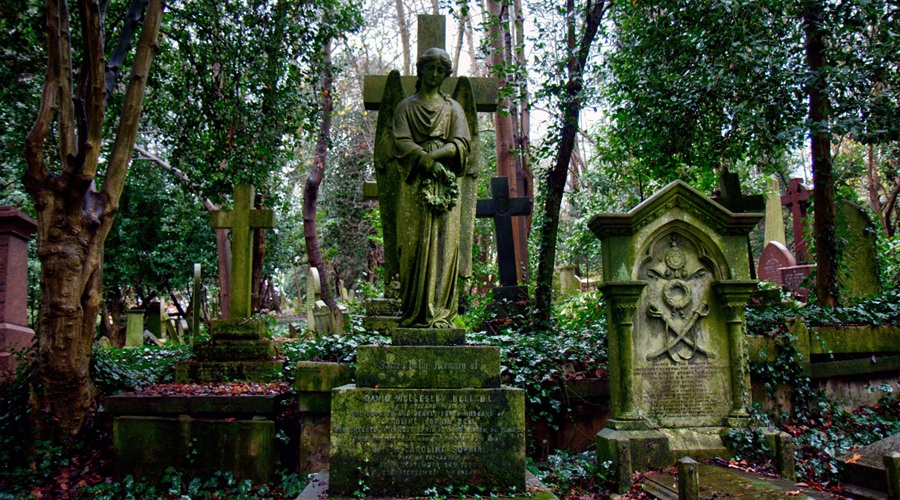 Highgate Cemetery
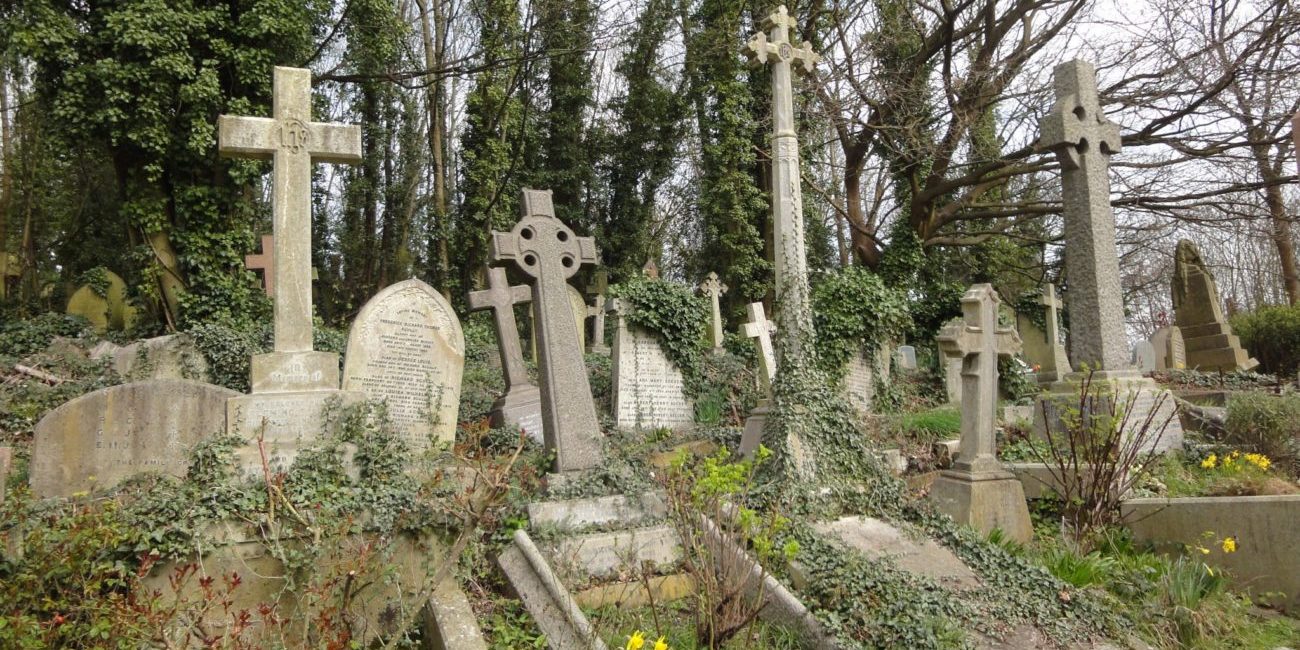 Highgate Cemetery
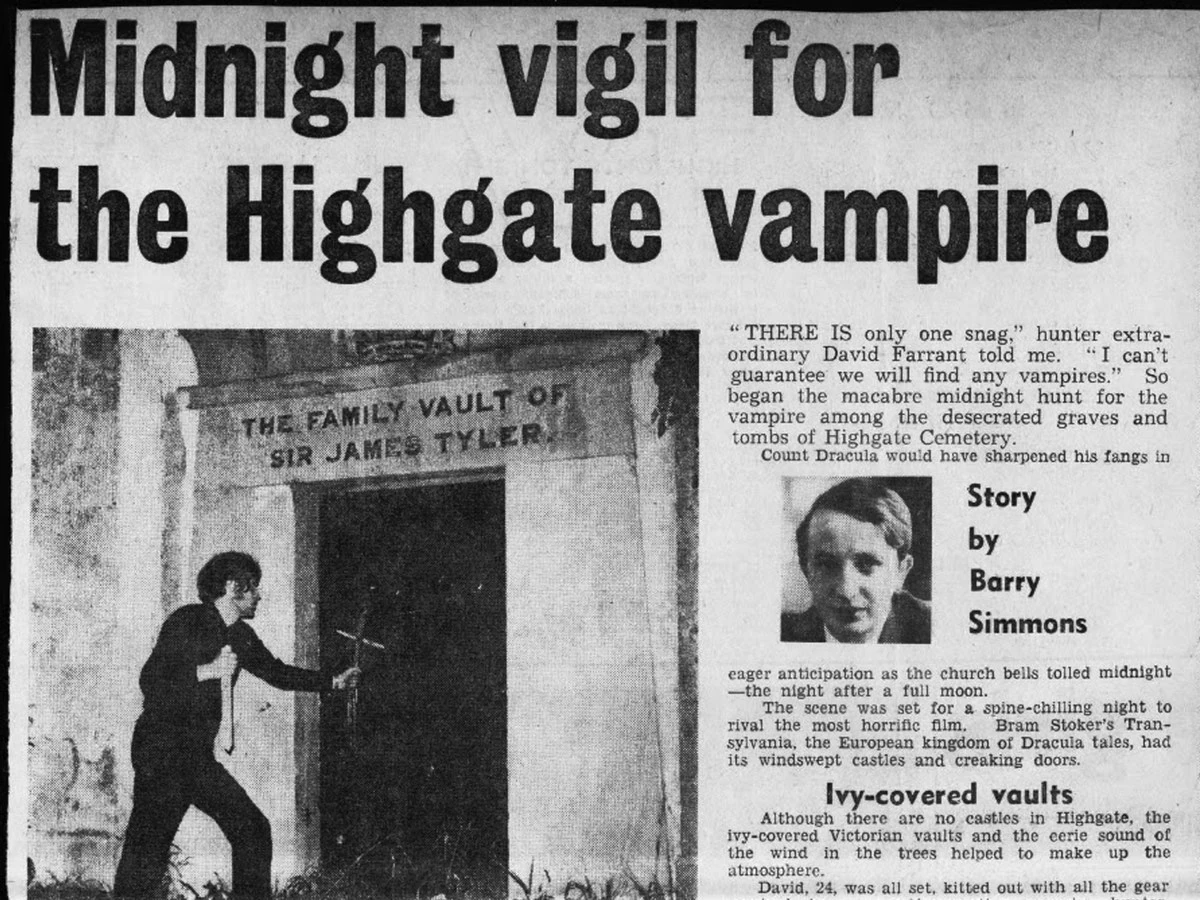 Newspaper headlines c. 1970
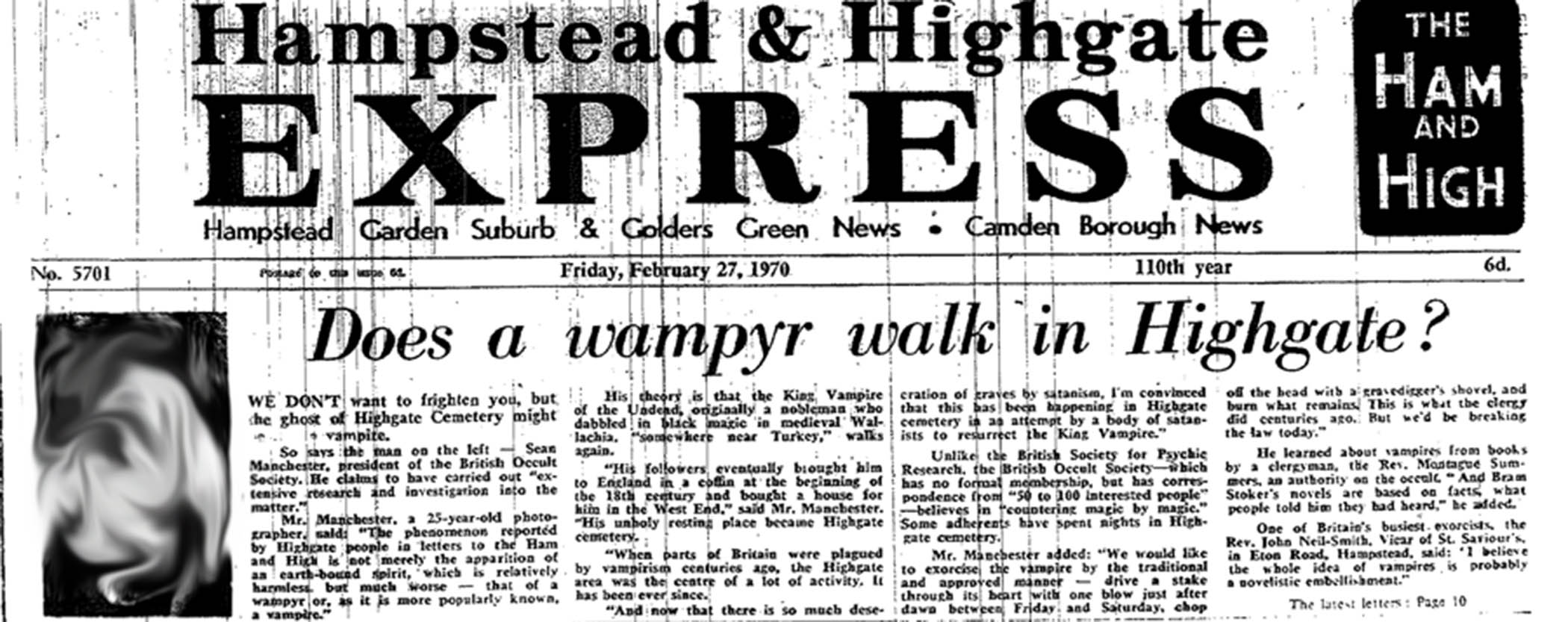 Newspaper headlines c. 1970
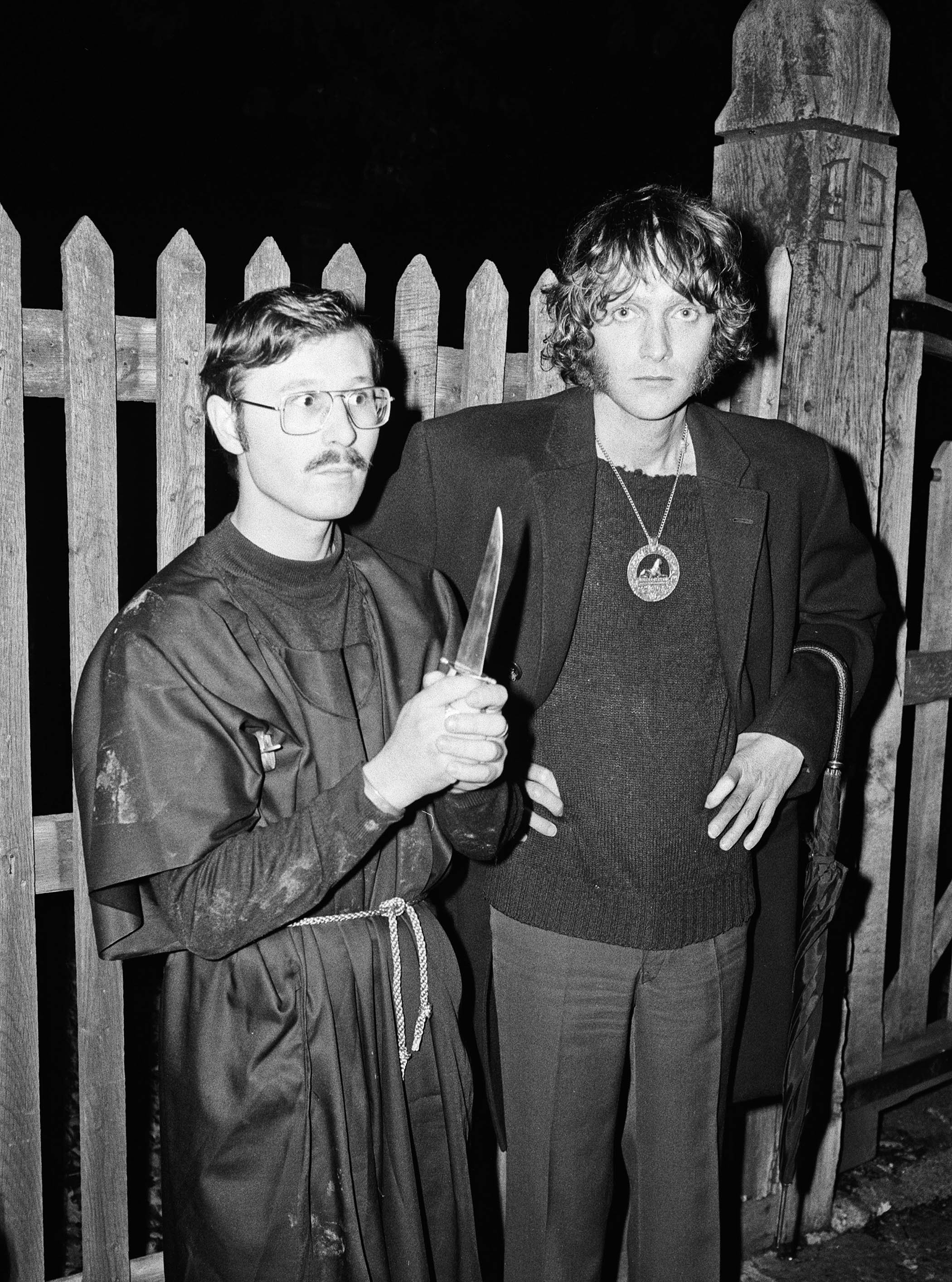 David Farrant, right, claimed to have seen a ‘ghost-like apparition’ in Highgate Cemetery
Investigation timeline
- 2026-09-26 — Historical file submitted.
- 2026-09-26 — Historical file accepted and published.
Research notes
Historical research: Mass Hysteria, Legend-Tripping, and Media Contagion
In sociology, folklore, and anomalistic psychology, the Highgate Vampire incident is studied as a classic paradigm of moral panic, media-driven social contagion, and ostensive action.
Scholars emphasize that the incident coincided with a resurgence of British gothic horror cinema (such as Hammer Film Productions) and widespread tabloid interest in the occult during the late 1960s. The neglect of Highgate Cemetery created a physical space conducive to "legend-tripping"—a practice where young people visit places associated with scary stories to test their bravery. Sociological analysis reveals that sensationalized coverage by the Hampstead & Highgate Express transformed scattered, ambiguous accounts of shadows and urban folklore into a structured "vampire" narrative. When self-styled experts validated these fears in national media, public anxiety crystallized into collective hysteria, resulting in mass mob behavior, trespassing, and vandalism.
Historical research: Environmental Anomalies, Atmospheric Optics, and Unresolved Perceptions
While social contagion accounts for the public panic and mob behavior, parapsychological researchers evaluate whether specific environmental or psychological factors initiated the early individual reports.
Anomalistic researchers point out that before media intervention, several independent witnesses reported consistent, non-vampiric phenomena—such as sudden localized temperature drops, feelings of paralysis, and sightings of a tall, dark humanoid entity near the central catacombs. Parapsychologists examine whether combinations of sleep paralysis, hypnagogic hallucinations, and acoustic/visual pareidolia—induced by the dark, dense foliage and flickering gas lighting along Swain's Lane—could account for these visions. While skeptics maintain these were ordinary misinterpretations amplified by expectation, open-minded researchers consider how environmental stress, low-frequency electromagnetic fields, or localized microclimates might trigger spontaneous, highly vivid perceptual anomalies in sensitive individuals.
Open research questions
A specific gap in the file. An accepted source, research note, or further-reading link closes it.
Trace the earliest contemporary sources for the Highgate reports and follow how the story developed during 1969–1970. Compare newspaper correspondence, witness accounts and statements by David Farrant and Sean Manchester to determine when specific vampire claims first appeared and which elements entered through later books, interviews, documentaries or retellings.
Propose evidence & media, a source citation, further reading, a research note, a correction, a related case, or a series link. Staff review before anything is added. An accepted correction does not replace the file by itself.