GG-2026-064
Tehran UFO Incident
- Phenomenon UFOs/UAPs
- Documentation
Rating B
- A — Strong dossier: several independent sources plus primary evidence (original media, records, measurements) a researcher could use without interviewing anyone.
- B — Well documented: multiple independent witnesses with at least some contemporary primary material, or one witness with substantial primary corroboration (photos, recordings, contemporaneous notes, documents).
- C — Multi-source but soft: several witnesses or a long run of reports, but mostly testimony and after-the-fact secondary sources (newspapers, folklore collections, later interviews). Little or no primary physical evidence. Regional legend clusters such as the Bridgewater Triangle land here.
- D — Thin: single witness (or one household), little or no support beyond the account. Normal for a sincere personal experience.
- E — Incomplete or not yet assessed. Every new submission starts here until staff have read it.
- Evidence & media 3 items
- Status Historic
- Location Tehran, Iran
- Occurred 19 September 1976
Summary
On September 19, 1976, residents and military radar operators in Tehran, Iran, reported an intensely bright airborne object. The Imperial Iranian Air Force scrambled two F-4 Phantom II jet interceptors to investigate. As both pilots acquired the target visually and on radar, their weapons systems, communications equipment, and avionics repeatedly failed during close approaches, creating a premier military UAP case.
Background
The Scramble and Interception
In the early hours of September 19, 1976, the command tower at Mehrabad International Airport received multiple citizen calls describing a brilliant, glowing object hovering in the night sky. After tower controller Youssef Jahandi visually confirmed a flashing, multi-colored object above the city, he alerted the Imperial Iranian Air Force (IIAF).
First Intercept (F-4 #1): At 1:30 AM, an F-4 Phantom II piloted by Captain Yaddi Nazeri took off from Shahrokhi Air Base. As Nazeri approached within 25 nautical miles of the object, his instrumentation and all radio communications suddenly ceased functioning. Turning the aircraft away from the object restored full avionics and radio control, prompting him to return to base.
Second Intercept (F-4 #2): A second F-4, piloted by Lieutenant Parviz Jafari with Weapons Systems Officer Lieutenant Jalal Jafari, scrambled at 1:40 AM. Jafari locked onto the object with airborne radar at 25 nautical miles, noting a target signature comparable to a Boeing 707 tanker.
Timeline of Key Events
├── Sept 19, 00:30 AM : Mehrabad Tower receives civilian calls regarding a bright object over Tehran.
├── Sept 19, 01:30 AM : First F-4 Phantom (Capt. Nazeri) scrambles; loses avionics/radio at 25 miles out.
├── Sept 19, 01:40 AM : Second F-4 (Lt. Jafari) achieves radar lock; object releases smaller luminous probe.
├── Sept 19, 01:48 AM : F-4 weapon control panel fails during AIM-9 missile preparation; object executes high-speed descent.
└── Sept 19, 02:00 AM : Object drops secondary light to ground; U.S. Defense Intelligence Agency files formal memo.
Weapon Malfunction and Secondary Probes
As Lieutenant Jafari closed the distance, the primary target accelerated away at high speed. Jafari then observed a smaller, brilliantly illuminated object detach from the main craft and move directly toward his F-4.
Interpreting the approaching object as a hostile missile, Jafari attempted to fire an AIM-9 Sidewinder heat-seeking missile. The moment he selected the missile control panel, his weapon control interface, radio, and interphone failed completely. Jafari executed a sharp diving turn to evade the incoming object. The smaller probe circled inside his turn and rejoined the primary craft. A second small object subsequently detached, descended rapidly, and landed softly on the desert ground near Rey, casting a bright illumination across the terrain before extinguishing.
Witness statement
No statement on file.
Evidence & media
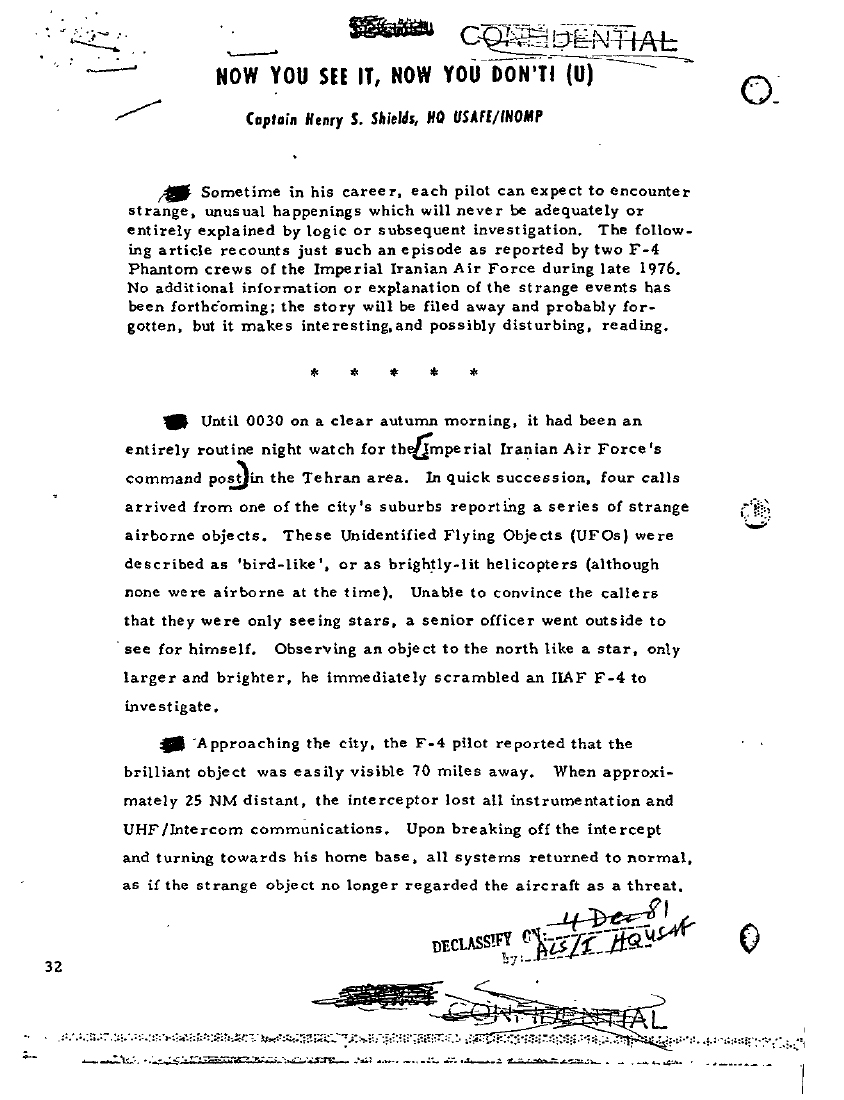 Air Force files on the Tehran UFO incident in 1976
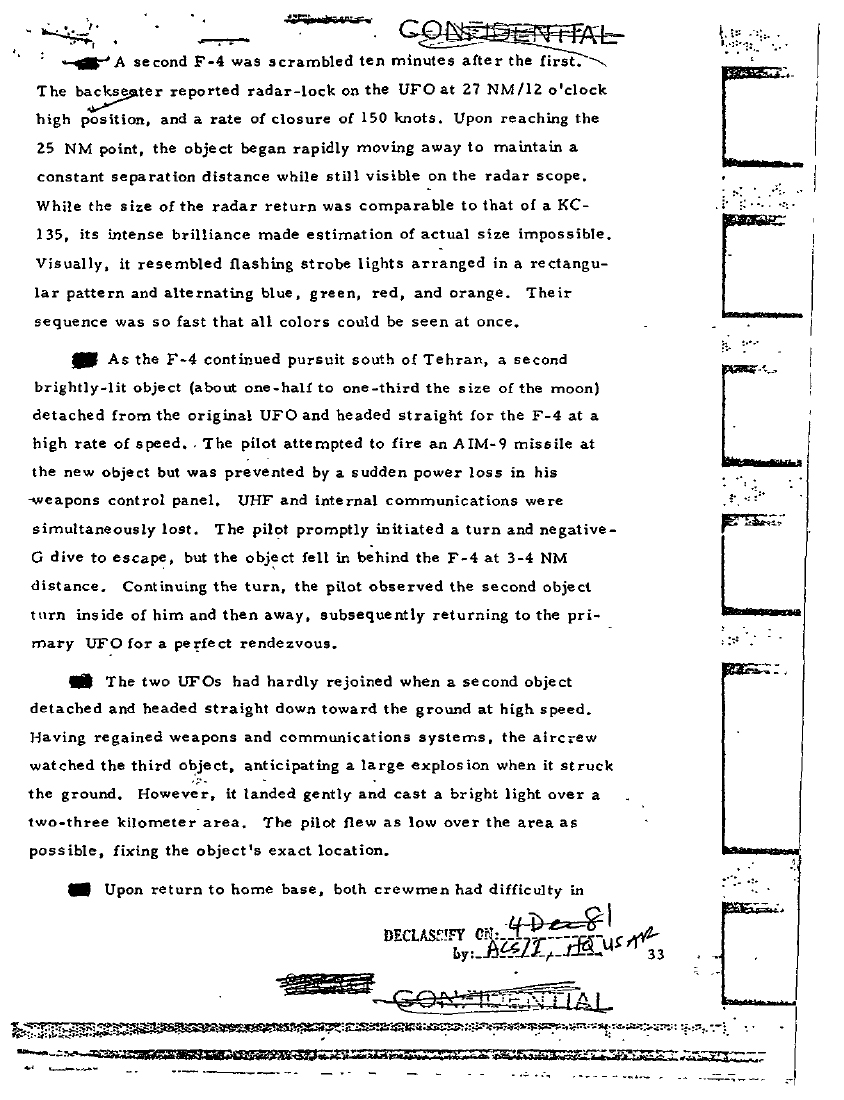 Air Force files on the Tehran UFO incident in 1976
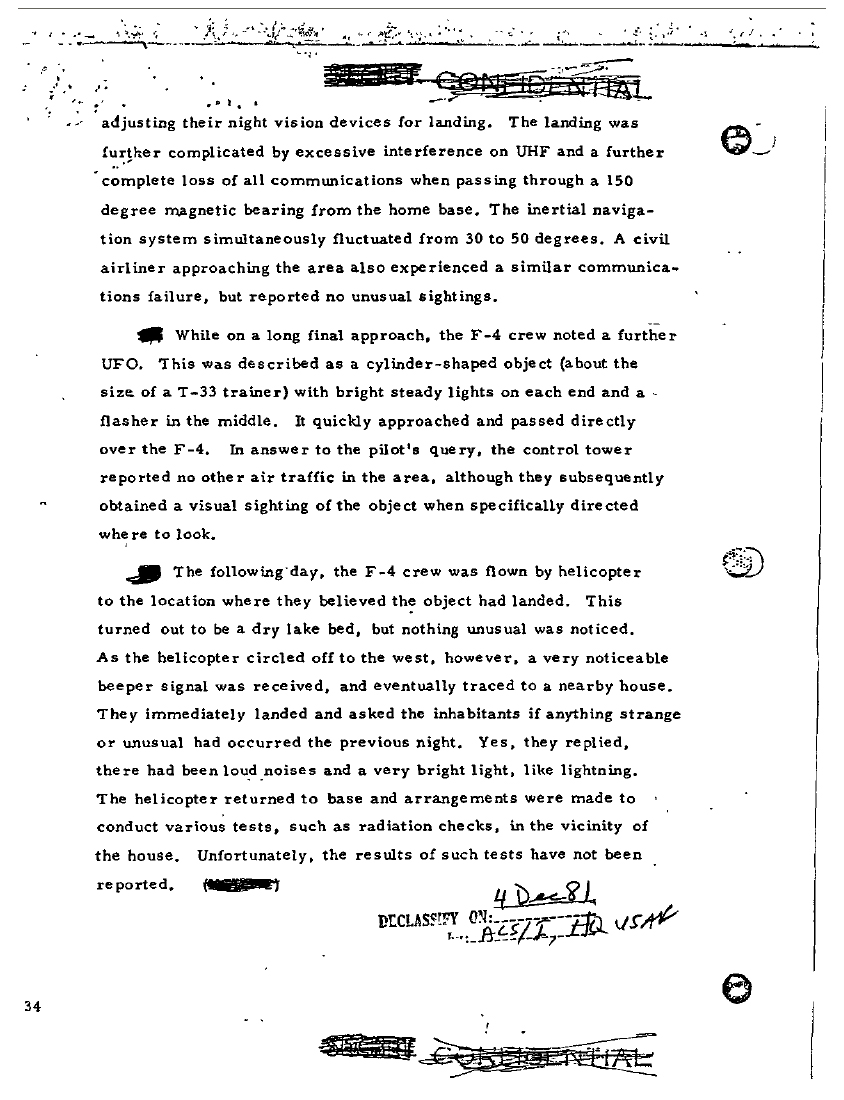 Air Force files on the Tehran UFO incident in 1976
Investigation timeline
- 2026-09-26 — Historical file submitted.
- 2026-09-26 — Historical file accepted and published.
Research notes
Historical research: Radar Misinterpretation, Astronomical Calibration, and Systems Reliability
In aviation security, atmospheric physics, and military systems engineering, the Tehran incident is evaluated through radar propagation anomalies, celestial misidentification, and avionics failure rates.
Skeptical researchers, led by Philip J. Klass and aviation analysts, suggest the primary visual target was an exceptionally bright opposition display of the planet Jupiter, exacerbated by atmospheric scintillation and temperature inversions over the desert basin. Skeptics argue that ground radar contacts recorded at Mehrabad were transient ground-clutter reflections (anomalous propagation) common in high-temperature environments. Furthermore, flight systems analysis notes that the F-4 Phantom II AN/APQ-120 radar and weapon release circuits experienced frequent electronic faults in mid-1970s military service. The temporary loss of communications is framed as a coincidence or radio frequency interference, amplified by pilot stress during a high-arousal night intercept mission.
Historical research: Electromagnetic Interference, Multi-Sensor Corroboration, and High-Performance Maneuvers
While astronomical explanations address single visual targets, anomalistic researchers and military analysts evaluate the case as an instance of non-conventional electromagnetic interference and coordinated radar-visual tracking.
A declassified U.S. Defense Intelligence Agency (DIA) evaluation report—titled UFO Incident in Iran—classified the event as an outstanding case study possessing high credibility. Parapsychologists and defense researchers emphasize three distinct corroborative elements: simultaneous visual sightings by trained military aircrews and ground air traffic controllers, physical radar returns on both ground and airborne radars, and correlated, temporary electrical disruptions affecting independent military aircraft systems. The research questions center on the mechanism behind localized, reversible electromagnetic pulse (EMP) effects that systematically disabled weapon circuits without causing permanent avionics burnouts, as well as the non-ballistic flight dynamics executed by the main object and secondary probes.
Propose evidence & media, a source citation, further reading, a research note, a correction, a related case, or a series link. Staff review before anything is added. An accepted correction does not replace the file by itself.