GG-2026-065
Bélmez Faces
- Phenomenon Physical & Poltergeist Activity
- Documentation
Rating B
- A — Strong dossier: several independent sources plus primary evidence (original media, records, measurements) a researcher could use without interviewing anyone.
- B — Well documented: multiple independent witnesses with at least some contemporary primary material, or one witness with substantial primary corroboration (photos, recordings, contemporaneous notes, documents).
- C — Multi-source but soft: several witnesses or a long run of reports, but mostly testimony and after-the-fact secondary sources (newspapers, folklore collections, later interviews). Little or no primary physical evidence. Regional legend clusters such as the Bridgewater Triangle land here.
- D — Thin: single witness (or one household), little or no support beyond the account. Normal for a sincere personal experience.
- E — Incomplete or not yet assessed. Every new submission starts here until staff have read it.
- Evidence & media 2 items
- Status Historic
- Location Bélmez de la Moraleda, Spain
- Occurred 23 August 1971
Summary
On August 23, 1971, María Gómez Cámara noticed a dark, human-like face emerging on the concrete floor of her kitchen in Bélmez de la Moraleda, Spain. After her family smashed the slab with a pickaxe and laid fresh cement, new faces appeared and multiplied across the home. The site quickly became Spain’s most famous modern anomaly, drawing psychical researchers, government scientists, and media attention. Over five decades, investigators debated whether the figures were a result of chemical fraud (using silver nitrate or acid etching), natural cement oxidation, or teleplastic thoughtography tied to human consciousness or underlying historical burials.
Background
The Initial Manifestation and Excavation
The phenomenon began in a modest single-story cottage on Calle Real in the rural village of Bélmez de la Moraleda (Jaén, Spain). María Gómez Cámara discovered the first image—later dubbed La Pava—near her cooking hearth. Scouring the mark with harsh detergents failed, as the image reportedly grew clearer and darker over the following days.
Floor Replacement: Distressed by the image, María's husband Juan Pereira and son Miguel used a pickaxe to destroy the concrete slab, dug out the subsoil, and poured a new cement floor. Within a week, a new facial shape re-emerged on the fresh surface.
The Excavation: As public interest exploded, local authorities ordered an official excavation beneath the kitchen floor. Digging down roughly nine feet revealed human skeletal remains dating back to the 13th to 17th centuries, indicating the home was built over a historic graveyard or church site. The bones were exhumed and reburied in a local cemetery, but when the kitchen floor was re-poured, multiple new faces—both male and female, displaying varied facial expressions—began appearing rapidly across different rooms.
Timeline of Key Events
├── Aug 23, 1971 : First face ("La Pava") appears on the hearth floor; scrubbed without effect.
├── Sept 1971 : Floor smashed with pickaxes; fresh cement poured; new face appears within days.
├── Early 1972 : Subsoil excavated, revealing 13th–17th century human remains under the home.
├── Spring 1972 : Floor re-poured under municipal supervision; site sealed for 3 months with official seals.
├── June 1972 : Seals broken in front of notary; new faces and shifting expressions recorded.
├── 1990–1992 : ICV (CSIC) conducts microscopic/elemental analysis on concrete samples.
└── Feb 2004 : María Gómez Cámara passes away; debate continues over new/fading images.
Controlled Observation and Sealing
To address growing accusations of fraud, Spanish researchers and local officials executed a controlled experiment in 1972. The kitchen floor was photographed, covered with protective material, and completely sealed with iron bars and official wax seals in the presence of a public notary. When the room was opened three months later, independent witnesses documented that the pre-existing facial contours had moved, morphed, and deepened in contrast, while several smaller, secondary facial outlines had formed on previously clear areas of the slab.
Witness statement
No statement on file.
Evidence & media
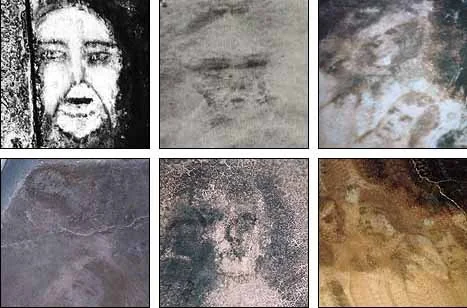 Pictures of the various faces that appeared on the floor.
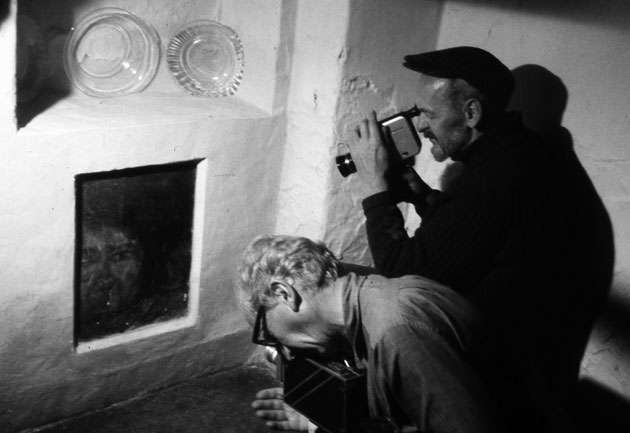 Germán de Argumosa y Valdés (top) & Prof. Hans Bender investigating the faces, Apr 1972.
Investigation timeline
- 2026-09-26 — Historical file submitted.
- 2026-09-26 — Historical file accepted and published.
Research notes
Historical research: Chemical Alteration, Acid Etching, and Pareidolia
Skeptical researchers, chemists, and forensic analysts argue that the Bélmez faces are terrestrial, human-made fabrications created via chemical reaction or natural visual misinterpretation.
Investigators such as José Luis Jordán and Luis Ruiz-Noguez suggested that the images were forged using chemical oxidizers—such as nitric acid, sulfuric acid, or silver salts (including silver nitrate)—which darken gradually when exposed to ambient light and moisture. Critics highlight that lead, chromium, and zinc detected in later floor samples could reflect industrial paints, enamels, or chemical reagents. Furthermore, cognitive scientists emphasize the role of pareidolia—the human brain's evolutionary hardwiring to identify human faces in random, irregular stains, concrete moisture patterns, and soot deposits from cooking fires.
Historical research: Material Analysis, Thoughtography, and Teleplastic Manifestation
Parapsychologists and materials researchers evaluate the case as a potential instance of thoughtography (psychic imprinting) or RSPK (Recurrent Spontaneous Psychokinesis).
Lead parapsychologists Germán de Argumosa and Hans Bender conducted on-site field testing, recording anomalous acoustic events (audio voice phenomena) inside the sealed home. In the 1990s, samples of the concrete floor were submitted to Spain's National Research Council (Instituto de Cerámica y Vidrio / ICV). The resulting mineralogical and chemical reports found no evidence of superficial paint films or conventional brushwork on tested segments, noting that darker mineral concentrations resided within the cement matrix itself. Parapsychological hypotheses posit that María Gómez Cámara acted as an unwitting unconscious focal point, imprinting mental images onto the porous calcium silicate matrix of the floor.
Propose evidence & media, a source citation, further reading, a research note, a correction, a related case, or a series link. Staff review before anything is added. An accepted correction does not replace the file by itself.