GG-2026-072
Glawackus of Glastonbury
- Phenomenon Cryptids & Unknown Zoology
- Documentation
Rating C
- A — Strong dossier: several independent sources plus primary evidence (original media, records, measurements) a researcher could use without interviewing anyone.
- B — Well documented: multiple independent witnesses with at least some contemporary primary material, or one witness with substantial primary corroboration (photos, recordings, contemporaneous notes, documents).
- C — Multi-source but soft: several witnesses or a long run of reports, but mostly testimony and after-the-fact secondary sources (newspapers, folklore collections, later interviews). Little or no primary physical evidence. Regional legend clusters such as the Bridgewater Triangle land here.
- D — Thin: single witness (or one household), little or no support beyond the account. Normal for a sincere personal experience.
- E — Incomplete or not yet assessed. Every new submission starts here until staff have read it.
- Evidence & media 2 items
- Status Historic
- Location Glastonbury, Connecticut
- Occurred 14 January 1939
Summary
On January 14, 1939, residents of Glastonbury, Connecticut, began reporting a mysterious, feline-like creature dubbed the "Glawackus." Described as a combination of a dog, panther, and bear, the animal terrorized livestock and unsettled locals with bloodcurdling, high-pitched shrieks. Despite extensive armed hunting parties, tracking dogs, and national press coverage, no specimen was ever captured, solidifying the Glawackus as an enduring piece of New England folklore.
Background
On the night of Saturday, January 14, 1939, farmers and residents in rural Glastonbury, Connecticut—particularly around Minnechaug Mountain—began noticing unusual livestock attacks and nocturnal disruptions.
Auditory and Physical Reports: Witnesses were first alerted by strange, piercing cries echoing across the snow-covered woods at night, described as a cross between a panther's screech and a human scream. Soon after, farmers reported slaughtered goats, sheep, and dogs showing unusual bite and claw marks.
Visual Descriptions: Sightings described a tawny or dark-brown creature roughly the size of a large dog or puma, with a long tail, rounded ears, and cat-like agility. Local reporter Mabel Addison of the Glastonbury Citizen coined the portmanteau "Glawackus" (combining Glastonbury, wacky, and globetrotter) to describe the elusive beast.
Timeline of Key Events
├── Jan 14, 1939 : First livestock attacks and shrieks reported near Minnechaug Mountain.
├── Jan 26, 1939 : Mabel Addison coins the name "Glawackus" in the Glastonbury Citizen.
├── Feb 2, 1939 : Armed posses and bloodhounds search the woods; tracks found in deep snow.
├── Feb 13, 1939 : Media frenzy erupts; papers nationwide cover the "Glastonbury Monster."
└── Mar 1939 : Sightings decline sharply without capture; enters local folklore.
Hunting Parties and Media Frenzy
By February 1939, panic and public fascination had spread across Connecticut. Local authorities permitted organized hunting posses, drawing hundreds of armed residents, state troopers, and big-game trackers with bloodhounds into the Glastonbury woods.
While hunters discovered large, unusual tracks in the snow that led toward dense ledges, the hounds frequently lost the scent near rocky outcroppings. Major regional and national publications, including The New York Times and TIME Magazine, picked up the story. Explanations offered by state game wardens ranged from an escaped exotic cat or a rabid fisher cat to a rogue mountain lion or an oversized wild dog. By early spring, the hysteria subsided as sightings ceased without a physical carcass or live specimen ever being secured.
Witness statement
No statement on file.
Evidence & media
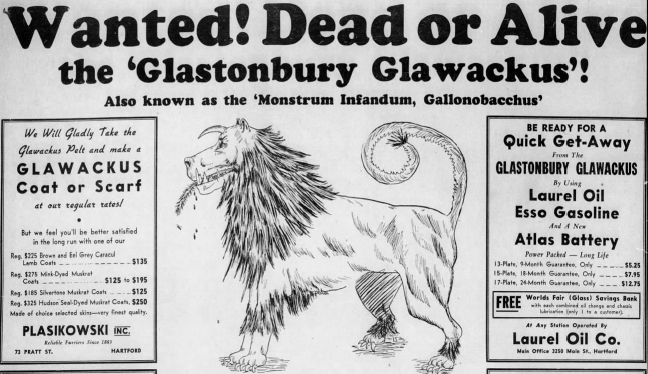 Hartford Current, 1939
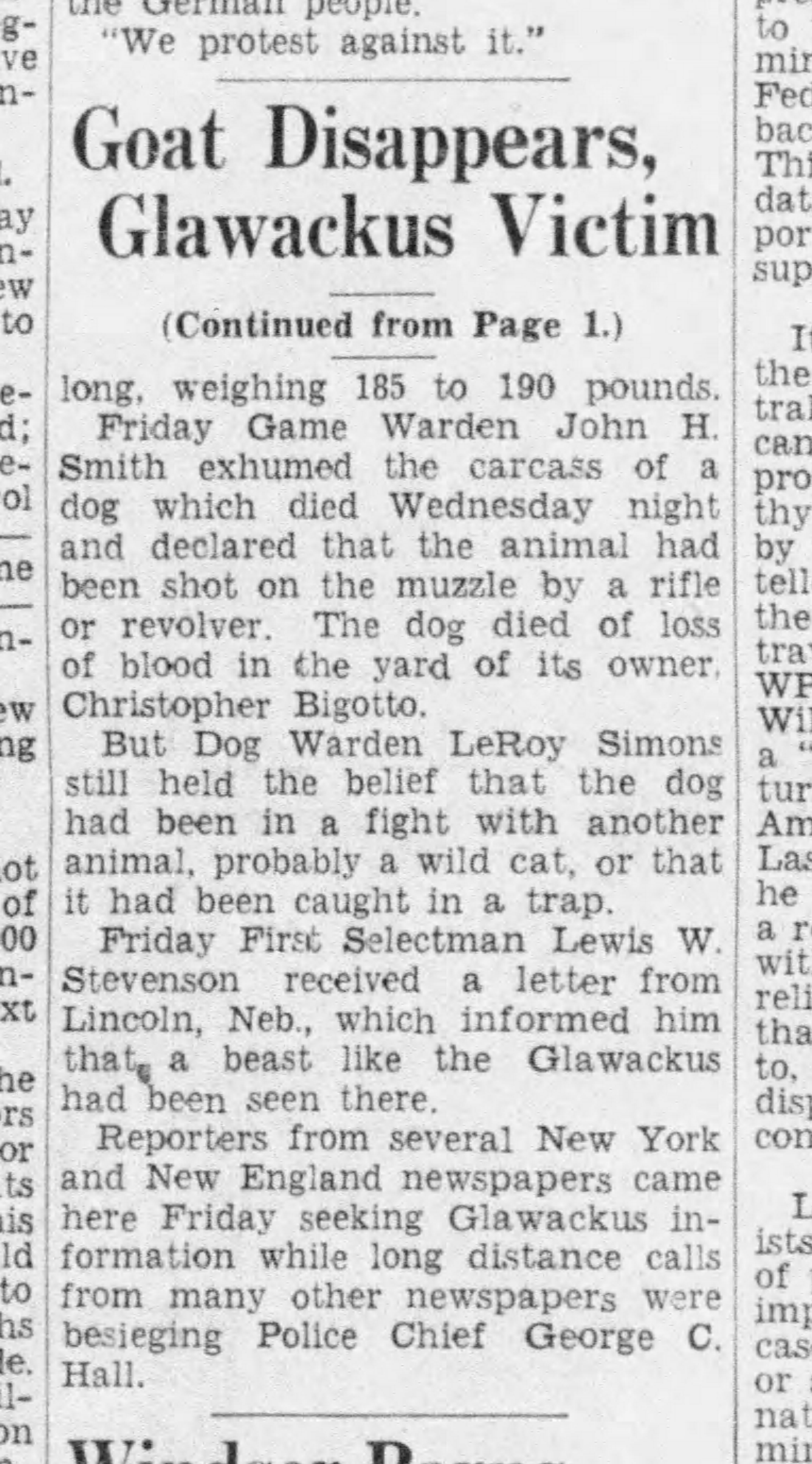 Hartford Current, 1939
Investigation timeline
- 2026-09-27 — Historical file submitted.
- 2026-09-27 — Historical file accepted and published.
Research notes
Historical research: Misidentification of Extirpated Predators, Fisher Cat Bioacoustics, and Media Amplification
From zoological and ecological perspectives, the Glawackus phenomenon is evaluated as a combination of misidentified native fauna and media-driven rural anxiety.
Wildlife biologists note that while the eastern cougar (Puma concolor) was considered officially extirpated from Southern New England by the late 19th century, vagrant individual sightings occasionally occurred. More likely, the audio and physical evidence aligns with the vocalizations and predation patterns of the fisher (Pekania pennanti) or a rogue bobcat (Lynx rufus). Fishers produce notoriously horrific, high-pitched nocturnal shrieks during territorial disputes or mating season, which can severely unnerve observers unfamiliar with the species. When combined with localized livestock damage caused by feral dogs, 1930s news outlets synthesized these distinct biological factors into a single "monster" narrative.
Historical research: Fearsome Critter Folklore Traditions, Cryptid Clustering, and Tracking Anomalies
Anomalistic researchers and cryptozoologists analyze the Glawackus within the broader context of New England "fearsome critter" traditions and elusive feline cryptids.
Cryptozoological analysis highlights the persistent gap between the tracking capabilities of experienced local hunters and the complete absence of physical traces left by the animal. Despite multi-day hunts using trained hounds across fresh, deep snowpack, the creature repeatedly evaded containment, leaving pad prints that experienced trackers claimed did not match standard canine or feline profiles. Anomalists point out that the Glawackus fits a well-documented historic pattern across North America: the sudden appearance of an aggressive, predatory "mystery cat" that exhibits uncanny evasive capabilities, terrorizes a localized region for a few weeks, and vanishes permanently before formal scientific documentation can take place.
Propose evidence & media, a source citation, further reading, a research note, a correction, a related case, or a series link. Staff review before anything is added. An accepted correction does not replace the file by itself.