GG-2026-082
Houghton Mansion
- Phenomenon Apparitions & Spirits, Auditory & Acoustic Events
- Documentation
Rating C
- A — Strong dossier: several independent sources plus primary evidence (original media, records, measurements) a researcher could use without interviewing anyone.
- B — Well documented: multiple independent witnesses with at least some contemporary primary material, or one witness with substantial primary corroboration (photos, recordings, contemporaneous notes, documents).
- C — Multi-source but soft: several witnesses or a long run of reports, but mostly testimony and after-the-fact secondary sources (newspapers, folklore collections, later interviews). Little or no primary physical evidence. Regional legend clusters such as the Bridgewater Triangle land here.
- D — Thin: single witness (or one household), little or no support beyond the account. Normal for a sincere personal experience.
- E — Incomplete or not yet assessed. Every new submission starts here until staff have read it.
- Evidence & media 2 items
- Status Active
- Location North Adams, Massachusetts · exact location withheld
- Occurred 1 August 1914
This case is associated with private or restricted property. Do not trespass, disturb residents, remove artifacts, or conduct an investigation without explicit permission.
Activity period
- Earliest claimed event Unknown
- Earliest documented report Unknown
- Latest documented report 2024
- Pattern Recurring
Summary
The Houghton Mansion in North Adams, Massachusetts, was built in the 1890s for industrialist and first mayor Albert C. Houghton. The property became associated with tragedy after a 1914 automobile accident killed Mary Houghton and family friend Sybil Hutton, followed by the deaths of John Widders and Albert Houghton shortly afterward. Later used as a Masonic lodge and historic site, the mansion developed a reputation for hauntings. Reports of apparitions, footsteps, voices, and other unexplained experiences remain part of the property's folklore, while the underlying family tragedy is a matter of historical record.
Background
The Houghton Mansion was built in the 1890s for Albert C. Houghton, president of the Arnold Print Works and the first mayor of North Adams, Massachusetts. Designed in an imposing Neo-Classical style, the residence became one of the city's most prominent homes and a symbol of the Houghton family's influence in Berkshire County.
The tragedy most closely associated with the mansion began on August 1, 1914. Albert Houghton, his daughter Mary Houghton, family friend Sybil Hutton, and chauffeur John Widders were traveling by automobile near Pownal, Vermont, when their Pierce-Arrow left the roadway and rolled down an embankment.
Sybil Hutton died at the scene, while Mary Houghton later died from her injuries. The accident deeply affected the Houghton family and quickly became one of the best-known tragedies in the region.
The aftermath brought additional loss. John Widders, who had been driving the vehicle, died by suicide the following day. Ten days after the accident, Albert Houghton also died. Contemporary accounts attributed his death to declining health, though later retellings often connected it to grief over the events of August 1914.
The mansion remained in private hands until 1926, when it was acquired by the local Masonic lodge. A large lodge hall was later added to the rear of the property, and the building served Masonic purposes for much of the twentieth century. During this period, stories of unusual experiences began to circulate among members, caretakers, and visitors.
Modern ghost traditions associated with the mansion commonly involve reports of footsteps, voices, shadowy figures, apparitions in period clothing, and unexplained sounds. Many accounts center on the main staircase, upper floors, and the former carriage-house area connected to John Widders. Other reports describe cold spots, unusual sensations, or objects appearing to move unexpectedly.
As with many historic properties connected to sudden deaths and local tragedy, explanations for these experiences vary. Some visitors interpret them as evidence of paranormal activity, while others point to suggestion, expectation, the building's age, and its dramatic history.
Today, the Houghton Mansion is remembered both as an important North Adams landmark and as one of the Berkshire region's best-known haunted locations. The 1914 accident and the deaths that followed are matters of historical record. The reported hauntings remain part of the mansion's folklore and visitor tradition.
Witness statement
No statement on file.
Evidence & media
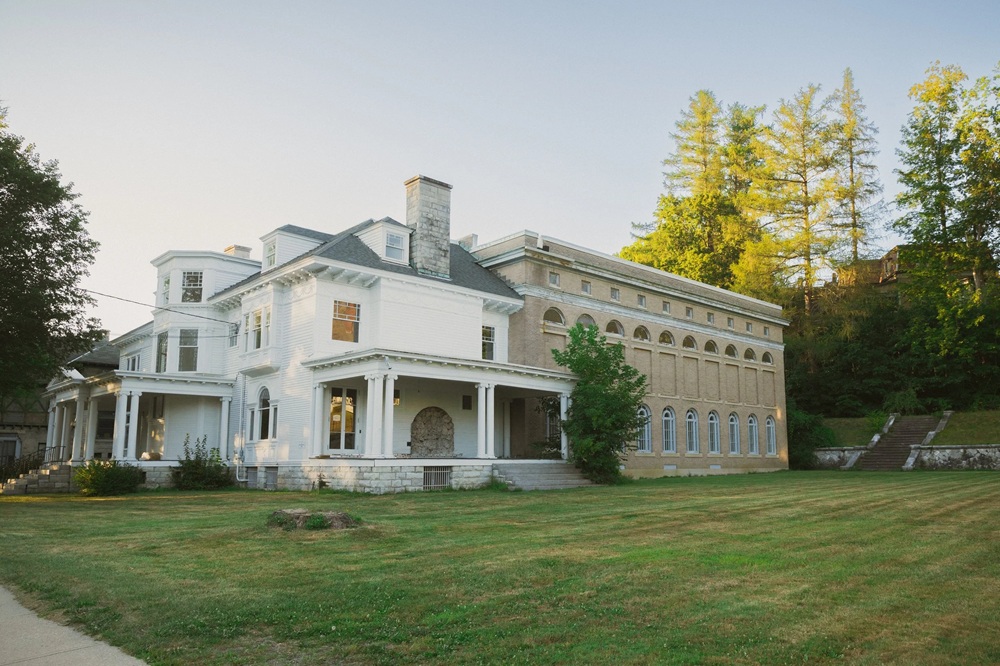
Haunted Mansion In Massachusetts Houghton
Houghton Mansion today.
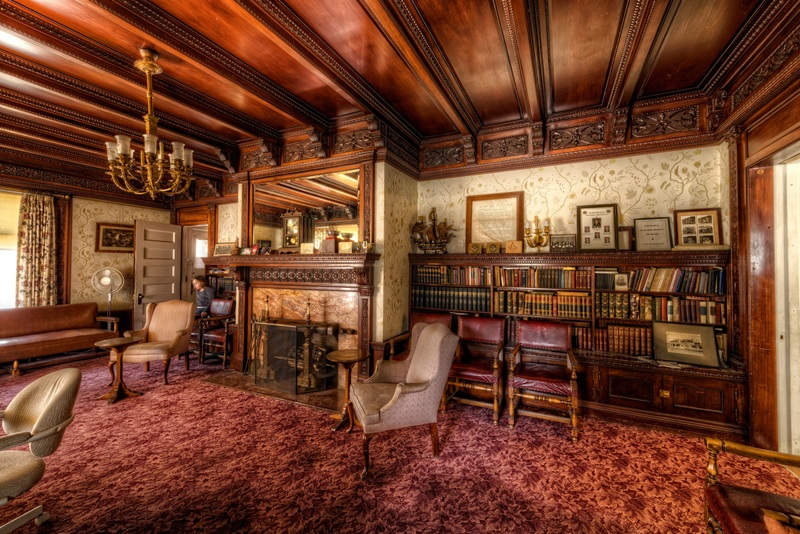
NEW3-X3
Interior shot.
Further reading
Continue exploring — Wikipedia, documentaries, podcasts, museum pages. Not treated as proof, and not independently verified by this archive.
Investigation timeline
- 2026-09-28 — Historical file submitted.
- 2026-09-29 — Historical file accepted and published.
Assigned GG-2026-082
Research notes
Historical research: Architectural Resonance, Thermal Dynamics, and Historical Trauma Priming
From environmental design, industrial history, and environmental psychology perspectives, the Houghton Mansion provides a clear case study in structural aging, acoustic reverberation, and cultural priming.
The physical building features sprawling timber framing, high ceilings, complex masonry additions, and expansive subterranean spaces from its Masonic era conversion. Environmental engineers note that historic structures situated near the Hoosic River valley experience significant seasonal thermal shifts and subterranean air drafts; these natural pressure differences create settling creaks, sudden temperature drops (cold spots), and door movements often misattributed to supernatural force. Additionally, visitors entering the mansion are almost universally briefed on the double-tragedy of 1914, creating a high degree of psychological priming. In conditions of low ambient light during nighttime tours, ambient house vibrations, shadow angles from streetlamps, and auditory background noise are readily interpreted through the lens of grief and historical tragedy.
Historical research: Guilt-Induced Trauma Imprinting, RSPK, and Instrument-Based Field Research
In parapsychology and anomalistic research, the Houghton Mansion is studied as an example of acute psychological trauma imprinting tied to sudden violent loss and remorse.
Researchers focus on the dual psychological vectors associated with the case: the violent physical shock of the automobile accident and the severe guilt experienced by Albert Houghton and John Widders in the immediate 24 to 48 hours following the event. Parapsychological theory explores whether such intense, localized emotional distress leaves a persistent psychical impression on physical surroundings. Instrumental field studies at the location frequently deploy electromagnetic field (EMF) meters, thermal imaging cameras, and digital audio recorders (EVP generation). Field groups regularly report anomalous low-frequency magnetic fluctuations in areas absent of active wiring, alongside coherent audio responses corresponding to historical queries about the 1914 accident.
Open research questions
A specific gap in the file. An accepted source, research note, or further-reading link closes it.
Trace the earliest surviving paranormal reports associated with Houghton Mansion and determine whether haunting claims existed during the Houghton family's occupancy, the Masonic period, or emerged later. Identify when reports of Albert Houghton, Mary Houghton, John Widders, footsteps, voices and shadow figures first appear, separating local testimony from later paranormal investigations and television coverage.
Propose evidence & media, a source citation, further reading, a research note, a correction, a related case, or a series link. Staff review before anything is added. An accepted correction does not replace the file by itself.