GG-2026-085
1952 Salem Coast Guard UFO Photographs
- Phenomenon UFOs/UAPs
- Documentation
Rating B
- A — Strong dossier: several independent sources plus primary evidence (original media, records, measurements) a researcher could use without interviewing anyone.
- B — Well documented: multiple independent witnesses with at least some contemporary primary material, or one witness with substantial primary corroboration (photos, recordings, contemporaneous notes, documents).
- C — Multi-source but soft: several witnesses or a long run of reports, but mostly testimony and after-the-fact secondary sources (newspapers, folklore collections, later interviews). Little or no primary physical evidence. Regional legend clusters such as the Bridgewater Triangle land here.
- D — Thin: single witness (or one household), little or no support beyond the account. Normal for a sincere personal experience.
- E — Incomplete or not yet assessed. Every new submission starts here until staff have read it.
- Evidence & media 3 items
- Status Historic
- Location Salem, Massachusetts
- Occurred 16 July 1952
Summary
On the morning of July 16, 1952, Coast Guard Seaman and photographer Shell R. Alpert captured one of the most famous government-associated UFO images in history from the Coast Guard Air Station at Winter Island in Salem, Massachusetts. At approximately 9:35 AM, Alpert observed four bright, elliptical formations of light hovering in a distinctive "V" formation in the sky above nearby power plant smokestacks. Calling over fellow Coastguardsman Thomas E. Flaherty to confirm the sighting, Alpert grabbed a camera from his photo lab desk and took a single black-and-white exposure through the window as the objects dimmed. Coming at the peak of the 1952 Washington, D.C. UFO flap and nationwide flying saucer anxiety, the photograph was immediately impounded by military authorities, analyzed by Air Force intelligence and Harvard scientists, and formally investigated under Project Blue Book, where it ultimately remained officially classified as "Unexplained."
Background
The Encounter at Winter Island
At 9:35 AM on July 16, 1952, Coast Guard Seaman Shell R. Alpert was working in his photographic laboratory at USCG Air Station Salem on Winter Island:
The Initial Sight: Sitting at his desk filing negatives, Alpert looked out the laboratory window toward Salem Harbor and noticed four brilliant, glowing elliptical lights hovering slightly to the right of the local power plant's smokestacks.
Corroboration: Perplexed by the intensity of the light, Alpert called Seaman Thomas E. Flaherty over to the window. Both servicemen watched as the four luminous objects briefly dimmed and then re-brightened.
The Photograph: Alpert grabbed a camera he was cleaning, pointed it through the glass window, and snapped a single exposure. Shortly after the shot was taken, the four lights faded from view completely.
Timeline of Key Events
├── July 16, 1952 (09:35 AM) : Shell Alpert & Thomas Flaherty witness 4 bright lights; Alpert snaps photo.
├── July 17–19, 1952 : Image turned over to USCG superiors; classified "Top Secret" and sent to Washington.
├── July 29, 1952 : Pentagon holds historic UAP press conference led by Maj. Gen. John A. Samford.
├── August 1, 1952 : U.S. Coast Guard officially releases the photograph to national press outlets.
└── 1952–1969 : Analyzed multiple times by Project Blue Book; case permanently categorized as "Unexplained."
Official Investigation and Press Release
Because the image was taken by an active-duty military photographer on a U.S. Coast Guard installation, it immediately triggered a high-level defense response during the height of the 1952 Cold War UFO wave:
Military Intelligence Interrogation: The negative was rushed to Coast Guard Headquarters in Washington, D.C., and subsequently transferred to the Air Technical Intelligence Center (ATIC) at Wright-Patterson Air Force Base in Ohio. Intelligence officers and astrophysicists, including personnel from Harvard University, subjected Alpert to extensive interrogations.
National Media Impact: On August 1, 1952, the U.S. Coast Guard formally released the photograph to national newspapers. Coming just three days after Major General John A. Samford’s landmark Pentagon press conference regarding radar and visual UAP encounters over Washington, D.C., the Salem photo became an international front-page sensation.
Witness statement
No statement on file.
Evidence & media
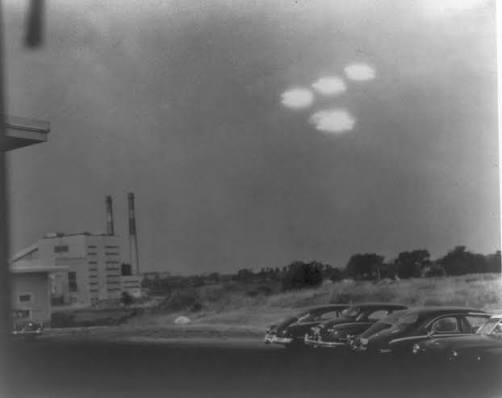 In 1952, a U.S. Coast Guard photographer captured an image that allegedly shows unidentified flying objects in a “V” formation over the USCG air station in Salem, MA.
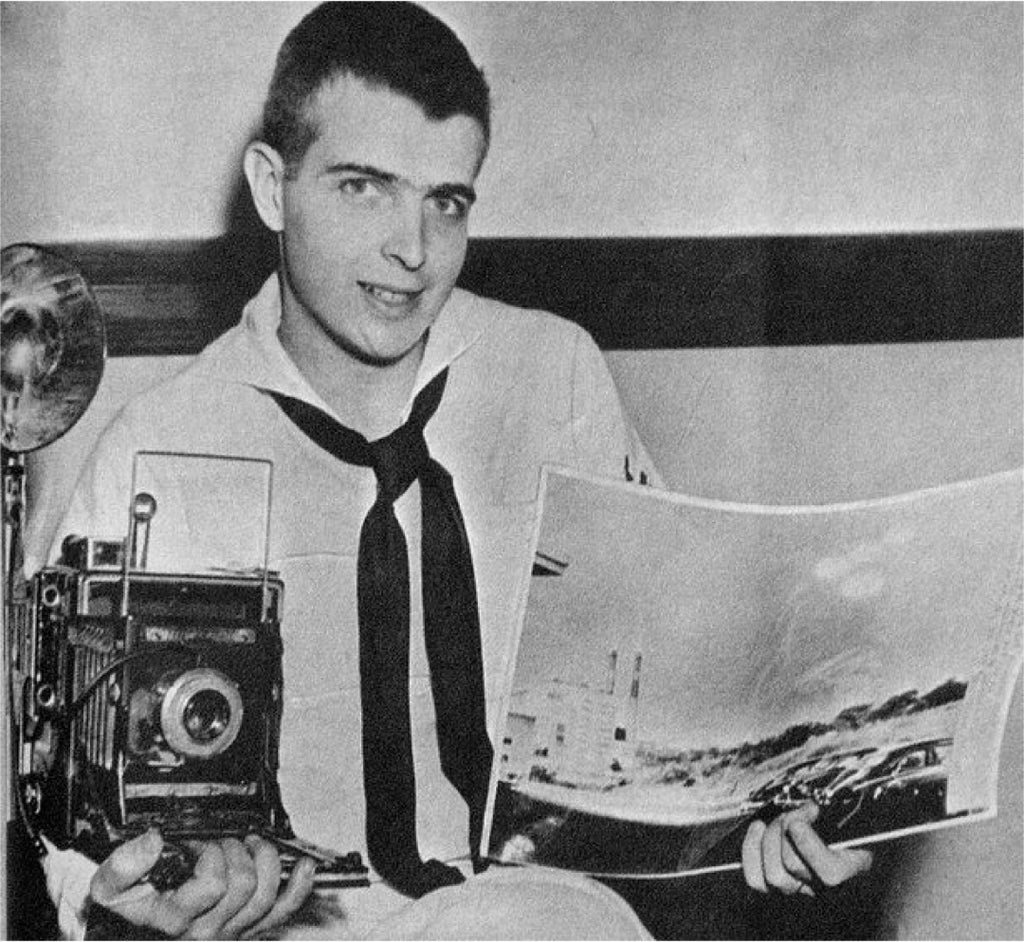 Shell R. Alpert with his camera.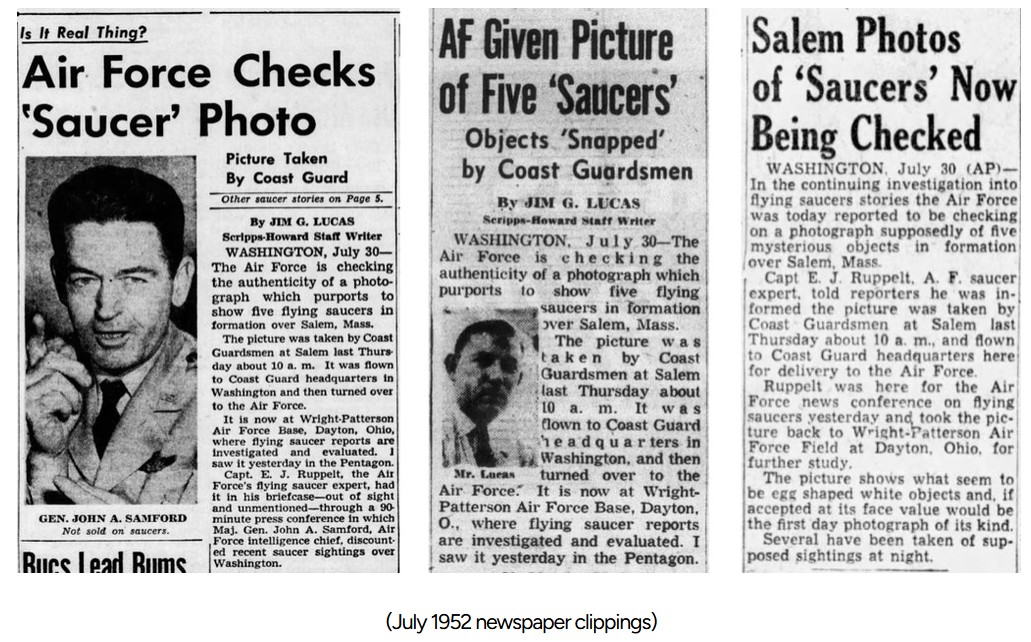
Investigation timeline
- 2026-09-29 — Historical file submitted.
- 2026-09-29 — Historical file accepted and published.
Research notes
Historical research: Photographic Artifacts, Internal Window Reflections, and Optical Physics
From photographic analysis, optics, and atmospheric physics perspectives, the Salem photograph serves as a classic textbook case study in evaluating physical film artifacts against true airborne anomalies.
Analysts examining the original negative noted that because Alpert shot the photograph through the glass window of his photo lab, the four luminous spots match the visual profile of internal glare or light fixtures reflecting off double-pane window glass. Skeptical analysts suggest that ceiling lights inside the laboratory or sun glare reflecting off a car chrome fitting outside could have created optical flare artifacts. However, photo-analysts at Wright-Patterson Air Force Base noted that the exposure on the film negative did not match typical double-exposure flaws or simple lens flare, as the shapes maintained sharp, consistent intensity without classical spherical aberration flares.
Historical research: Project Blue Book Case #1501, Visual/Acoustic Disparity, and Military UAP Records
In UAP research and military history, the Salem sighting is recognized as one of the few official military-captured photographic cases that survived rigorous scientific debunking without being debunked.
Project Blue Book initially evaluated the photograph under two hypotheses: first as a deliberate double-exposure hoax, and second as interior room lights reflecting off glass. Upon interviewing both witnesses—Alpert and Flaherty—investigators ruled out a hoax due to their strong service records and consistent testimonies. When researchers attempted to replicate the exact internal window reflection at the photo lab, the lighting angles failed to reproduce the distinct brightness and positioning relative to the exterior background smokestacks. Consequently, the Air Force officially classified Case #1501 as Unidentified, making it a benchmark historical case in UAP literature.
Propose evidence & media, a source citation, further reading, a research note, a correction, a related case, or a series link. Staff review before anything is added. An accepted correction does not replace the file by itself.