GG-2026-089
Val Johnson Incident
- Phenomenon UFOs/UAPs, Spatiotemporal Anomalies (Missing Time)
- Documentation
Rating B
- A — Strong dossier: several independent sources plus primary evidence (original media, records, measurements) a researcher could use without interviewing anyone.
- B — Well documented: multiple independent witnesses with at least some contemporary primary material, or one witness with substantial primary corroboration (photos, recordings, contemporaneous notes, documents).
- C — Multi-source but soft: several witnesses or a long run of reports, but mostly testimony and after-the-fact secondary sources (newspapers, folklore collections, later interviews). Little or no primary physical evidence. Regional legend clusters such as the Bridgewater Triangle land here.
- D — Thin: single witness (or one household), little or no support beyond the account. Normal for a sincere personal experience.
- E — Incomplete or not yet assessed. Every new submission starts here until staff have read it.
- Evidence & media 3 items
- Status Historic
- Location Stephen, Minnesota
- Occurred 27 August 1979
Summary
The Val Johnson Incident is one of the most unusual law-enforcement UFO cases in American history. On August 27, 1979, Deputy Sheriff Val Johnson was driving alone near Stephen, Minnesota when he reported seeing a bright light approaching his patrol car. Moments later, he lost consciousness. His vehicle was found damaged, his wristwatch and dashboard clock were reportedly off by several minutes, and no definitive explanation was ever established.
Background
The Encrumpting Highway 220 Incident
On a clear night near the Canadian border, Deputy Val Johnson was conducting routine rural road patrols south of Stephen, Minnesota:
Visual Acquisition: At 1:40 AM, Johnson noticed a intense, self-contained light low to the ground about three miles away. As he turned his patrol car onto a section of gravel road to investigate, the light shot across the terrain toward his vehicle at extreme velocity.
The High-Strangeness Impact: Johnson reported that the light blindingly illuminated the interior of his cruiser. He heard the sound of glass shattering and felt an intense sensation of heat across his face before losing consciousness.
The Aftermath: Regaining awareness at 2:19 AM, Johnson discovered his car had veered across the opposite lane and come to rest sideways in a ditch. Weak and disoriented, he radioed dispatch, stating: "Something just hit my car. I don't know what. I'm hurt."
Physical Trauma & Equipment Anomalies: Responding officers found Johnson in mild shock with red, irritated eyes and face burns resembling solar radiation or ultraviolet arc welding flashes. His wrist watch and the patrol car's electrical clock had both stopped or lost exactly 14 minutes relative to real time, despite both mechanisms functioning properly before and after the event.
Timeline of Key Events
├── Aug 27, 1979 (01:40 AM) : Deputy Val Johnson spots low-altitude bright sphere on Highway 220.
├── Aug 27, 1979 (01:40–02:19) : High-speed approach, light engulfment, 39 minutes of missing time.
├── Aug 27, 1979 (02:19 AM) : Johnson regains consciousness in ditch; radio dispatch call logged.
├── Aug 27, 1979 (04:00 AM) : Medical examination notes radiation-like corneal burns and skin inflammation.
└── Sept 1979 : Honeywell & Meriden windshield experts conduct forensic damage analysis on patrol car.
The Patrol Car Examination
The primary strength of the Val Johnson case rests in the physical vehicle, which was impounded and subjected to rigorous technical analysis:
Smashed Windshield: The driver’s side of the heavy safety glass windshield was fractured into a micro-shatter pattern, yet the inner plastic laminate layer remained intact with no internal glass fragments found inside the cabin.
Bended Antennas: The vehicle's 60-inch trunk-mounted radio antenna was bent at a sharp 60-degree angle approximately two inches above its base. The hood-mounted CB antenna was bent in a completely different direction.
Headlight Damage: One of the inner high-beam glass headlights was shattered, while the surrounding plastic grill work and chrome bumper showed zero scratch marks, paint transfer, or impact dents.
Witness statement
No statement on file.
Evidence & media
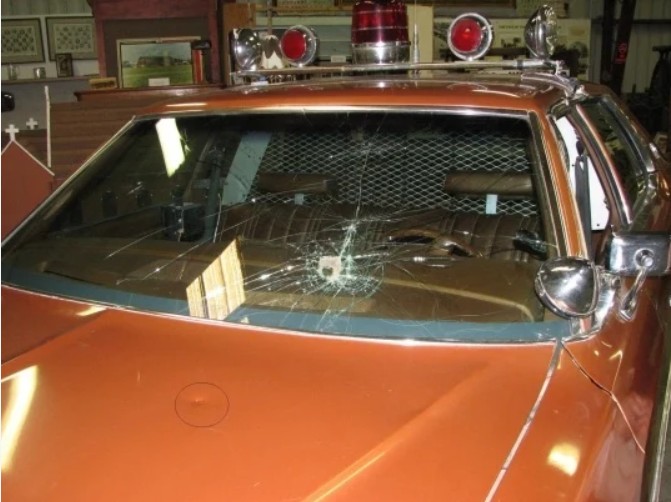 Damaged windshield of Johnson's squad car.
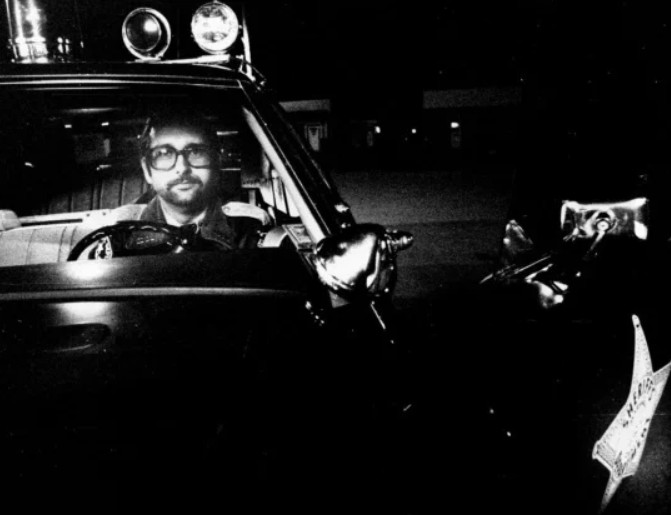 Johnson in his squad car Aug 27, 1979
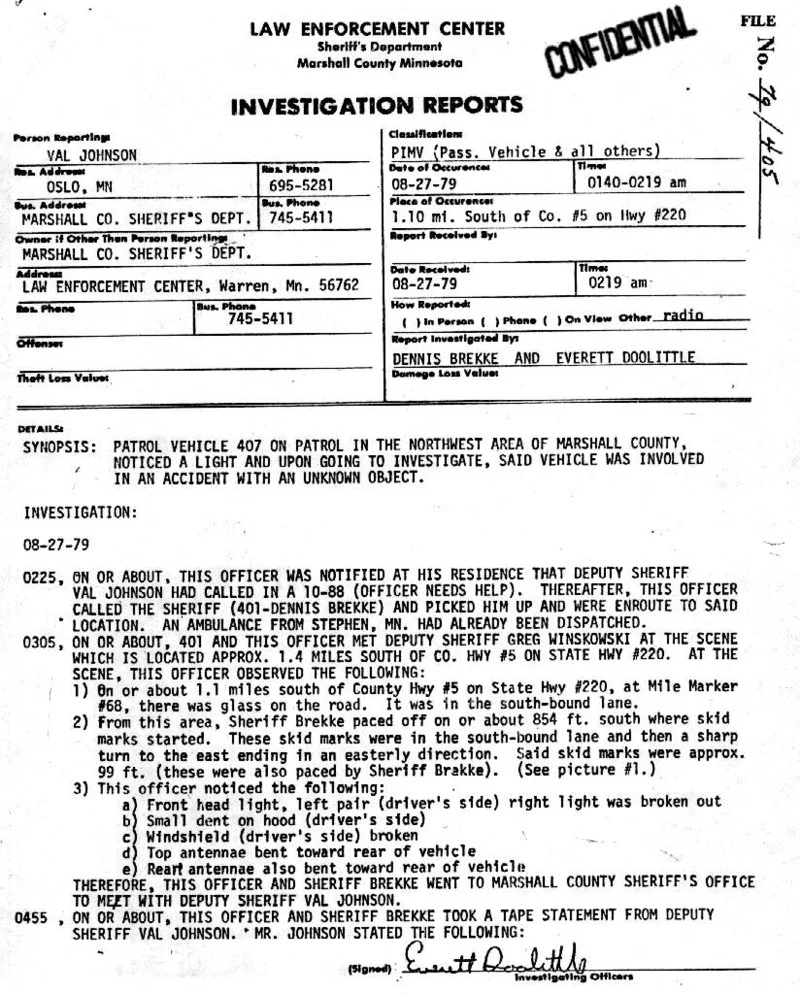 Johnson incident report.
Sources
No sources listed.
Investigation timeline
- 2026-09-29 — Historical file submitted.
- 2026-09-30 — Historical file accepted and published.
Research notes
Historical research: A Case Defined by Physical Damage Rather Than Observation
The Val Johnson Incident differs from many UFO reports because the strongest evidence is not the reported light itself but the documented aftermath. Johnson's damaged patrol vehicle, his injuries, and the timing discrepancies provide investigators with physical facts that require explanation. Unlike many classic sightings, the central mystery is not "Did someone see something unusual?" but rather "What caused the damage and loss of awareness?"
The limitations of the case are equally important. No secondary witness observed the object at close range, no photograph exists, and no recovered material linked the event to a UFO. Under Gothic.Black standards, the historical incident is well documented, the vehicle damage is established, and Johnson's report is preserved in official records. The cause of the encounter remains unresolved.
Historical research: Glass Deformation Dynamics, Electromagnetic Induction, and Forensic Vehicle Analysis
From a forensic engineering perspective, the structural damage on Johnson's Dodge St. Regis displays significant mechanical anomalies that resist standard collision models.
An independent analysis conducted by Meriden, an automotive glass manufacturing consultant, determined that the windshield breakage was caused by highly concentrated, localized thermal or mechanical stress rather than an impact from a solid object (e.g., a bird, stone, or agricultural equipment). A solid projectile passing through safety glass at high velocity creates a clear impact crater and ejects glass inward; Johnson’s windshield exhibited a web of thousands of minute cracks with no point-of-impact indentation or foreign residue. Furthermore, metallurgical examination of the bent radio antenna revealed that the glass-fiber core had been fractured internally without scorching the outer rubber coating, suggesting a high-energy directional force or powerful atmospheric turbulence rather than physical strike force.
Historical research: Ocular Photokeratitis, Microwave Radiation Effects, and Spatiotemporal Discrepancies
In anomalistic medicine and UAP studies, the physiological symptoms exhibited by Johnson provide empirical data regarding proximity to high-energy atmospheric phenomena.
The attending physician, Dr. D.F. Derby, diagnosed Johnson with acute photokeratitis (corneal burn caused by intense ultraviolet light exposure) and superficial skin burns identical to those suffered by nuclear lab technicians or unshielded arc welders. The 14-minute clock synchronization discrepancy—wherein two independent mechanical/electrical timing devices experienced identical time lag—has been cited by researchers investigating localized gravitational or intense electromagnetic field effects. Skeptics suggest a severe electrical surge during the impact disabled the car clock and magnetically affected the balance wheel of Johnson's spring-wound watch, though this fails to fully account for why both timepieces resumed ticking at normal rates post-incident.
Propose evidence & media, a source citation, further reading, a research note, a correction, a related case, or a series link. Staff review before anything is added. An accepted correction does not replace the file by itself.