GG-2026-092
Mantell Incident
- Phenomenon UFOs/UAPs
- Documentation
Rating B
- A — Strong dossier: several independent sources plus primary evidence (original media, records, measurements) a researcher could use without interviewing anyone.
- B — Well documented: multiple independent witnesses with at least some contemporary primary material, or one witness with substantial primary corroboration (photos, recordings, contemporaneous notes, documents).
- C — Multi-source but soft: several witnesses or a long run of reports, but mostly testimony and after-the-fact secondary sources (newspapers, folklore collections, later interviews). Little or no primary physical evidence. Regional legend clusters such as the Bridgewater Triangle land here.
- D — Thin: single witness (or one household), little or no support beyond the account. Normal for a sincere personal experience.
- E — Incomplete or not yet assessed. Every new submission starts here until staff have read it.
- Evidence & media 3 items
- Status Historic
- Location Fort Knox, Kentucky · regional placement
- Occurred 7 January 1948
This case is associated with private or restricted property. Do not trespass, disturb residents, remove artifacts, or conduct an investigation without explicit permission.
Regional marker using Godman Army Airfield at Fort Knox as a reference point for the January 7, 1948 Mantell incident. Reports, aerial observations, the interception flight and the fatal crash occurred across multiple locations in Kentucky. This marker does not identify the object's position or Mantell's crash site.
This file is placed as a region or body of water, not a single exact event location.
Activity period
- Earliest claimed event 7 January 1948
- Earliest documented report 7 January 1948
- Latest documented report 7 January 1948
- Pattern Single event
Summary
The Mantell Incident was one of the first widely publicized UFO cases investigated by the U.S. military. On January 7, 1948, Captain Thomas F. Mantell Jr., a Kentucky Air National Guard pilot, was directed to investigate an unidentified object reported near Godman Army Airfield in Kentucky. During the pursuit, Mantell climbed to a high altitude without supplemental oxygen and later crashed, resulting in his death. The incident received national attention and became an important case in the early history of military UFO investigations. Debate over the nature of the object has continued for decades.
Background
On January 7, 1948, military personnel and civilians across parts of Kentucky reported observing a bright object in the daytime sky. Among the locations receiving reports was Godman Army Airfield near Fort Knox, where base personnel attempted to determine the identity of the object.
At the time, a flight of Kentucky Air National Guard F-51 Mustangs led by Captain Thomas Mantell was operating in the region. Mantell and the other pilots were asked to investigate the reported aerial object.
As the pursuit continued, Mantell climbed to a significantly higher altitude than the accompanying aircraft. Some of the other pilots ended the climb, citing operational limitations and lack of oxygen equipment. Mantell continued ascending and remained focused on the object.
Radio communications indicate that Mantell described seeing an object that appeared large and metallic. His final transmissions suggested that he intended to continue the climb while attempting to identify the target.
Shortly afterward, contact was lost. Mantell's aircraft ultimately crashed near Franklin, Kentucky, and he was killed. Later investigations generally concluded that hypoxia caused by high-altitude flight without supplemental oxygen likely contributed to the accident.
The incident immediately attracted public attention because it combined a military pursuit, reports of an unidentified object, and the death of a respected pilot. Newspapers across the United States covered the story, making it one of the earliest UFO cases to receive sustained national publicity.
Military investigators considered multiple explanations for the object. Early suggestions included astronomical misidentification, while later research focused on the possibility that witnesses had observed a classified Project Skyhook balloon. Because Skyhook operations were not publicly known at the time, investigators did not initially have access to all relevant information.
Supporters of the Skyhook explanation argue that a high-altitude research balloon could account for the appearance and apparent stationary nature of the object. Critics note that witness descriptions and portions of the historical record continue to generate debate.
Today, the Mantell Incident occupies an important place in UFO history because it occurred during the period when the U.S. military was beginning to organize formal investigations of unidentified aerial reports. The sighting reports, Mantell's pursuit, and the fatal crash are matters of historical record. The precise identity of the object observed on January 7, 1948, remains disputed.
Witness statement
No statement on file.
Evidence & media
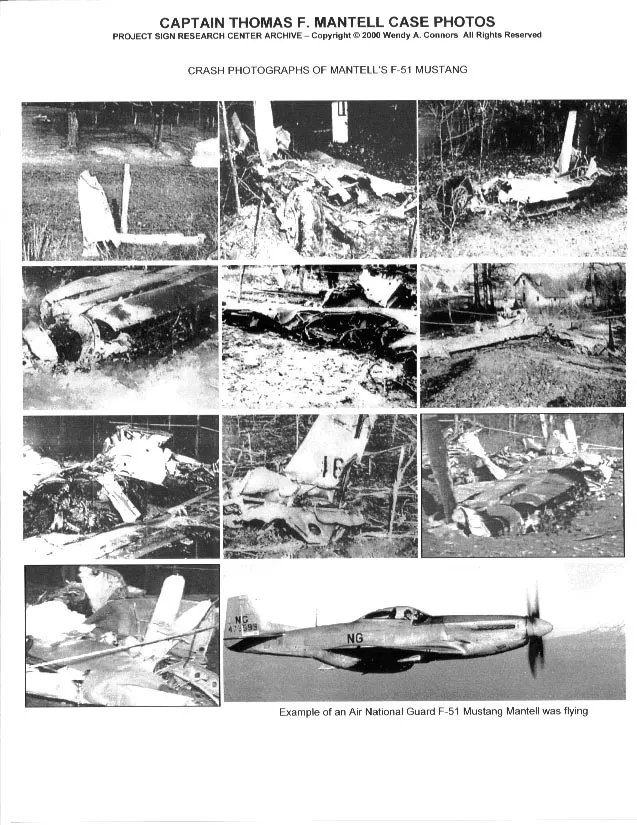
0_39rGshqiOj3LuZQq
Crash case photos.
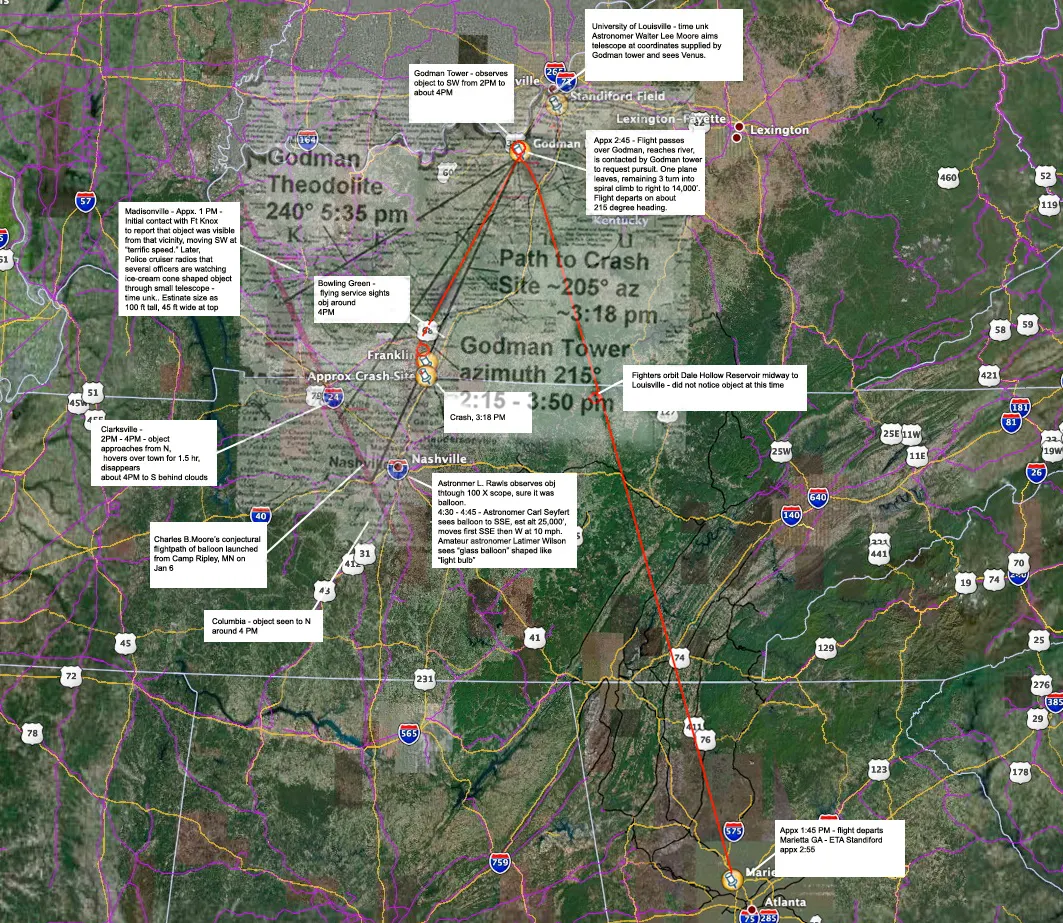
0_oDM3x3SSAqcMdmn6
Route of the F-51Ds from Marietta to Standiford with the locations of where the object was seen by witnesses.
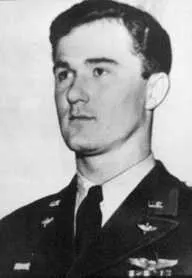
0_II-awywoQaq2CRs3
Captain Thomas F. Mantell Jr. (Kentucky National Guard).
Further reading
Continue exploring — Wikipedia, documentaries, podcasts, museum pages. Not treated as proof, and not independently verified by this archive.
Investigation timeline
- 2026-09-29 — Historical file submitted.
- 2026-09-30 — Historical file accepted and published.
Assigned GG-2026-092
Research notes
Historical research: A Historically Important Case That May Be Substantially Resolved
The Mantell Incident occupies a unique place in UFO history because of its influence rather than its evidentiary strength. The event directly contributed to growing military concern about unidentified aerial reports and became one of the first nationally publicized UFO investigations. The historical facts are clear: an unidentified object was reported, Captain Thomas Mantell pursued it, and he died after climbing to unsafe altitude without oxygen.
The principal debate concerns the object's identity. Modern researchers generally regard a classified Skyhook balloon as the strongest conventional explanation, and many historians consider the case substantially explained. Unlike cases such as Socorro or Kecksburg, the Mantell mystery centers less on unknown physical evidence and more on whether witnesses correctly identified an unconventional but terrestrial object. Under Gothic.Black standards, this places the case somewhere between "Historic UFO Incident" and "Probable Conventional Explanation."
Earliest Documented Report
January 7, 1948, approximately 1:15-1:20 PM — reports of an unusual aerial object began reaching Godman Army Airfield.
Key Historical Event
January 7, 1948, approximately 2:45-3:18 PM — Captain Thomas Mantell pursued the object and was killed when his aircraft crashed near Franklin, Kentucky.
Historical research: High-Altitude Hypoxia Dynamics, Spatial Disorientation, and Structural Disintegration
From an aviation medicine and accident investigation standpoint, the physical cause of the crash is straightforward and undisputed.At altitudes exceeding 18,000 feet, ambient atmospheric pressure drops significantly, leading to rapid onset of hypoxia (oxygen deprivation) if supplemental oxygen is absent. In an unpressurized WWII-era fighter like the F-51D, a pilot flying above 20,000 feet experiences loss of cognitive function, severe visual tunneling, and eventual unconsciousness within 3 to 5 minutes. As Mantell passed 22,000 feet without an oxygen mask, he lost consciousness while maintaining a trim configuration. The Mustang continued climbing until stalling, entering a high-speed diving spiral that exceeded the aircraft's structural design limits, causing the airframe wings to sheer off prior to ground impact.
Historical research: Project Sign Genesis, Cold War Hysteria, and Institutional Secrecy
In UAP history, the Mantell Incident represents the exact catalyst that forced the U.S. military to treat unidentified aerial objects as potential defense threats.
The timing of Mantell’s death—coming six months after Kenneth Arnold’s 1947 sighting and the Roswell incident—created intense national press coverage. Rumors spread that Mantell’s plane had been shot down by a ray weapon or destroyed in dogfight combat with an alien craft. Because Project Skyhook was a top-secret Navy intelligence program measuring cosmic rays and atmospheric radiation, the Air Force could not publicly disclose the balloon launches in early 1948. This enforced secrecy fueled public distrust, creating an early pattern where classified military hardware programs inadvertently generated lasting extraterrestrial narratives.
Open research questions
A specific gap in the file. An accepted source, research note, or further-reading link closes it.
Reconstruct the January 7, 1948 observations from Kentucky State Police, Godman Field and Air Force records. Compare witness descriptions, viewing locations and Mantell's reported radio statements, and determine which quotations and object descriptions are actually preserved in contemporary documents.
Trace the Air Force's changing explanation of the Mantell object from early consideration of Venus through the later Skyhook-balloon hypothesis. Identify what evidence supports a Skyhook-type balloon, whether a specific launch can be tied to the observations, and what uncertainties remain in the surviving record.
Propose evidence & media, a source citation, further reading, a research note, a correction, a related case, or a series link. Staff review before anything is added. An accepted correction does not replace the file by itself.