GG-2026-095
Mad Gasser of Mattoon
- Phenomenon Unclassified & Other, Physiological & Biological Effects
- Documentation
Rating B
- A — Strong dossier: several independent sources plus primary evidence (original media, records, measurements) a researcher could use without interviewing anyone.
- B — Well documented: multiple independent witnesses with at least some contemporary primary material, or one witness with substantial primary corroboration (photos, recordings, contemporaneous notes, documents).
- C — Multi-source but soft: several witnesses or a long run of reports, but mostly testimony and after-the-fact secondary sources (newspapers, folklore collections, later interviews). Little or no primary physical evidence. Regional legend clusters such as the Bridgewater Triangle land here.
- D — Thin: single witness (or one household), little or no support beyond the account. Normal for a sincere personal experience.
- E — Incomplete or not yet assessed. Every new submission starts here until staff have read it.
- Evidence & media 2 items
- Status Historic
- Location Mattoon, Illinois
- Occurred 31 August 1944
Summary
The Mad Gasser of Mattoon was a series of mysterious incidents reported in Mattoon, Illinois during the summer of 1944. Residents claimed an unknown individual was releasing a toxic gas into homes, causing nausea, paralysis, weakness, and strange odors. Despite widespread publicity, police investigations, and dozens of reports, no perpetrator was identified. Today, the case is often cited as one of America's most famous examples of a possible mass panic.
Background
The Outbreak Sequence (Late Summer 1944)
The events in Coles County, Illinois, escalated rapidly from an isolated domestic incident to a city-wide emergency:
August 31, 1944 (The Opening Incident): Urban driver Bert Kearney returned home to find his wife, Aline, partially paralyzed in bed after smelling a sickeningly sweet odor outside her window. As local police investigated, an unseen figure was allegedly spotted fleeing the premises, though no footprints or mechanical devices were recovered.
September 5–8, 1944 (Media Surge & Escalation): Following front-page coverage in the Mattoon Daily Journal-Gazette, report volume spiked. Multiple households reported waking up to sweet, perfume-like, or metallic fumes followed by lower-limb weakness, dry mouth, and nausea. Armed neighborhood watch groups armed with shotguns began patrolling city streets.
September 12, 1944 (Peak & Police Rebound): Mattoon Police Chief C.E. Cole publicly announced that while some initial reports may have involved real industrial pollutants, the majority of subsequent calls were driven by mass panic and hysteria. Reports abruptly ceased within 48 hours of official police skepticism.
Timeline of Key Events
├── Aug 31, 1944 : First report filed by Aline Kearney regarding sweet fumes and temporary paralysis.
├── Sep 5, 1944 : Local press publishes sensational front-page stories; public reports surge exponentially.
├── Sep 7, 1944 : Armed civilian vigilante groups form across Mattoon neighborhoods.
├── Sep 10, 1944 : Illinois State Police conduct chemical/forensic sweeps of reported attack sites (0 evidence found).
├── Sep 12, 1944 : Police Chief Cole publicly attributes the surge to hysteria and environmental odors.
└── Sep 13, 1944 : Reported attacks cease entirely across Coles County.
Witness statement
No statement on file.
Evidence & media
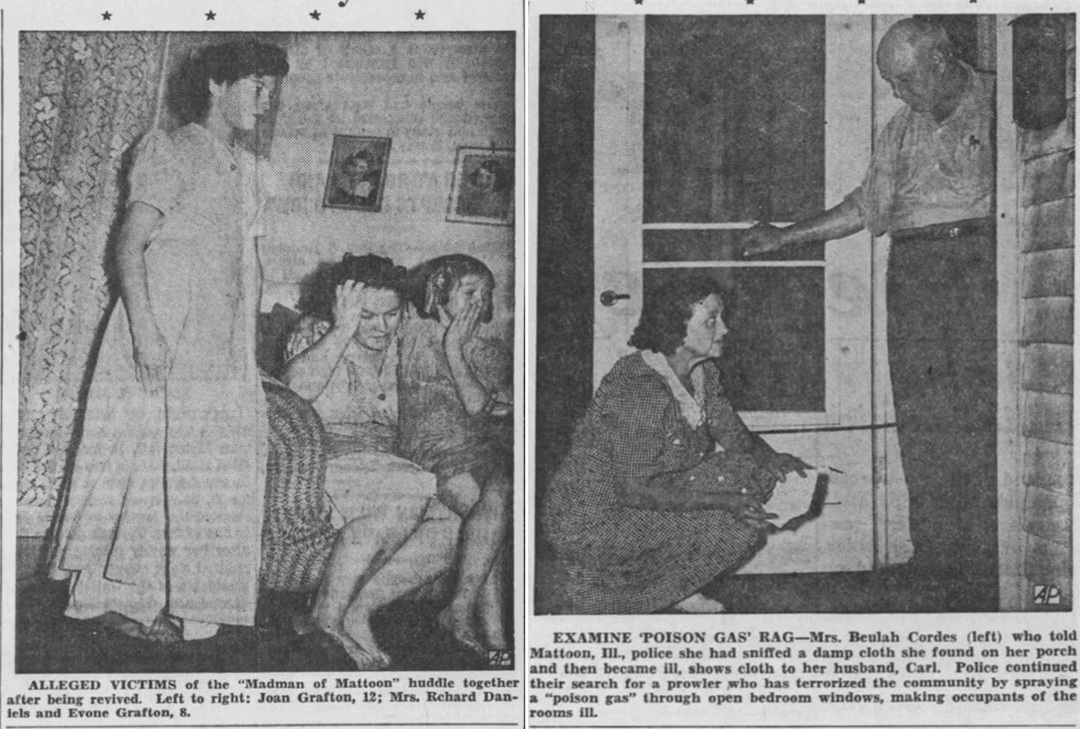 News reports in the Moline (Ill.) Dispatch on the “Madman of Mattoon” alleged poison gas attacks in 1944. (The Dispatch)
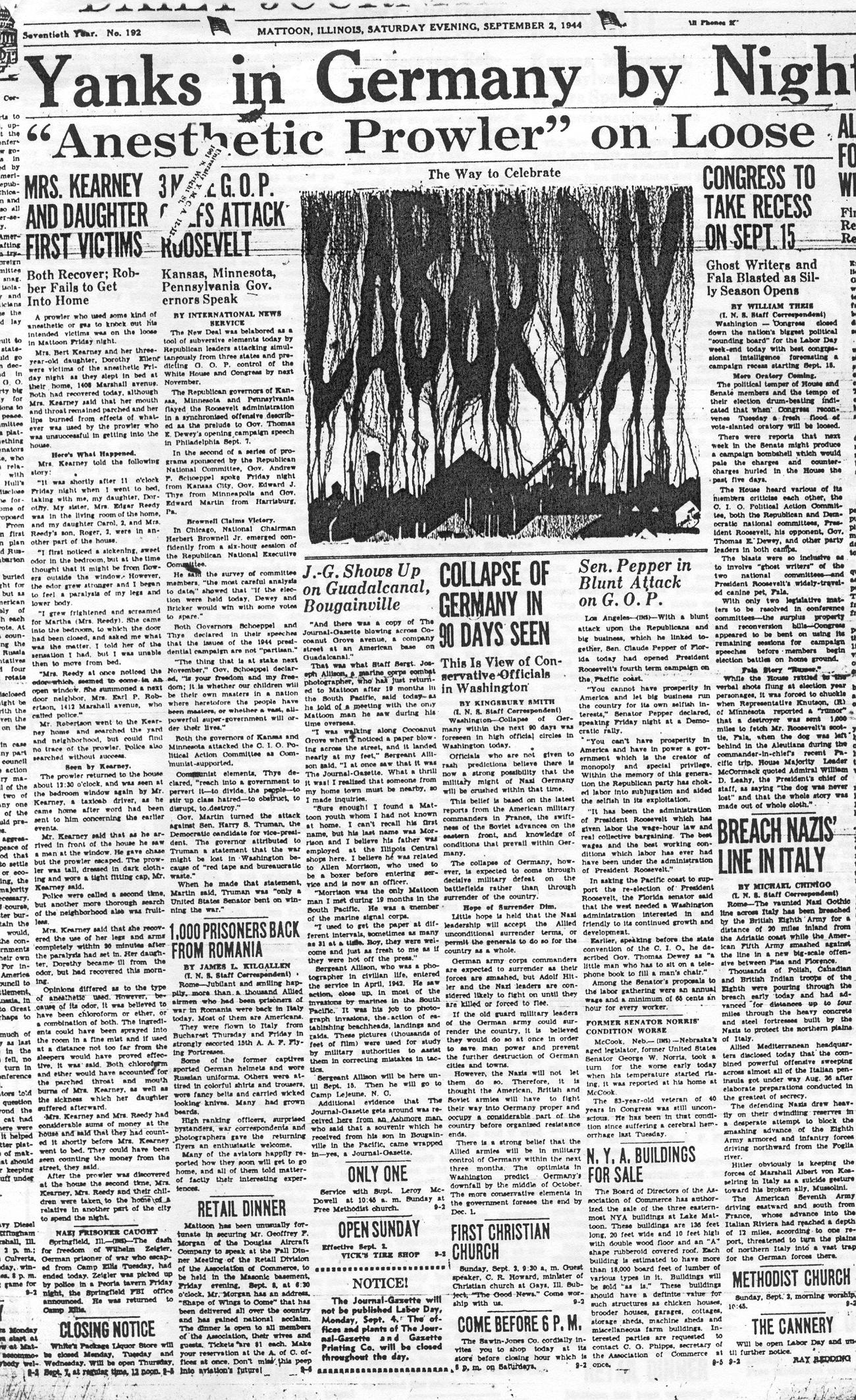 Saturday Evening. Sept 2, 1944
Investigation timeline
- 2026-09-29 — Historical file submitted.
- 2026-09-30 — Historical file accepted and published.
Research notes
Historical research: America's Most Famous Phantom Gasser Case
The Mad Gasser of Mattoon occupies a unique position in American folklore because it sits at the intersection of crime, psychology, wartime anxiety, and mystery. Unlike many paranormal cases, the central question is not whether witnesses reported unusual experiences. They clearly did. Newspaper records, police reports, and community reactions establish that Mattoon experienced a genuine wave of fear during late summer 1944.
The unresolved issue is identifying the cause. Modern scholarship generally favors a combination of wartime stress, rumor amplification, and mass psychogenic illness. However, no single explanation has completely accounted for every report. Under Gothic.Black standards, the outbreak itself is historical fact. Whether an actual "Mad Gasser" ever existed remains disputed.
Earliest Documented Report
August 31, 1944 in Mattoon, Illinois.
Main Incident Period
August-September 1944, during the peak wave of reported attacks.
Historical research: Volatile Organic Compounds (VOCs), Sensory Misattribution, and Lack of Residual Chemistry
From a forensic chemical standpoint, the physical existence of a toxic gas capable of inducing rapid paralysis without leaving detectable environmental residues is chemically unviable.
Gases capable of causing immediate motor paralysis or loss of consciousness (such as high-concentration ether, chloroform, or chloropicrin) require massive volumetric concentration in open residential air—quantities that would linger for hours, leave distinct chemical staining, and affect pets and livestock uniformly. Forensic sweeps conducted by Illinois State Police chemists failed to discover chemical trace residues, compressed gas cylinders, or delivery nozzle wear on window sills. Consequently, forensic consensus attributes initial smell triggers to routine industrial exhaust (chlorine/solvent outgassing) combined with standard domestic gas leaks.
Propose evidence & media, a source citation, further reading, a research note, a correction, a related case, or a series link. Staff review before anything is added. An accepted correction does not replace the file by itself.