GG-2026-100
Beast of Whitehall
- Phenomenon Cryptids & Unknown Zoology
- Documentation
Rating C
- A — Strong dossier: several independent sources plus primary evidence (original media, records, measurements) a researcher could use without interviewing anyone.
- B — Well documented: multiple independent witnesses with at least some contemporary primary material, or one witness with substantial primary corroboration (photos, recordings, contemporaneous notes, documents).
- C — Multi-source but soft: several witnesses or a long run of reports, but mostly testimony and after-the-fact secondary sources (newspapers, folklore collections, later interviews). Little or no primary physical evidence. Regional legend clusters such as the Bridgewater Triangle land here.
- D — Thin: single witness (or one household), little or no support beyond the account. Normal for a sincere personal experience.
- E — Incomplete or not yet assessed. Every new submission starts here until staff have read it.
- Evidence & media 2 items
- Status Active
- Location Whitehall, New York
- Occurred 24 August 1976
Summary
On the night of August 24, 1976, three teenagers driving along isolated Abair Road near Whitehall, New York, encountered a massive, 7-to-8-foot-tall bipedal entity covered in coarse brown hair with glowing red/yellow eyes standing in a field along the road shoulder. Fleeing to report the event, they alerted local authorities, bringing Whitehall Police Officer Brian Gosselin and Washington County Deputy Sheriff Dan Gordon to the scene. Gosselin personally confronted the creature at point-blank range in his patrol car headlights, observing a 400-pound hominid that let out a terrifying, high-pitched scream before retreating into the brush near the Poultney River. The ensuing multi-week investigation drew state troopers, game wardens, and local police who documented 19-inch footprint tracks with distinct dermal ridges. Unlike typical civilian urban legends, the Whitehall case stands out in cryptozoology history due to the high volume of corroborated reports filed by active law enforcement officers.
Background
The August 1976 Outbreak Sequence
The sightings along the Vermont–New York border escalated rapidly over several days, transforming a quiet railroad town into a focal point of regional cryptozoological inquiry:
August 24, 1976 (Initial Encounter): Teenagers Paul Gosselin, Brian Kinney, and a third companion were driving down Abair Road around 10:00 PM when they observed a tall figure standing near a field boundary. The driver swerved as the creature loomed above the car. Describing a 7-to-8-foot hairy "beast" that walked with a fluid, human-like gait, they sped into town to locate law enforcement.
August 25, 1976 (Law Enforcement Confrontation): Officer Brian Gosselin (no relation to the teenage witness) and Deputy Dan Gordon returned to Abair Road to inspect the area. Waiting in his patrol car with the lights doused, Officer Gosselin heard heavy footfalls approaching through the tall grass. Upon flipping on his high beams, Gosselin observed the creature standing roughly 30 feet away. He noted its thick brown coat, long head hair, and striking red eyeshine. The entity stood motionless for several seconds before emitting a blood-curdling screech and bounding into the woods.
Subsequent Police Sweeps: Over the next 48 hours, additional officers—including State Trooper Dick Travis and local game wardens—converged on the Poultney River marshlands. Multiple officers reported hearing strange, guttural vocalizations and finding trampled vegetation along river banks.
Timeline of Key Events
├── Aug 24, 1976 (10:00 PM) : Three teens encounter a 7-foot hairy biped on Abair Road.
├── Aug 25, 1976 (02:00 AM) : Officer Brian Gosselin illuminates the creature at 30 feet with patrol high beams.
├── Late Aug 1976 : Washington County deputies & state troopers conduct riverbank sweeps.
├── Sep 1976 : 19-inch tracks discovered near the Poultney River bridge; plaster casts poured.
└── 2004–Present : Whitehall adopts "Sasquatch Capital of New York" branding; hosts annual festival.
Physical Evidence & Trace Documentation
Footprint Tracks & Castings: Investigators discovered a series of 19-inch, four-toed footprint impressions along the muddy banks of the Poultney River near the Vermont state line. Plaster casts poured by local researchers (including Paul Bartholomew) revealed impression depth indicating a subject weighing between 350 and 450 pounds.
Dermal Ridge Claims: Dactyloscopy analysis conducted on select cast impressions suggested fine parallel ridges resembling dermal friction ridges, leading researchers to rule out simple wooden footprint-carving hoaxes.
Latest sightings
7 August 2018 — a driver on Route 4, about two miles from the New York–Vermont line, outside Whitehall. BFRO report 59838, Class A. Paul Bartholomew met the witness the next day and took casts. The New York Post ran it on 13 August 2018. Bartholomew also notes a similar crossing on that same stretch of road on 4 September 2006.
June 2019 — a dog walker on the north side of Whitehall, filed with BFRO on 25 August 2020 as report 65975, Class A. The witness described a figure about six feet tall; Bartholomew and others reported footprints and a bedding area afterward.
Witness statement
No statement on file.
Evidence & media
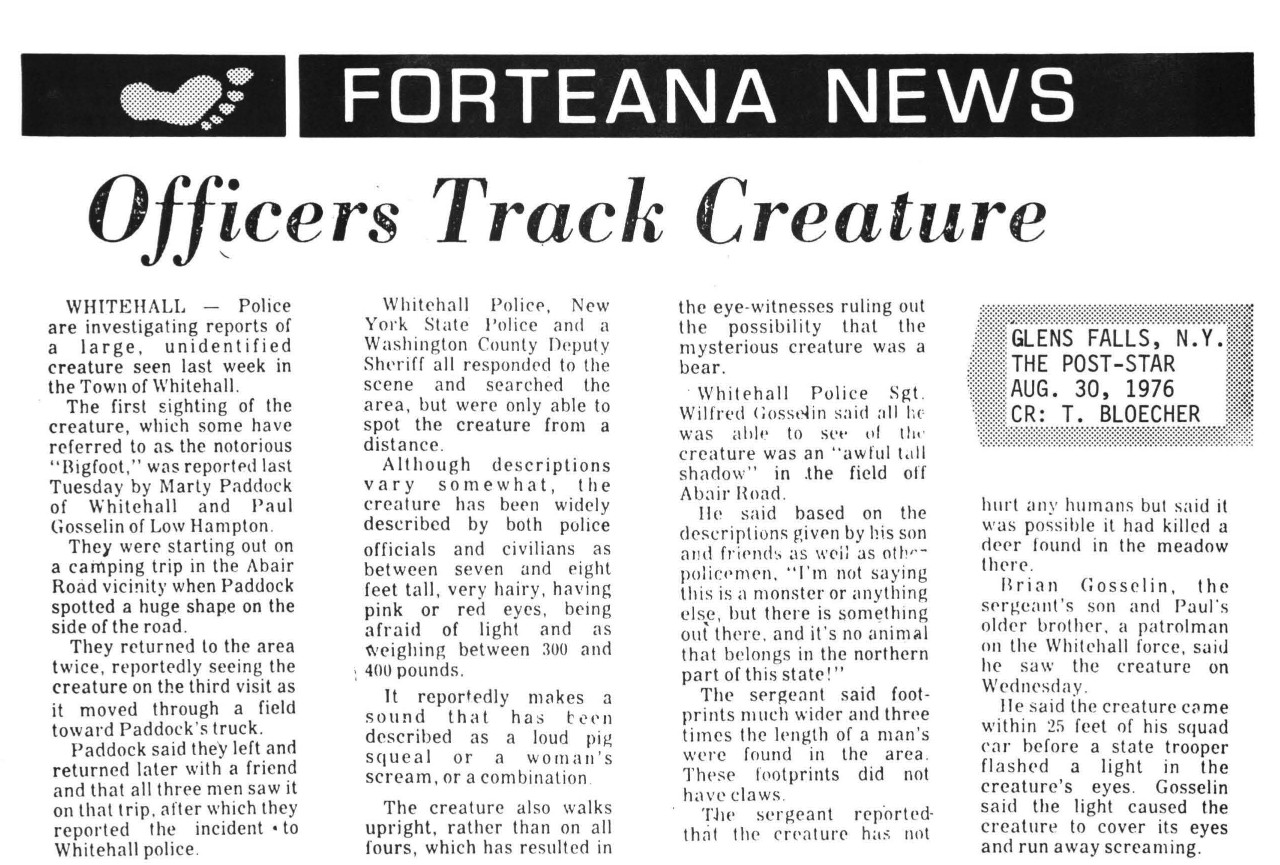 Post-Star article. Aug 30, 1976
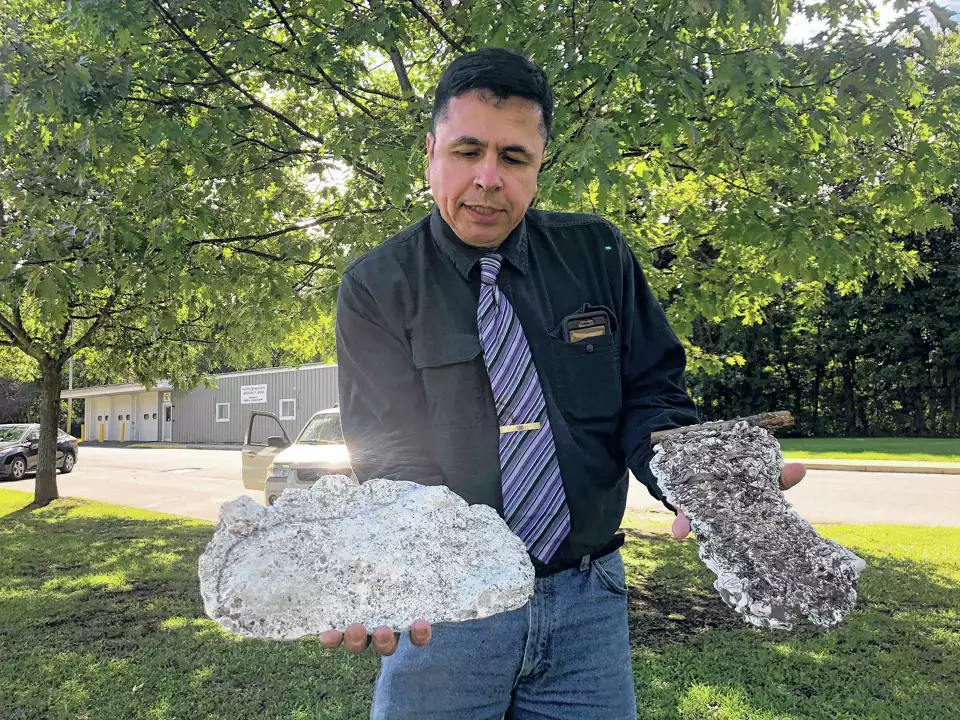 Paul Bartholomew, an investigator and researcher of unexplained phenomena, took a reporter on Sept. 25, 2018, to various spots in Whitehall where Bigfoot has been spotted.
Investigation timeline
- 2026-09-30 — Historical file submitted.
- 2026-09-30 — Historical file accepted and published.
Research notes
Historical research: Patrol Car Headlight Illuminance, Red Eyeshine Physics, and Officer Witness Reliability
From a forensic and investigative standpoint, the Whitehall incident holds exceptional weight due to the involvement of trained law enforcement observers acting under official duty.
Officer Brian Gosselin operated a standard 1970s police cruiser equipped with high-intensity sealed-beam halogen lamps. At a distance of 30 feet, illuminance was sufficient to evaluate anatomical details, eliminating common low-light distance distortion. The "glowing red eyes" reported by Gosselin and civilian witnesses represent tapetum lucidum retro-reflection—a biological layer behind the retina found in nocturnal predators (such as bears, panthers, and deer) that reflects light back toward the source. However, the physical height (over 7 feet) and erect bipedal locomotion rule out native quadrupedal fauna like the white-tailed deer (Odocoileus virginianus).
Historical research: American Black Bear (Ursus americanus) Bipedalism vs. Unclassified Primates
From a zoological perspective, skeptical analysis focuses on the population dynamics of the Adirondack black bear.
Black bears frequently exhibit short-distance bipedal standing to survey terrain or scent the wind. In rare instances of paw injury or anatomical deformation, bears have been documented walking on their hind legs for extended distances. A large male black bear standing erect can reach heights of 6.5 to 7 feet. However, witness statements from experienced outdoorsmen and police officers specifically emphasize human-like shoulder movement, longer facial hair, and rapid bipedal strides across open fields—locomotion mechanics distinct from the awkward, shuffling waddle of a standing bear.
Propose evidence & media, a source citation, further reading, a research note, a correction, a related case, or a series link. Staff review before anything is added. An accepted correction does not replace the file by itself.