GG-2026-101
Flathead Lake Monster
- Phenomenon Cryptids & Unknown Zoology
- Documentation
Rating C
- A — Strong dossier: several independent sources plus primary evidence (original media, records, measurements) a researcher could use without interviewing anyone.
- B — Well documented: multiple independent witnesses with at least some contemporary primary material, or one witness with substantial primary corroboration (photos, recordings, contemporaneous notes, documents).
- C — Multi-source but soft: several witnesses or a long run of reports, but mostly testimony and after-the-fact secondary sources (newspapers, folklore collections, later interviews). Little or no primary physical evidence. Regional legend clusters such as the Bridgewater Triangle land here.
- D — Thin: single witness (or one household), little or no support beyond the account. Normal for a sincere personal experience.
- E — Incomplete or not yet assessed. Every new submission starts here until staff have read it.
- Evidence & media 1 item
- Status Active
- Location Flathead Lake, Montana
- Occurred 1889
Summary
Spanning over 130 years of documented reports, the Flathead Lake Monster (colloquially nicknamed "Flessie") represents one of the American West's most enduring freshwater cryptid traditions. The recorded history began on July 5, 1889, when Captain James C. Kerr of the steamboat U.S. Grant and his passengers observed a massive, serpent-like creature measuring 20 to 40 feet in length with dark, eel-like skin and prominent black eyes swimming alongside the vessel. Native Salish and Kootenai oral traditions describe similar large, horn-headed water entities (n recollect) inhabiting the deep glacial waters long before European settlement. Over the decades, hundreds of sightings—including a 1993 incident where a mother and son reported a whale-like creature lifting a kayak—have described a creature with a plesiosaurian, eel, or giant sturgeon morphology. Despite occasional reward offers and sonar anomalies recorded by recreational fishermen, no biological specimens, carcass remains, or definitive underwater photography have been produced, leaving the phenomenon centered at the intersection of relict megafauna hypothesis, white sturgeon misidentifications, and deep-water optical illusions.
Background
Historical Development & Major Sighting Waves
Flathead Lake—the largest natural freshwater lake by surface area in the western contiguous United States (covering 197 square miles and reaching depths of 370 feet)—provides a massive, cold-water habitat:
Indigenous Kootenai & Salish Lore: Long prior to 19th-century settlement, tribal traditions held that a large water monster dwelt beneath the ice and deep channels of the lake. One traditional legend describes tribal members attempting to cross the frozen lake when two giant horns poked through the ice; upon cutting off a horn, the monster thrashed, breaking the ice and drowning several individuals.
July 5, 1889 (The Steamboat Incident): Captain James C. Kerr, operating the steamboat U.S. Grant, along with dozens of passengers, logged the first recorded non-indigenous sighting. Passengers observed an elongated, dark creature surfacing near the boat. A passenger reportedly fired a rifle at the entity, causing it to dive violently, creating large wake swells.
May 1955 (The "Flessie" Surge): A massive wave of sightings occurred during the 1950s. On May 28, 1955, thirteen independent witnesses across different shorelines reported seeing a 30-foot serpentine creature moving at high speed across the open water near Yellow Bay.
May 1993 (The Kayak Encounter): A local resident and her son kayaking near Bigfork reported an encounter at close range. The witness described an eel-like creature roughly 20 to 30 feet long with smooth, dark skin and a head resembling a python or seal, which surfaced directly beneath the kayak, lifting it slightly before submerging.
Timeline of Key Events
├── Pre-1800s : Kootenai & Salish oral histories document giant horned water entities.
├── Jul 5, 1889: Captain James C. Kerr & steamboat passengers file first published sighting.
├── May 1955 : Multi-witness sighting wave across Yellow Bay; 13 independent reports filed in 1 day.
├── May 1993 : Kayaker encounter near Bigfork provides close-range anatomical description.
└── Present : Annual sightings logged by local marinas and the Flathead Lake Protection Association.
Physical Evidence & Search Operations
Unlike cases with land tracks or hair samples, evidence for the Flathead Lake Monster relies almost entirely on sonar contacts and surface wake observations:
Sonar Targets: Local fishing charters using modern side-scan sonar have occasionally logged massive, moving sonar signatures at depths of 150 to 250 feet that do not match standard schools of lake trout or lake whitefish.
1950s Cash Bounty: Local businessmen and civic groups offered cash rewards during the 1950s for verifiable photographic proof or capture of the entity. Despite increased boat traffic and watch parties, no specimen was produced.
Witness statement
No statement on file.
Evidence & media
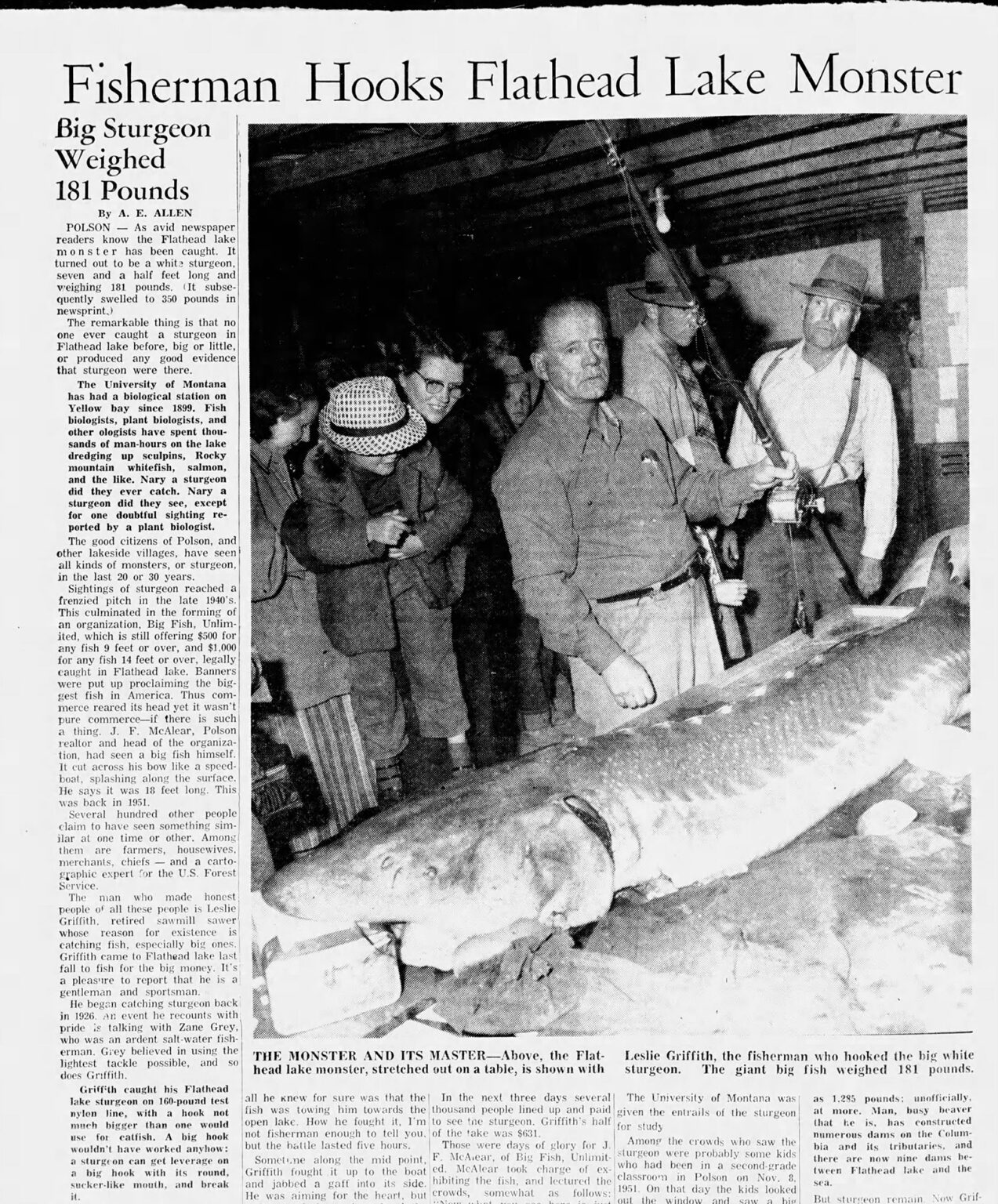 A 1955 clipping from the Great Falls Tribune portrays Leslie Griffith and his controversial sturgeon.
Investigation timeline
- 2026-09-30 — Historical file submitted.
- 2026-09-30 — Historical file accepted and published.
Research notes
Historical research: Acipenser transmontanus (White Sturgeon) Introduction, Size Biomass, and Depth Habitat
From an ichthyological perspective, the leading biological explanation for historical and modern sightings involves the White Sturgeon (Acipenser transmontanus).
While not officially native to Flathead Lake's immediate upper basin, white sturgeon are native to the Columbia River system (to which the Flathead/Kootenai systems connect). Sturgeon can live for over 100 years, reach lengths of 12 to 20 feet, weigh over 1,000 pounds, and possess armor-like bony plates (scutes) along their backs that give them a jagged, prehistoric appearance. An ancient, landlocked sturgeon surfacing briefly or breaking the water column closely mirrors the "bumpy spine," dark coloration, and 15-to-20-foot length descriptions reported by witnesses. In 1955, a 7.5-foot sturgeon was caught in nearby waters, proving their physical presence in the drainage basin.
Historical research: Boat Wake Divergence, Thermal Stratification (Seiches), and Distance Distortion
From a physical limnology standpoint, Flathead Lake's vast size (nearly 30 miles long) creates specific optical and fluid dynamic illusions.
Large lakes frequently experience internal seiches (standing waves caused by wind pushing surface water) and thermal refraction (mirages) created by cold air sitting directly above cold water under sunny conditions. Furthermore, boat wakes from distant motorcraft can travel miles across calm water, converging and forming isolated, undulating wave trains ("boat wake logs") that appear to move independently against the current. To an observer on shore, a series of 3 or 4 rolling boat wake crests viewed through atmospheric shimmer creates a vivid illusion of a multi-humped serpentine monster moving rapidly across the surface.
Propose evidence & media, a source citation, further reading, a research note, a correction, a related case, or a series link. Staff review before anything is added. An accepted correction does not replace the file by itself.