GG-2026-104
Kaikoura Lights
- Phenomenon UFOs/UAPs
- Documentation
Rating A
- A — Strong dossier: several independent sources plus primary evidence (original media, records, measurements) a researcher could use without interviewing anyone.
- B — Well documented: multiple independent witnesses with at least some contemporary primary material, or one witness with substantial primary corroboration (photos, recordings, contemporaneous notes, documents).
- C — Multi-source but soft: several witnesses or a long run of reports, but mostly testimony and after-the-fact secondary sources (newspapers, folklore collections, later interviews). Little or no primary physical evidence. Regional legend clusters such as the Bridgewater Triangle land here.
- D — Thin: single witness (or one household), little or no support beyond the account. Normal for a sincere personal experience.
- E — Incomplete or not yet assessed. Every new submission starts here until staff have read it.
- Evidence & media 6 items
- Status Historic
- Location Kaikōura, New Zealand
- Occurred 21 December 1978
Summary
In late December 1978, a series of extraordinary radar-visual encounters unfolded over the northeastern coast of New Zealand's South Island, specifically above the Kaikoura Ranges and the Clarence River delta. Crew members aboard Safe Air Limited cargo flights (operating Armstrong Whitworth AW.660 Argosy aircraft) observed multiple glowing, highly luminous, pulsating orb-like structures that executed rapid maneuvers, tracked alongside their aircraft, and vanished at high speeds. Crucially, these visual sightings were tracked simultaneously by air traffic control operators at Wellington radar control using ground-based primary radar systems and confirmed on the Argosy aircraft's onboard weather radar. On the night of December 30–31, an Australian television news crew aboard one of the flights captured over 20 minutes of 16mm color film and synchronized audio of the lights while ground radar actively tracked targets operating in close proximity to the aircraft. Investigated extensively by the Royal New Zealand Air Force (RNZAF), civil aviation authorities, and independent atmospheric scientists, the Kaikoura Lights remain one of aviation history's most rigorously documented multi-sensor UAP cases.
Background
The December 1978 Outbreaks
The event sequence occurred over two main nights involving scheduled freight runs between Wellington (North Island) and Blenheim/Christchurch (South Island):
December 21, 1978 (Initial Encounter): During a routine night cargo flight from Blenheim to Christchurch, the crew of a Safe Air Argosy freighter observed five brightly glowing, pulsating yellow-orange lights. Wellington Air Traffic Control simultaneously tracked multiple stationary and fast-moving unclassified radar returns on their air defense primary radar systems corresponding directly to the crew's visual line of sight.
December 30–31, 1978 (Filmed Engagement): Prompted by news of the earlier incident, an Australian Channel 0 (now Channel 10) news team led by reporter Quentin Fogarty boarded an Argosy freighter piloted by Captain Bill Startup and Co-Pilot Bob Guard. Shortly after takeoff from Blenheim at 11:45 PM, Wellington ground radar alerted the crew to an unidentified target 10 miles ahead.
Observation & Tracking: The crew observed a massive, glowing sphere flanked by smaller orbiting lights that tracked parallel to the aircraft. The object illuminated the ocean surface below and appeared on the aircraft's onboard radar screen before accelerating vertically at immense velocity. Sound recordist David Crockett captured live audio of the crew and radar controllers while cameraman Denis Connell recorded color 16mm footage of the glowing entities.
Timeline of Key Events
├── Dec 21, 1978 : First Argosy cargo crew observes pulsating lights; Wellington ATC confirms radar targets.
├── Dec 30, 1978 (11:45 PM): Australian news crew departs Blenheim on Safe Air Argosy freight flight.
├── Dec 31, 1978 (00:10 AM): Wellington ground radar locks target tracking 10 miles from Argosy; crew visually acquires orb.
├── Dec 31, 1978 (01:00 AM): Cameraman Denis Connell films 16mm color footage of pulsating light matching radar bearing.
├── Jan 1979 : Royal New Zealand Air Force (RNZAF) launches official government investigation.
└── Nov 1979 : RNZAF releases official report attributing sightings to atmospheric refraction & Venus.
Sensor Correlation & Physical Data
Ground Primary Radar: Wellington Control utilized a Thompson-CSF primary radar installation. Controllers documented targets that maintained stationary positions against strong coastal winds before accelerating into rapid turns, matching the exact bearings reported by the Argosy pilots over radio channels.
Airborne Weather Radar: The Argosy's onboard Bendix radar registered targets at ranges between 10 and 20 nautical miles, confirming solid radar cross-section reflection from the visual light sources.
Witness statement
No statement on file.
Evidence & media
 The Kaikoura UFOs - 1978
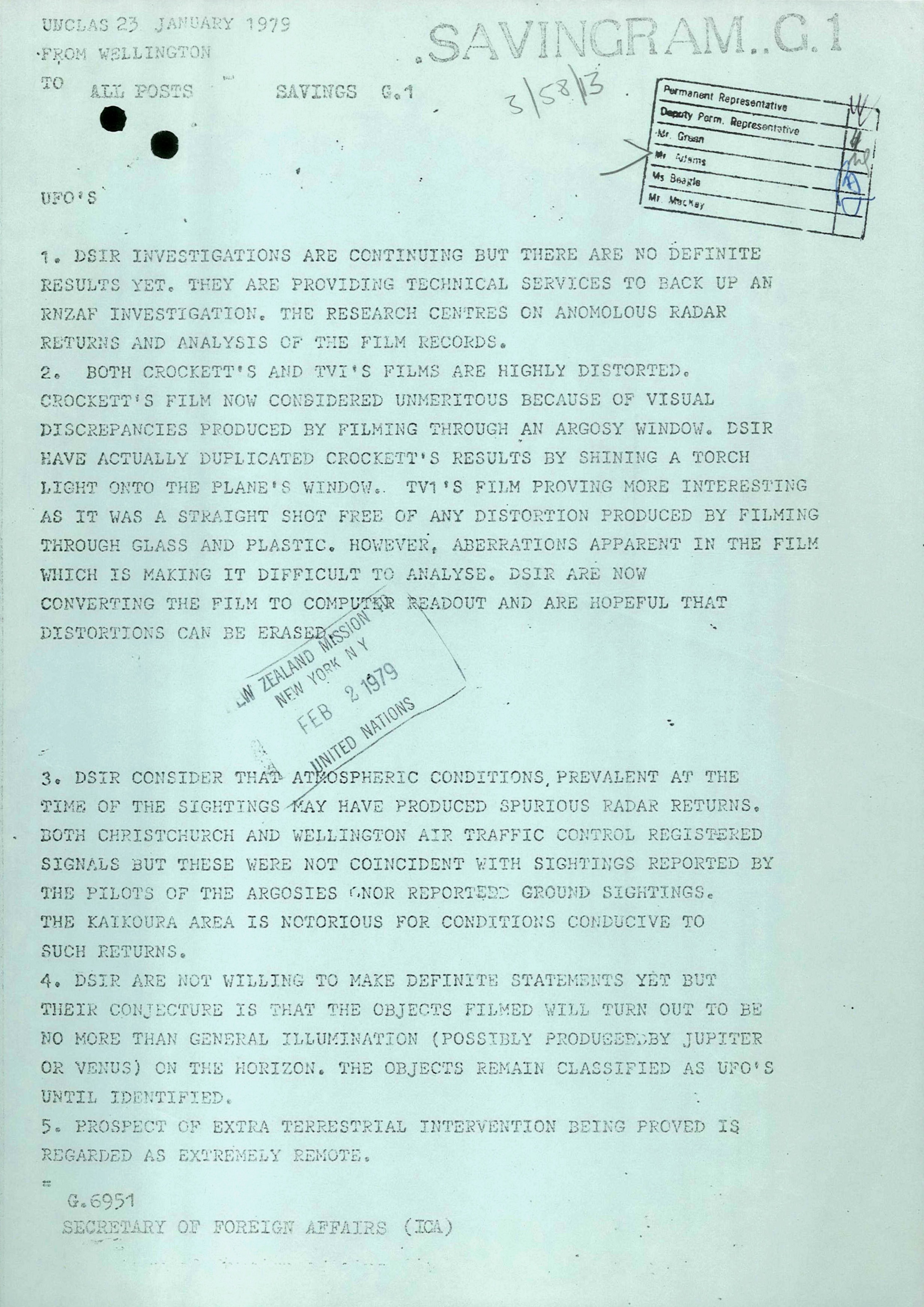 Document from the New Zealand Permanent Mission to the United Nations relating to the Kaikoura Lights (1979)
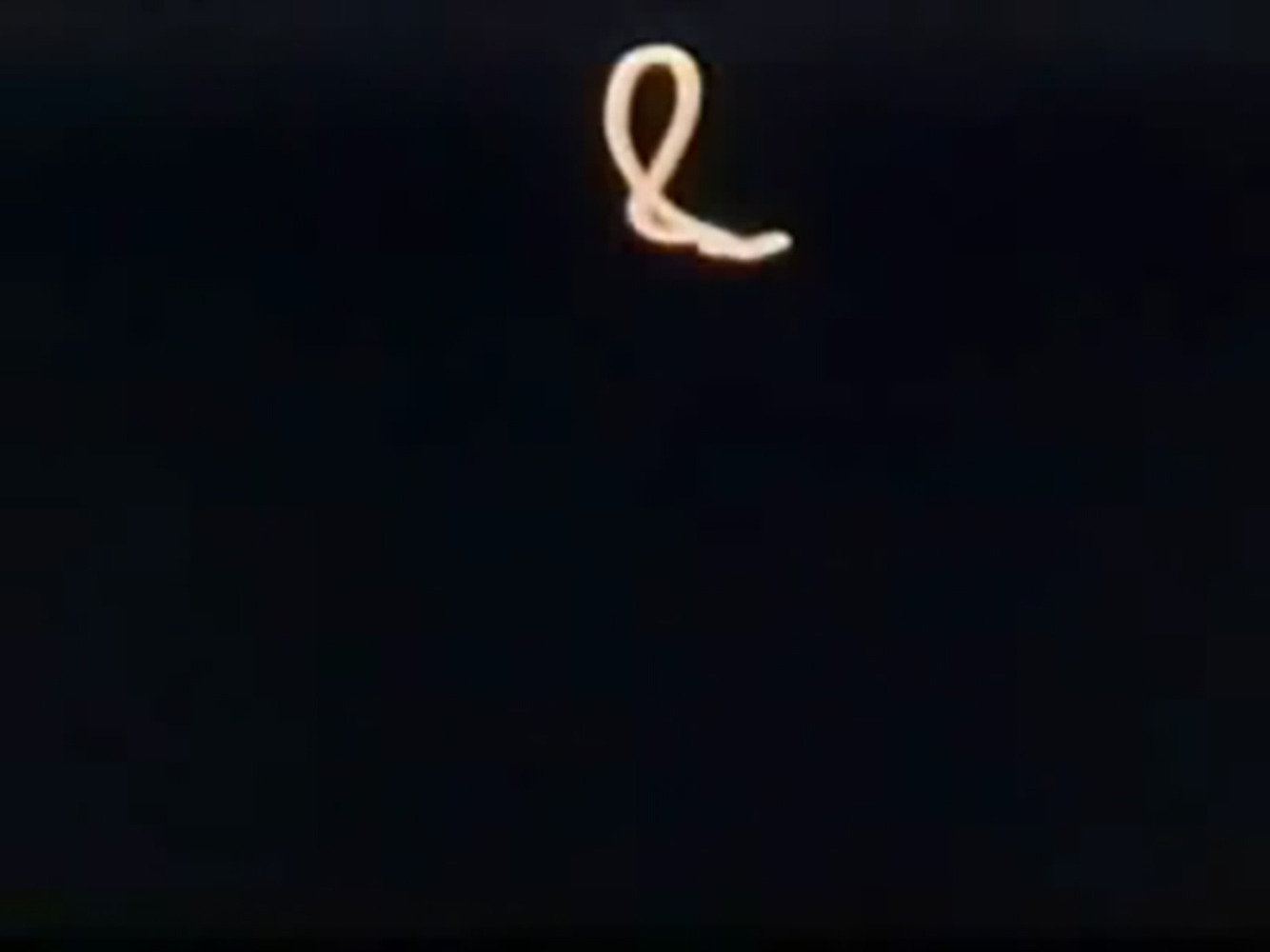 A single frame from the Channel 0 footage.
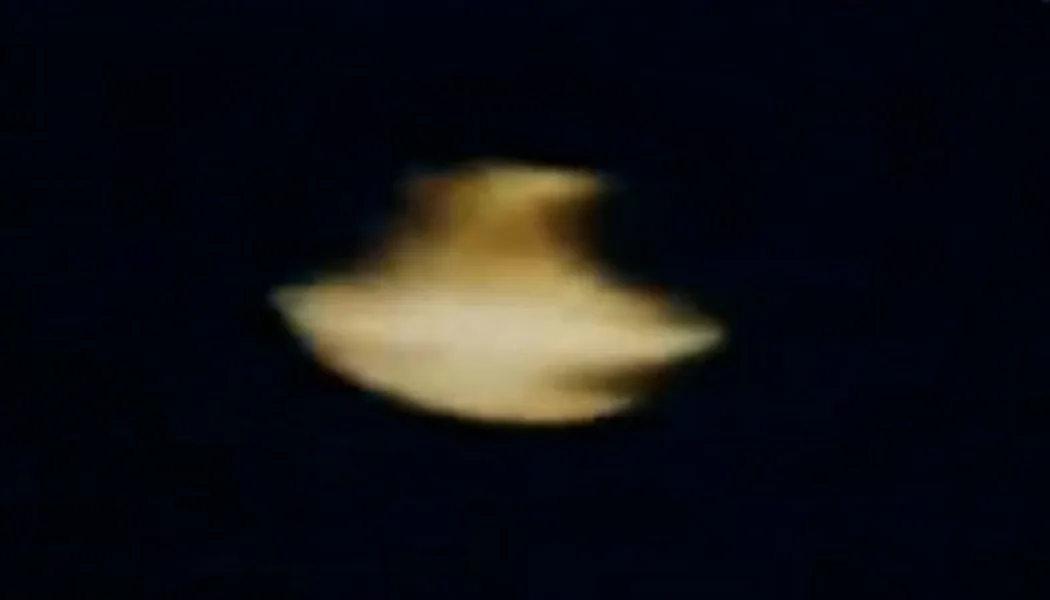 A single frame from the Channel 0 footage.
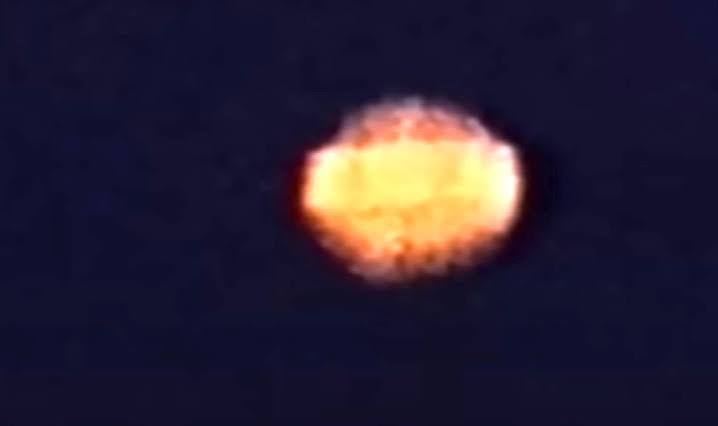 A single frame from the Channel 0 footage.
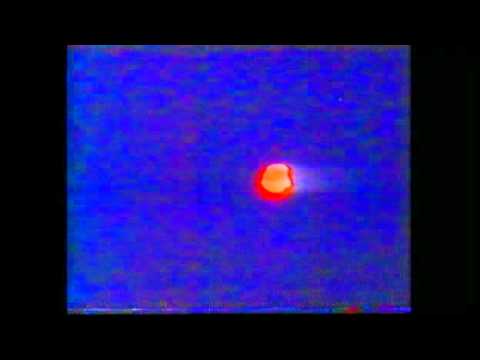 The Kaikoura Lights video
Investigation timeline
- 2026-09-30 — Historical file submitted.
- 2026-09-30 — Historical file accepted and published.
Research notes
Historical research: Ground/Airborne Radar Propagation, Anomalous Propagation (AP), and Thermal Inversions
From an atmospheric physics and radar engineering perspective, official skeptical critiques focused heavily on coastal meteorological anomalies.
The official Royal New Zealand Air Force (RNZAF) investigation concluded that many of the radar returns were generated by Anomalous Propagation (AP)—a condition where temperature inversion layers over the ocean bend radar beams downward, causing ground or ocean surface clutter (such as large waves or coastal bluffs) to appear on air traffic screens as airborne targets. Skeptics, including Dr. Donald Menzel and Philip Klass, argued that the visual lights were misidentified astronomical bodies (such as the planet Venus or Jupiter) or squid-fishing boat lights reflected through anomalous atmospheric refraction ("mirages"). However, atmospheric physicists noted that standard AP rarely produces clean, isolated targets that track along the exact moving trajectory of an aircraft while simultaneously displaying matching airborne radar returns.
Historical research: Photometric Film Analysis, Cockpit Reflection Physics, and Multi-Sensor Convergence
From an optical analysis standpoint, independent scientific reviews evaluated the 16mm film footage and flight logs.
Physicist Dr. Bruce Maccabee conducted a frame-by-frame photometric analysis of Denis Connell's 16mm film footage. His findings established that the light sources recorded on camera were far brighter than any astronomical object or distant ship light, exhibiting intrinsic luminosity shifts and distinct shape changes. Furthermore, the geometric relationship between the ground radar vectors, airborne radar range displays, cockpit audio commentary, and film frame timestamps indicated that all three sensors (visual/optical, ground radar, airborne radar) were reacting to the same physical point-source phenomenon in three-dimensional space, ruling out simple internal cockpit reflections or camera artifacts.
Propose evidence & media, a source citation, further reading, a research note, a correction, a related case, or a series link. Staff review before anything is added. An accepted correction does not replace the file by itself.