GG-2026-105
Voronezh UFO Incident
- Phenomenon UFOs/UAPs
- Documentation
Rating B
- A — Strong dossier: several independent sources plus primary evidence (original media, records, measurements) a researcher could use without interviewing anyone.
- B — Well documented: multiple independent witnesses with at least some contemporary primary material, or one witness with substantial primary corroboration (photos, recordings, contemporaneous notes, documents).
- C — Multi-source but soft: several witnesses or a long run of reports, but mostly testimony and after-the-fact secondary sources (newspapers, folklore collections, later interviews). Little or no primary physical evidence. Regional legend clusters such as the Bridgewater Triangle land here.
- D — Thin: single witness (or one household), little or no support beyond the account. Normal for a sincere personal experience.
- E — Incomplete or not yet assessed. Every new submission starts here until staff have read it.
- Evidence & media 1 item
- Status Historic
- Location Voronezh, Soviet Union
- Occurred 27 September 1989
Summary
In late September 1989, during the height of Mikhail Gorbachev's Glasnost (openness) campaign, the industrial city of Voronezh, located approximately 300 miles south of Moscow, became the epicenter of one of the most widely publicized extraterrestrial landing claims in Soviet history. On the evening of September 27, 1989, dozens of witnesses—predominantly local school children playing in South Park, later corroborated by adult bystanders and local police officers—reported observing a luminous, deep-red spherical craft approximately 30 to 40 feet in diameter land in a public park. Witnesses described three-eyed, giant entity figures (standing nearly 9 to 10 feet tall) clad in silver overalls accompanied by a small robotic companion exiting the craft, performing a brief walk, and utilizing a weapon-like tube that allegedly rendered a young boy briefly invisible before the entity reboarded and departed. The case gained worldwide media attention when the official Soviet state news agency, TASS, reported the story as a factual occurrence on October 9, 1989, marking an unprecedented shift in official state media policy regarding anomalous phenomena.
Background
The September 27 Event & Witness Sequence
The Voronezh incident occurred amid a broader wave of aerial sightings reported across the Voronezh Oblast between August and October 1989:
Observation & Touchdown: At approximately 6:30 PM on September 27, children and parkgoers observed a glowing pink/red disc or sphere hovering above South Park. The object cycled through light phases, performed low-altitude passes, and extended three landing legs before settling onto the grass.
Entity Manifestation: A hatch opened on the underside of the craft, revealing a 9-foot-tall humanoid figure with three eyes (the central eye moving independently) wearing silver boots and a metallic jumpsuit, along with a shorter box-like robot. Witnesses stated the entity looked around, pointed a metallic tube at an alarmed 16-year-old boy, causing him to vanish momentarily, before restoring him when the craft lifted off.
Immediate Police & Media Response: Local militia (police) dispatches responded to the park, logging statements from over 30 independent child witnesses who drew strikingly consistent diagrams of the craft, its underside insignia (resembling the ancient Greek letter Xi or a stylized version of the Ummo symbol), and the entity's proportions.
Timeline of Key Events
├── Sep 21–Oct 2, 1989: Localized sighting wave reported across industrial parks in Voronezh.
├── Sep 27, 1989 (18:30): Mass landing event in South Park; entity claims recorded by local militia.
├── Oct 9, 1989 : Soviet state news agency TASS releases official dispatch confirming landing.
├── Oct 11, 1989 : Genrikh Silanov & Voronezh Section of the Russian UAP Group inspect site.
└── Late Oct 1989 : TASS issues clarification; scientific consensus cites media exaggeration and soil contamination.
Ground Evidence & Physical Trace Controversies
Initial reports claimed dramatic physical evidence was recovered from the park depression:
Ground Depression & Radioactivity: Early field inspections led by Genrikh Silanov of the Voronezh Geophysical Laboratory reported circular ground indentations corresponding to a heavy weight (estimated at several tons) and claimed elevated levels of the radioactive isotope Cesium-137 in soil cores.
Retraction & Contamination: Subsequent independent laboratory analysis by the USSR Academy of Sciences and Voronezh State University debunked the initial physical claims. The elevated cesium levels were shown to be consistent with regional fallout from the 1986 Chernobyl nuclear disaster rather than an anomalous landing, and the soil compaction was within normal limits for urban park usage.
Witness statement
No statement on file.
Evidence & media
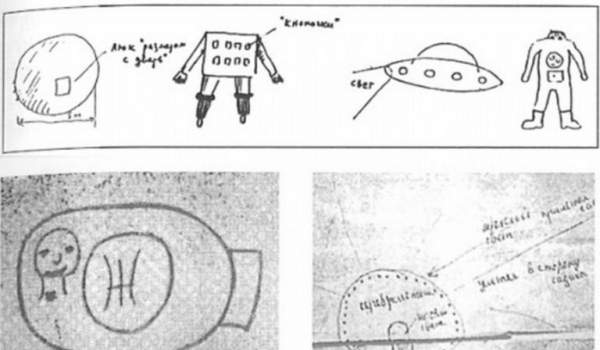 Drawings by some of the children who witnessed the event.
Investigation timeline
- 2026-09-30 — Historical file submitted.
- 2026-09-30 — Historical file accepted and published.
Research notes
Historical research: TASS State Media Dissemination, Political Liberalization, and Mass Media Sensationalism
From a historical and sociological perspective, the Voronezh case serves as a landmark study in media evolution during the final years of the Soviet Union.
Prior to Gorbachev's policies of Glasnost (openness) and Perestroika (restructuring), official Soviet media outlets like TASS, Pravda, and Izvestia operated under strict ideological censorship, routinely dismissing UAP reports as "bourgeois superstition" or Western distraction. The October 9, 1989 TASS report—authored by correspondent Vladimir Lebedev—represented a dramatic reversal, publishing sensational witness claims without editorial filtration. Western media (including The New York Times, TIME, and BBC) picked up the story precisely because it carried the official stamp of the Soviet government. Sociologists note that the rapid economic and social shifts of 1989 created an environment where state journalists eagerly pursued high-profile, non-political sensationalism to drive readership.
Historical research: Cross-Examination of Child Witnesses, Contagion Effects, and Visual Schema
From a psychological perspective, researchers evaluated the consistency of the juvenile testimony.
Over 30 children interviewed separately by militia officers and journalists provided remarkably coherent accounts regarding the craft's color, size, and landing sequence. However, investigative psychologists point out that the initial questioning occurred in group settings where dominant peers influenced the narrative before formal individual statements were recorded. Furthermore, the entity's description—combining giant stature, three eyes, and a "disintegration ray"—heavily reflected popular science fiction tropes that were rapidly flooding Soviet popular culture through newly translated Western comic books, science fiction magazines, and television broadcasts in 1989.
Propose evidence & media, a source citation, further reading, a research note, a correction, a related case, or a series link. Staff review before anything is added. An accepted correction does not replace the file by itself.