Gothic.Black · Paranormal Files
Case File Database
Documentation archive — ratings measure evidence volume, not truth.
← All cases
Activity period
- Earliest claimed event 1 July 1965
- Earliest documented report 2 July 1965
- Latest documented report 2 July 1965
- Pattern Single event
Summary
The Valensole Encounter is one of the most widely discussed UFO cases in France. On July 1, 1965, farmer Maurice Masse reported observing an unusual object and two small humanoid figures in a lavender field near Valensole. Masse claimed that he became temporarily unable to move during the encounter before the object departed. French authorities investigated the site and documented ground traces that became the subject of later study. The incident remains one of the best-known close-encounter cases in European UFO literature.
Background
On the morning of July 1, 1965, Maurice Masse was working near his lavender fields outside Valensole, France, when he reported hearing an unusual sound. Investigating the source, he stated that he observed an unfamiliar object resting in a nearby field.
According to Masse's account, two small humanoid figures stood near the object. He later described them as wearing light-colored clothing and communicating with one another. Masse stated that when the figures noticed his presence, one directed a device or object toward him, after which he found himself unable to move.
Masse reported that the figures soon returned to the object, which then departed from the area. He later claimed the temporary paralysis gradually subsided and that he eventually recovered normal movement.
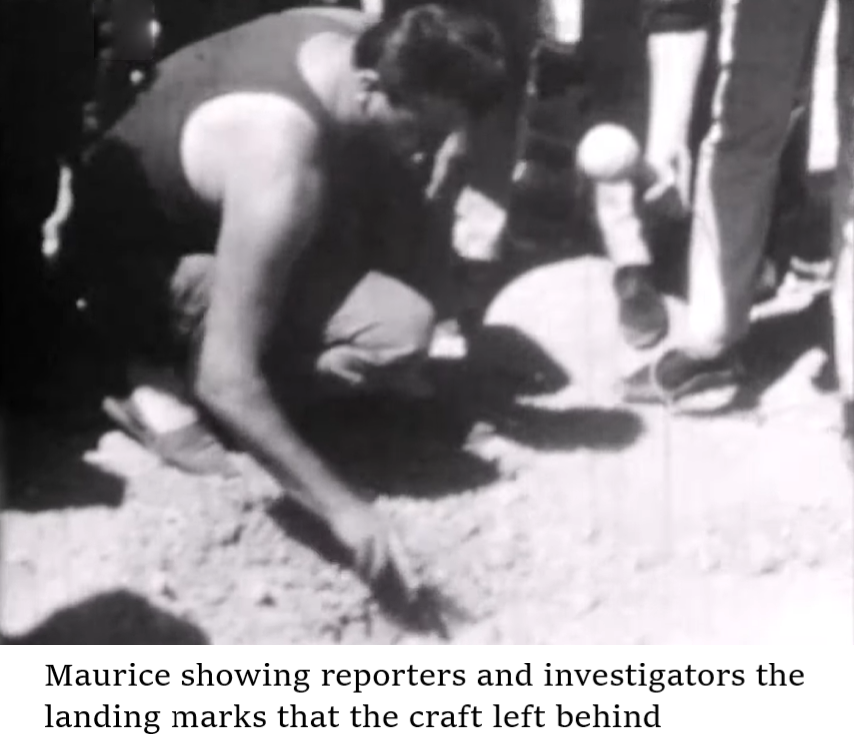
The incident attracted immediate attention from local authorities. Officers from the French Gendarmerie examined the location and documented ground impressions and disturbed soil. These observations formed an important part of the later investigation.
In subsequent years, researchers studied reported physical traces at the site, including soil disturbances and alleged effects on nearby vegetation. Supporters of the case argue that these findings provide evidence that an unusual event occurred. Critics have questioned the interpretation of the reported traces and whether they can be linked conclusively to the object described by Masse.
Because the report involved a named witness, an official investigation, and alleged physical traces, the Valensole Encounter became one of the most frequently cited UFO cases in France. The witness testimony and investigation are well documented. The nature of the reported object and figures remains unresolved.
Witness statement
No statement on file.
Evidence & media
Untitled Photo
Further reading
Continue exploring — Wikipedia, documentaries, podcasts, museum pages. Not treated as proof, and not independently verified by this archive.
Investigation timeline
- 2026-10-01 — Historical file submitted.
- 2026-10-02 — Historical file accepted and published.
Assigned GG-2026-110
Research notes
Historical research: One of Europe's Most Important Close-Encounter Cases
The Valensole Encounter is often compared to cases such as the Socorro landing reported by Lonnie Zamora. Both involve a close-range witness, an alleged landed craft, occupant reports, and physical traces at the scene. Unlike many UFO sightings involving only distant lights, Valensole presented investigators with a named witness, a specific location, and documented ground effects.
The case's greatest strength is the immediacy of the report and the witness's consistency over time. Its greatest weakness is the lack of definitive physical evidence linking the observed traces to an extraordinary craft. Under Gothic.Black standards, the strongest conclusion is that Maurice Masse experienced and reported an unusual event on July 1, 1965. The nature of what he encountered remains unresolved.
Historical research: Judicial Documentation, Witness Reliability, and State Inquiry
From a legal and investigative standpoint, the Valensole inquiry set early standards for how European law enforcement processed physical trace cases.
The Gendarmerie Nationale conducted exhaustive background checks on Maurice Masse. Investigators verified he had no financial debts, no history of psychological instability, no political motivations, and no interest in science fiction or media attention. The initial Gendarmerie report (Procès-Verbal No. 138/1965) concluded that an heavy, unidentified physical apparatus had indeed rested in the field, and that Masse was a completely reliable witness acting in good faith. When GEPAN (France's official government UAP study group) was established in 1977 under CNES, the Valensole case files were re-examined and retained as an unclarified "Category D" (unexplained physical event) case.
Historical research: Selective Neuromuscular Blockade and Microwave/EM-Induced Radiation
From a biophysical perspective, the specific symptoms reported by Masse present a complex neuromuscular paradox:
The targeted paralysis—where voluntary motor function in the skeletal muscles was instantly shut down without affecting autonomic functions (cardiac rhythm, involuntary respiration, ocular movement) or conscious awareness—suggests a highly focused neurological disruption rather than an atmospheric chemical agent. Modern biophysicists evaluating historical CEIII accounts note that high-frequency electromagnetic field exposure (or pulsed microwave radiation) can induce transient peripheral nerve blocking or central motor cortex suppression without inducing thermal tissue damage or unconsciousness. This matches the simultaneous observation of localized soil moisture calcification and botanical cell destruction at the landing site.
Propose evidence & media, a source citation, further reading, a research note, a correction, a related case, or a series link. Staff review before anything is added. An accepted correction does not replace the file by itself.