GG-2026-130
Beast of Bladenboro
- Phenomenon Cryptids & Unknown Zoology, Folklore & Cultural Encounters
- Documentation
Rating B
- A — Strong dossier: several independent sources plus primary evidence (original media, records, measurements) a researcher could use without interviewing anyone.
- B — Well documented: multiple independent witnesses with at least some contemporary primary material, or one witness with substantial primary corroboration (photos, recordings, contemporaneous notes, documents).
- C — Multi-source but soft: several witnesses or a long run of reports, but mostly testimony and after-the-fact secondary sources (newspapers, folklore collections, later interviews). Little or no primary physical evidence. Regional legend clusters such as the Bridgewater Triangle land here.
- D — Thin: single witness (or one household), little or no support beyond the account. Normal for a sincere personal experience.
- E — Incomplete or not yet assessed. Every new submission starts here until staff have read it.
- Evidence & media 2 items
- Status Historic
- Location Bladenboro, North Carolina
- Occurred 29 December 1953
Summary
In late December 1953 and early January 1954, the small rural town of Bladenboro, North Carolina, was gripped by terror following a series of brutal, highly localized dog and livestock killings. Eyewitnesses described a mysterious, sleek, dark creature—frequently likened to a giant panther, a bobcat, or a strange hybrid hound—that made piercing, baby-like shrieks in the night. The panic intensified when local veterinarians and police noted that the victims had been crushed around the neck and allegedly drained of blood. Within days, hundreds of armed hunters, state wildlife officials, and national media converged on the swampy lowlands surrounding the town. Although police eventually ended the hunt after displaying a large shot bobcat to appease the public, the true identity of the predator—and whether the "vampiric" blood-draining claims were anything more than post-mortem pooling—remains a foundational legend in Southern cryptozoology.
Background
The Outbreak of Attacks (December 1953 – January 1954)
The First Strikes: On December 29, 1953, two dogs belonging to local residents were found dead, their skulls crushed and bodies drained of blood. Over the next week, additional dogs and livestock were attacked in similar fashion.
Eyewitness Descriptions: Local resident Clark Kinlaw reported seeing a creature that looked like a "bear or panther, about 4.5 feet long, dark, and sleek." Another resident, Mrs. Luther Elder, reported a large cat-like beast attempting to drag off her dog.
The Screams in the Swamp: Multiple townspeople reported hearing blood-curdling shrieks emanating from the nearby swamps—describing the sound as "like a woman crying" or "a baby screaming," a vocalization often associated with panthers or cougars.
The Mass Hunt and Media Circus
Mobilization: Bladenboro Police Chief Roy Fores took the reports seriously as fear mounted among parents and farmers. By January 6, 1954, over 500 armed men carrying shotguns and hunting dogs flooded the local woods and swamps.
National Attention: Wire services picked up the story, branding the creature the "Vampire Beast of Bladenboro." Mayor Luther Heustess eventually established a curfew and organized armed patrols to manage the hundreds of out-of-town hunters pouring into Bladen County.
The Resolution: On January 16, 1954, a hunter shot a 35-pound bobcat nearby. Police Chief Fores hung the animal in town and declared the threat eliminated to restore order and disperse the crowd, though many locals doubted a single bobcat could crush the skulls of large dogs.
Chronology of the Bladenboro Panic
├── Dec 29, 1953 : First domestic dogs found killed with crushed skulls near Bladenboro.
├── Jan 1–5, 1954: Sighting reports multiply; creature described as a sleek, dark panther/bear hybrid.
├── Jan 6, 1954 : Over 500 armed hunters flood the swamps; national press arrives.
├── Jan 8, 1954 : Mayor Heustess imposes a town curfew; state wildlife agents intervene.
├── Jan 16, 1954 : Large bobcat displayed to end the hunt; panic subsides.
└── 2000s–Pres : Annual "Beast of Bladenboro" festival cements the cryptid into local civic heritage.
Witness statement
No statement on file.
Evidence & media
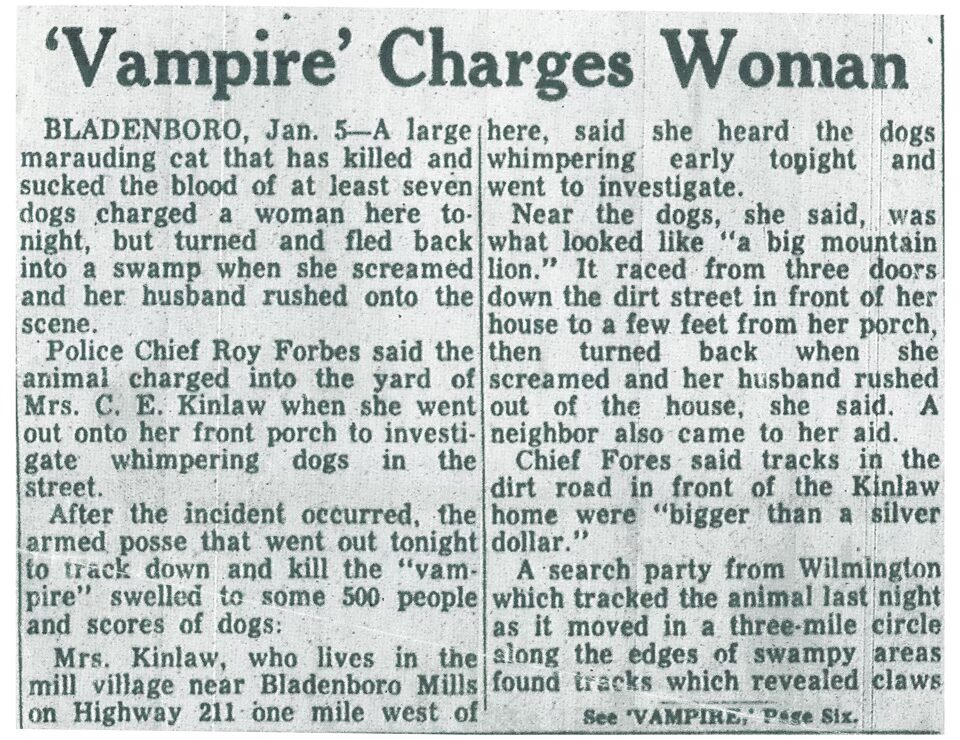 Raleigh News and Observer front-page article, 1954.
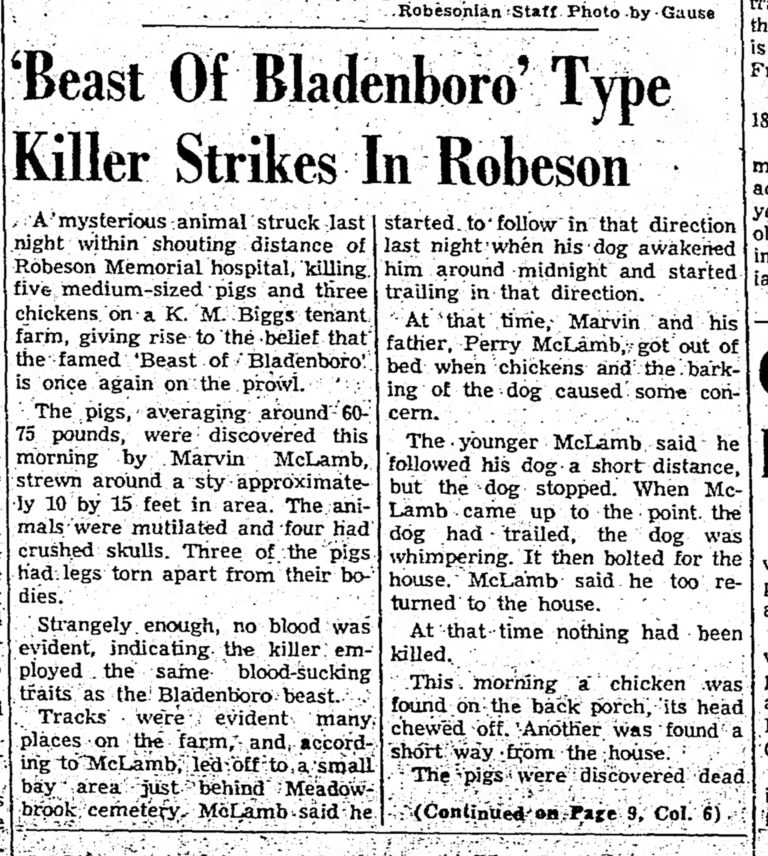 The Robesonian, 15 December 1954.
Investigation timeline
- 2026-10-15 — Historical file submitted.
- 2026-10-16 — Historical file accepted and published.
Research notes
Historical research: Predatory Mechanics, Taphonomy, and Wildlife Candidates
Taphonomy & "Blood Draining" Mythos: Wildlife experts and forensic biologists note that claims of animals being "completely drained of blood" are common in livestock attack reports. When a predator pierces the jugular or carotid artery, internal hemorrhaging combined with post-mortem blood pooling (livor mortis) makes the carcass appear bloodless to non-veterinary observers.
Candidate Species: The physical behavior—crushing the neck/throat to suffocate prey—is classic feline predation. Potential candidates included a rogue cougar (Puma concolor), an abnormally large bobcat, an escaped exotic big cat, or a pack of wild feral dogs (Canis lupus familiaris).
Historical research: The Vampire Beast Template and Mass Hysteria Dynamics
Precursor to the Chupacabra Archetype: Decades before the Chupacabra phenomenon emerged in Puerto Rico, the Beast of Bladenboro established the American template for a "vampiric" livestock predator that triggers localized mass media panics.
Acoustic Priming & Swampland Folklore: The "crying baby" vocalization heavily reinforced the supernatural reputation of the entity. In rural Southern folklore, nocturnal animal calls (such as the female red fox screech or cougar scream) frequently prime isolated communities to interpret normal apex predator activity as an anomalous or demonic entity.
Propose evidence & media, a source citation, further reading, a research note, a related case, or a series link. Staff review before anything is added.