GG-2026-132
Clarenville UFO Incident
- Phenomenon UFOs/UAPs
- Documentation
Rating B
- A — Strong dossier: several independent sources plus primary evidence (original media, records, measurements) a researcher could use without interviewing anyone.
- B — Well documented: multiple independent witnesses with at least some contemporary primary material, or one witness with substantial primary corroboration (photos, recordings, contemporaneous notes, documents).
- C — Multi-source but soft: several witnesses or a long run of reports, but mostly testimony and after-the-fact secondary sources (newspapers, folklore collections, later interviews). Little or no primary physical evidence. Regional legend clusters such as the Bridgewater Triangle land here.
- D — Thin: single witness (or one household), little or no support beyond the account. Normal for a sincere personal experience.
- E — Incomplete or not yet assessed. Every new submission starts here until staff have read it.
- Evidence & media 3 items
- Status Historic
- Location Newfoundland · approximate placement
- Occurred 26 October 1978
Approximate public reference area overlooking Random Sound and Random Island. Witnesses observed the reported object from multiple locations around Clarenville, and no single observation point can be established as the definitive event site.
Activity period
- Earliest claimed event 26 October 1978
- Earliest documented report 26 October 1978
- Latest documented report 26 October 1978
- Pattern Single event
Summary
In the early hours of October 26, 1978, residents of Clarenville, Newfoundland, reported an unusual luminous object visible toward Random Island and Trinity Bay. Local resident Chester Lethbridge contacted the Royal Canadian Mounted Police, and responding constable James Blackwood subsequently observed the phenomenon through binoculars and a telescope. Witnesses described a bright oval or elongated object with colored flashing lights that remained visible for approximately an hour or more. Blackwood later reported attempting to signal the object with vehicle lights and believed its flashing pattern changed in response. The sighting entered RCMP, Department of National Defence, and National Research Council records. No photograph was successfully obtained, and no corresponding radar target was detected at Gander. The National Research Council later proposed bright astronomical objects, particularly Jupiter, as a likely explanation, but the available records do not provide a measured reconstruction conclusively identifying what the witnesses observed.
Background
In the early hours of October 26, 1978, Chester Lethbridge contacted the Royal Canadian Mounted Police in Clarenville, Newfoundland, to report an unusual bright object visible toward Random Island and Trinity Bay. The surviving RCMP material logs the call at approximately 1:45 a.m. and identifies Lethbridge, Lethbridge's spouse, and responding constable James Blackwood among the observers.
Blackwood initially viewed the phenomenon with optical equipment available at the scene and subsequently used a tripod-mounted telescope. Witness descriptions recorded in the official reporting chain characterized the object as a bright white oval or elongated form with a triangular feature and flashing colored lights. Estimates of its range, altitude, size, movement, and duration differed among the surviving RCMP and Department of National Defence records and were visual estimates rather than instrument measurements.
That distinction is important because later retellings often transform the sighting into a precisely observed metallic craft of known dimensions hovering at a measured height above the water. The contemporary documentary record supports a detailed optical observation, but it does not provide measured distance or altitude from which the physical size of the phenomenon can be securely calculated.
The duration of the observation nevertheless made Clarenville unusual among fleeting light reports. The surviving official material describes the phenomenon as visible for roughly an hour or longer, giving the witnesses time to observe it repeatedly through binoculars and a telescope.
James Blackwood later became particularly associated with another part of the story. Blackwood said he flashed vehicle lights toward the phenomenon and interpreted a subsequent change in its flashing pattern as a response. Later interviews preserve a more elaborate version in which the object's lights deliberately mimicked Blackwood's signals. That interpretation remains Blackwood's testimony rather than an independently recorded communication experiment.
Attempts to obtain stronger physical documentation were unsuccessful. A Department of National Defence message states that Blackwood attempted to move closer in order to obtain photographs, but no photograph of the object was successfully taken. The record also states that no nearby aircraft were identified and that Gander radar did not detect a corresponding target.
Those negative findings cut in both directions. The absence of a known aircraft left the witnesses without an immediate aviation identification, but the absence of radar detection also means the case lacks independent sensor confirmation of a physical object at the visually estimated position.
The incident moved through official channels after the sighting. RCMP reporting was followed by Department of National Defence correspondence, while the National Research Council later considered possible astronomical explanations. The NRC's assessment proposed that the October reports most likely involved bright celestial objects, particularly Jupiter, with Saturn and bright stars also present.
That explanation deserves serious consideration without being treated as a demonstrated solution. The NRC assessment identifies known astronomical objects present under the relevant sky conditions, but the surviving record does not contain a measured reconstruction showing that every reported visual characteristic, movement, duration, or flashing-light observation resulted from Jupiter or another specific celestial source.
The Clarenville case therefore benefits from a stronger documentary history than many civilian UFO reports. Named witnesses are preserved in near-contemporary official records, a serving RCMP officer participated in the observation, multiple forms of optical equipment were used, and the incident entered Canadian government reporting channels.
At the same time, later retellings need to remain separate from what those records actually establish. Precise descriptions of a large metallic craft, claims of deliberate intelligent signaling, exact dimensions, and longer witness counts sometimes derive from retrospective accounts rather than measurements made during the event.
The case has remained culturally important in Newfoundland. In 2020, the Royal Canadian Mint issued a collector coin commemorating the Clarenville event, using artwork inspired by the reported sighting. That commemoration documents the event's place in Canadian folklore and UFO history; it is not government confirmation of an extraordinary craft.
Witness statement
No statement on file.
Evidence & media
 Interview of RCMP Constable James Blackwood
Later interview with James Blackwood concerning Blackwood's October 1978 Clarenville sighting. The interview preserves the witness's retrospective account and should be distinguished from the RCMP and Department of National Defence records created closer to the event.
Status: Verified
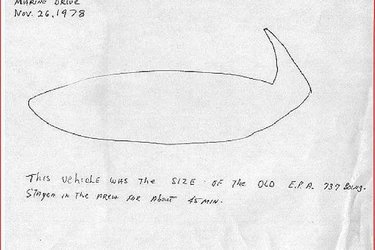
James Blackwood drawing of the reported Clarenville object
Drawing attributed to James Blackwood illustrating the appearance of the object reported during the October 26, 1978 Clarenville sighting. The drawing preserves the witness's visual description and is not a photograph or measured representation of the object's size or distance.
Status: Attributed
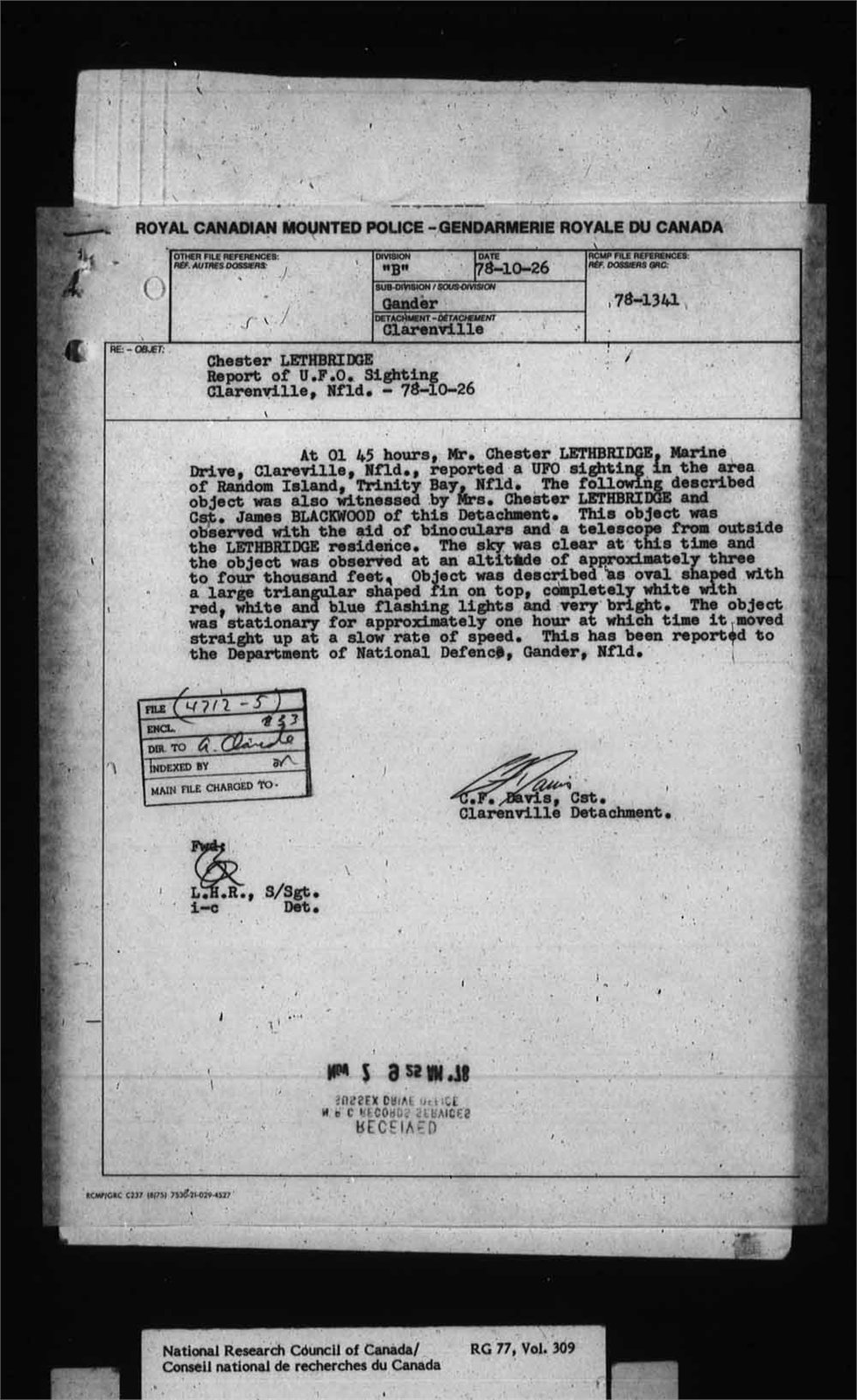
RCMP report on the Clarenville UFO incident
Royal Canadian Mounted Police documentation concerning the October 26, 1978 Clarenville sighting. The report records the official reporting chain, named witnesses, observational details, and subsequent handling of the incident.
Status: Verified
Further reading
Continue exploring — Wikipedia, documentaries, podcasts, museum pages. Not treated as proof, and not independently verified by this archive.
Investigation timeline
- 2026-10-30 — Historical file submitted.
- 2026-10-30 — Research question opened: Are complete RCMP, Department of National Defence, and NRC records for the incident publicly available and fully catalogued?
- 2026-10-30 — Research question opened: Can the reported object be reconciled with astronomical, atmospheric, or aviation sources documented for the area that night?
- 2026-10-30 — Research question opened: How consistent are surviving witness statements when compared to the earliest official reports?
- 2026-10-30 — Historical file accepted and published.
Assigned GG-2026-132
Research notes
No curated research notes.
Open research questions
A specific gap in the file. An accepted source, research note, or further-reading link closes it.
Are complete RCMP, Department of National Defence, and NRC records for the incident publicly available and fully catalogued?
Can the reported object be reconciled with astronomical, atmospheric, or aviation sources documented for the area that night?
How consistent are surviving witness statements when compared to the earliest official reports?
Propose evidence & media, a source citation, further reading, a research note, a correction, a related case, or a series link. Staff review before anything is added. An accepted correction does not replace the file by itself.