GG-2026-134
Falkville Metal Man
- Phenomenon UFOs/UAPs, Folklore & Cultural Encounters
- Documentation
Rating D
- A — Strong dossier: several independent sources plus primary evidence (original media, records, measurements) a researcher could use without interviewing anyone.
- B — Well documented: multiple independent witnesses with at least some contemporary primary material, or one witness with substantial primary corroboration (photos, recordings, contemporaneous notes, documents).
- C — Multi-source but soft: several witnesses or a long run of reports, but mostly testimony and after-the-fact secondary sources (newspapers, folklore collections, later interviews). Little or no primary physical evidence. Regional legend clusters such as the Bridgewater Triangle land here.
- D — Thin: single witness (or one household), little or no support beyond the account. Normal for a sincere personal experience.
- E — Incomplete or not yet assessed. Every new submission starts here until staff have read it.
- Evidence & media 2 items
- Status Historic
- Location Falkville, Morgan County, Alabama · exact location withheld
- Occurred 17 October 1973
This case is associated with private or restricted property. Do not trespass, disturb residents, remove artifacts, or conduct an investigation without explicit permission.
Location withheld because the reported encounter occurred near privately controlled rural property outside Falkville and the precise historical encounter site has not been independently established. The general locality is preserved without publishing a public map point.
Activity period
- Earliest claimed event 17 October 1973
- Earliest documented report 18 October 1973
- Latest documented report November 1973
- Pattern Single event
Summary
On October 17, 1973, Greenhaw, police chief of Falkville, Alabama, reported encountering and photographing an unusual human-shaped figure after responding to a call concerning a supposed UFO outside town. Greenhaw said he found no landed craft but encountered a tall figure covered in intensely reflective material beside a rural road. He took four Polaroid photographs before the figure reportedly fled. The photographs entered newspaper coverage immediately and remain the central evidence associated with the case. They authentically document a brightly reflective humanoid figure but do not reveal clearly non-human anatomy or establish any connection between the figure and a UFO. Later investigators proposed that the encounter involved a person in reflective protective clothing or a deliberately constructed costume, while claims that someone later confessed to staging the incident remain incompletely documented.
Background
On the night of October 17, 1973, Greenhaw, then police chief of Falkville, Alabama, said he received a telephone call reporting a strange object or UFO outside town. Accounts differ over whether the caller was anonymous or known to Greenhaw, and no surviving dispatch recording or independent statement from the caller has been located in the source record reviewed here.
Greenhaw took a Polaroid camera and drove into the rural area described by the caller. He did not find a landed spacecraft. Instead, Greenhaw said he encountered a human-shaped figure standing near a road or field.
Greenhaw described the figure as slightly over six feet tall and covered from head to foot in material that reflected light exceptionally strongly. He compared its appearance with polished metal and said the head and neck appeared almost joined together. The figure reportedly did not respond when Greenhaw attempted to speak to it.
Greenhaw photographed the figure four times with the Polaroid camera. The surviving reproductions show a roughly human-shaped form covered in highly reflective, wrinkled material. The photographs are among the unusual strengths of the Falkville case because they were reportedly taken during the encounter itself rather than produced later from memory.
Their evidentiary value nevertheless has limits. The photographs do not preserve clearly identifiable non-human facial features, anatomy, or technology. The visible figure can be interpreted as a person wearing highly reflective clothing or a constructed suit, and the photographs themselves cannot establish who or what was inside the reflective covering.
Greenhaw said the figure eventually moved away and that he followed in the patrol vehicle. Later accounts describe the figure moving with an unusual stiff or mechanical gait and traveling faster than expected for a person on foot. Those claims depend upon Greenhaw's testimony rather than an independent measurement or second witness.
The encounter entered the public record almost immediately. The Decatur Daily published the story on October 18, 1973, under the headline“Howdy Says Policeman to UFO Creature,” followed by additional Alabama newspaper coverage. The four photographs were subsequently reproduced in newspapers and UFO publications.
That contemporary press coverage gives Falkville a stronger documentary history than a sighting reconstructed decades later. It demonstrates that Greenhaw was publicly making the account immediately after the event and that the photographs were already associated with the story. It does not independently confirm Greenhaw's interpretation of the figure or the extraordinary movements later attributed to it.
A conventional explanation emerged quickly and has remained central to skeptical assessments of the case: the photographed figure resembles a person wearing reflective fire-protective clothing or another improvised metallic-looking costume. Even NICAP's current case page concludes that the incident was most likely a hoax, although it allows that Greenhaw himself may have been the target rather than a participant.
Later investigators also repeated a claim that an individual had confessed to staging the encounter. That allegation would be highly significant if the original statement could be located and authenticated. The publicly available source chain reviewed here does not contain the underlying confession or enough documentation to treat the claim as independently established.
The history of the original Polaroids introduces another archival problem. Conflicting later accounts describe the photographs as either lost during a fire or stolen years afterward. Surviving reproductions derive from press and research copies made while the originals were still available, leaving the images themselves historically genuine case artifacts while limiting the ability of modern researchers to conduct fresh analysis from the original film.
The reported UFO that supposedly initiated the encounter is more poorly documented still. Greenhaw reported finding no spacecraft, and the unidentified caller's original testimony has not been independently recovered. The UFO report and the photographed figure therefore should not automatically be treated as two independently established parts of one event.
The Falkville Metal Man is consequently best described as a well-preserved single-witness encounter with genuine photographic artifacts but weak independent corroboration of the extraordinary interpretation. Greenhaw unquestionably reported the experience, four photographs of a reflective humanoid figure entered contemporary circulation, and newspapers covered the incident immediately.
Witness statement
No statement on file.
Evidence & media
 Chief of Police Jeff Greenhaw talks about his 1973 encounter with the Falkville Metal Man.
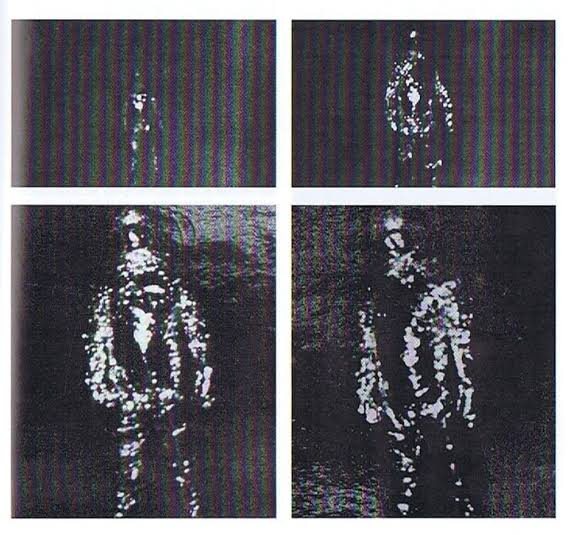
Jeff Greenhaw's four Falkville Metal Man photographs
Reproductions of the four Polaroid photographs attributed to Greenhaw and associated with the October 17, 1973 Falkville encounter. The images show a brightly reflective human-shaped figure photographed at night. They document the appearance of the figure before the camera but do not independently establish its identity or any connection with the reported UFO call.
Status: Verified
Further reading
Continue exploring — Wikipedia, documentaries, podcasts, museum pages. Not treated as proof, and not independently verified by this archive.
Investigation timeline
- 2026-10-30 — Historical file submitted.
- 2026-10-30 — Research question opened: Are original newspaper negatives or first-generation reproductions of the four Polaroids still preserved in any archive?
- 2026-10-30 — Research question opened: Is there verifiable documentation supporting later claims that an individual confessed to staging the encounter?
- 2026-10-30 — Research question opened: Can the original dispatch call that sent Jeff Greenhaw to the scene be independently verified through surviving records?
- 2026-10-30 — Historical file accepted and published.
Assigned GG-2026-134
- 2026-11-03 — Location precision revised from Approximate to Withheld.
Research notes
No curated research notes.
Open research questions
A specific gap in the file. An accepted source, research note, or further-reading link closes it.
Are original newspaper negatives or first-generation reproductions of the four Polaroids still preserved in any archive?
Is there verifiable documentation supporting later claims that an individual confessed to staging the encounter?
Can the original dispatch call that sent Jeff Greenhaw to the scene be independently verified through surviving records?
Were aluminized heat-protective suits or similar reflective garments available to fire, industrial, aviation, or other organizations in the Falkville area in 1973, and can any such equipment be connected to people associated with the encounter?
Propose evidence & media, a source citation, further reading, a research note, a correction, a related case, or a series link. Staff review before anything is added. An accepted correction does not replace the file by itself.