GG-2026-141
Shipton Footprint Photograph
- Phenomenon Cryptids & Unknown Zoology, Folklore & Cultural Encounters
- Documentation
Rating A
- A — Strong dossier: several independent sources plus primary evidence (original media, records, measurements) a researcher could use without interviewing anyone.
- B — Well documented: multiple independent witnesses with at least some contemporary primary material, or one witness with substantial primary corroboration (photos, recordings, contemporaneous notes, documents).
- C — Multi-source but soft: several witnesses or a long run of reports, but mostly testimony and after-the-fact secondary sources (newspapers, folklore collections, later interviews). Little or no primary physical evidence. Regional legend clusters such as the Bridgewater Triangle land here.
- D — Thin: single witness (or one household), little or no support beyond the account. Normal for a sincere personal experience.
- E — Incomplete or not yet assessed. Every new submission starts here until staff have read it.
- Evidence & media 4 items
- Status Historic
- Location Menlung Glacier, Nepal-Tibet · approximate placement
- Occurred 8 November 1951
The footprint photograph was taken during the 1951 Everest Reconnaissance Expedition near the Menlung Glacier in the Nepal-Tibet border region west of Mount Everest. The precise location of the photographed track is not documented with modern GPS coordinates; the map marker represents the general area associated with the discovery.
Activity period
- Earliest claimed event 8 November 1951
- Earliest documented report 8 November 1951
- Latest documented report 8 November 1951
- Pattern Single event
Summary
The Shipton Footprint Photograph is one of the most famous pieces of alleged Yeti evidence ever recorded. During the 1951 Mount Everest Reconnaissance Expedition, mountaineer Eric Shipton photographed a series of unusual footprints discovered by Michael Ward on the Menlung Glacier. The resulting image, showing a large footprint beside an ice axe or boot for scale, became internationally famous and remains one of the most recognizable photographs associated with the Yeti.
Background
The photograph was taken by Eric Shipton during the 1951 Everest Reconnaissance Expedition. The footprint itself was reportedly discovered by Michael Ward at the Menlung Glacier near Everest. The image showed an unusually shaped footprint in snow and quickly became central to discussions about the Yeti, also known as the Abominable Snowman.
Publication of the image in newspapers and magazines during the early 1950s transformed the Yeti from a regional Himalayan legend into an international cryptozoological mystery. The photograph became one of the most widely reproduced images in cryptid history.
Interpretation and Legacy
The Shipton photograph is notable because it is:
1. A genuine historical photograph
2. Taken by a respected mountaineer
3. Associated with a documented expedition
4. One of the best-known pieces of Yeti evidence
However, the photograph does not establish the source of the footprint. Proposed explanations have included:
Unknown animal tracks
Snow-distorted bear tracks
Multiple overlapping footprints
Melting and enlargement effects in snow
Modern researchers generally favor prosaic explanations, including snow-distorted bear tracks, overlapping animal tracks, or natural enlargement through melting and refreezing. However, no definitive explanation for the specific footprint photographed by Eric Shipton has been established.
Witness statement
No statement on file.
Evidence & media
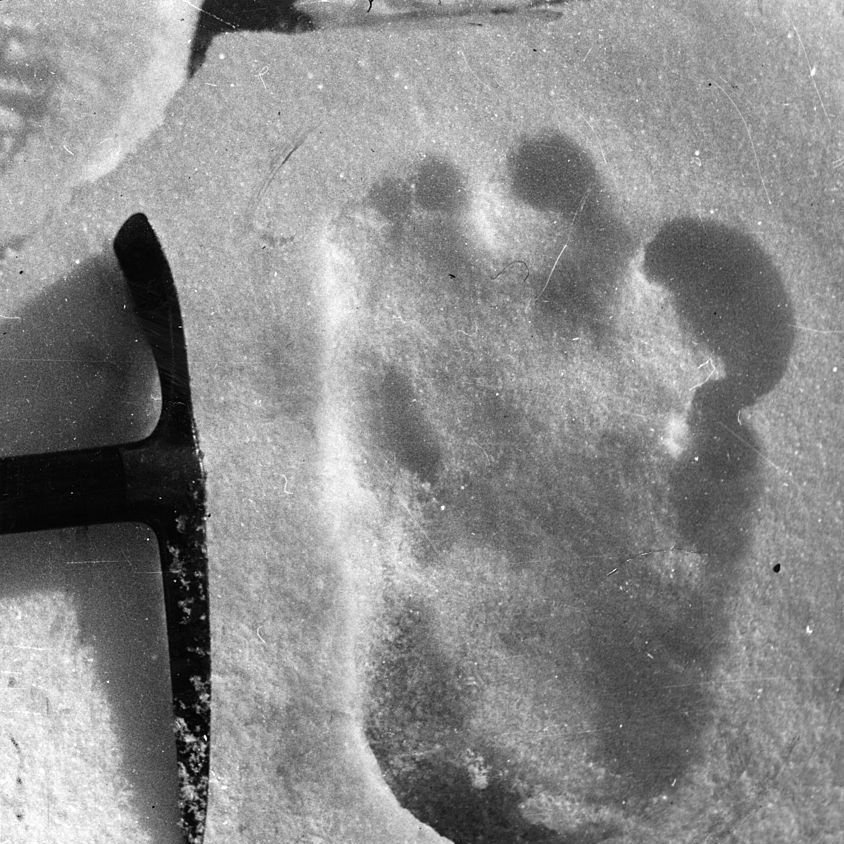
Photograph of an alleged Yeti footprint discovered during the 1951 Everest Reconnaissance Expedition. The image was taken by Eric Shipton near the Menlung Glacier with an ice axe positioned for scale.
Status: Verified
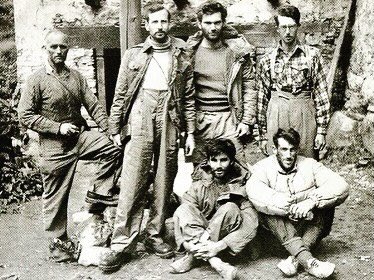
The 1951 Everest Reconnaissance team.
(standing: Eric Shipton (left), W. H. Murray, Dr Michael Ward, Edmund Hillary. Seated: T.D. Bourdillon (left) and H.E. Riddiford)
Status: Verified
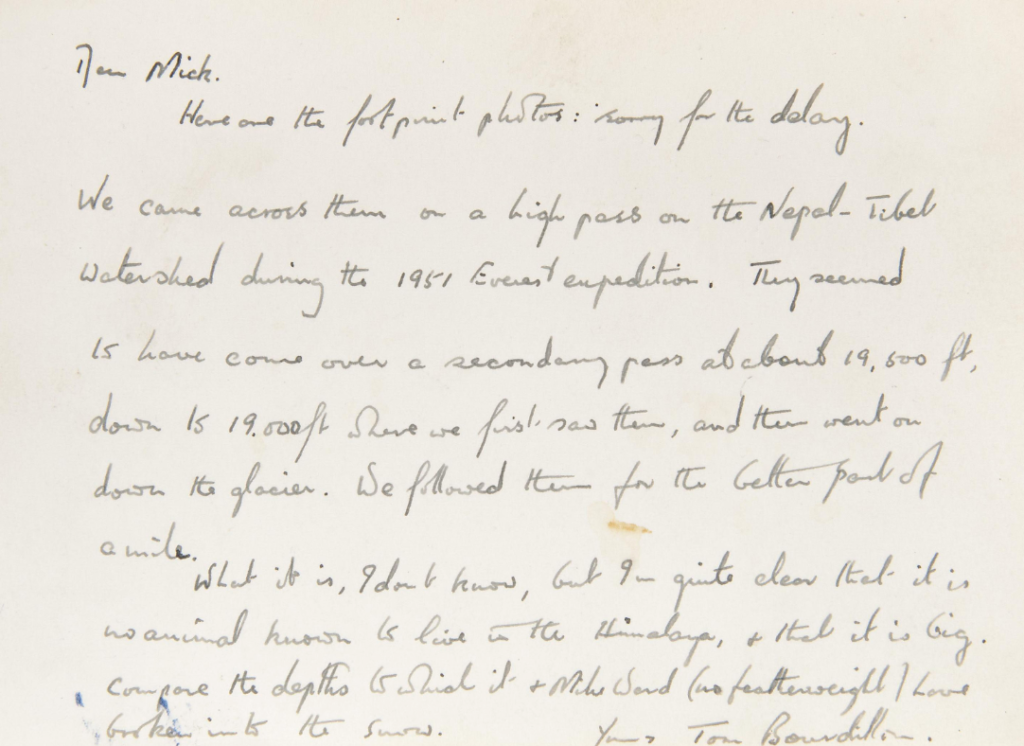
Letter from Tom Bourdillon to Michael John Davies, c. 1950s
Letter from T. D. Bourdillon discussing the 1951 footprint discovery. In the correspondence, Bourdillon states that the tracks were followed for nearly a mile and did not appear to belong to any known Himalayan animal.
Status: Verified
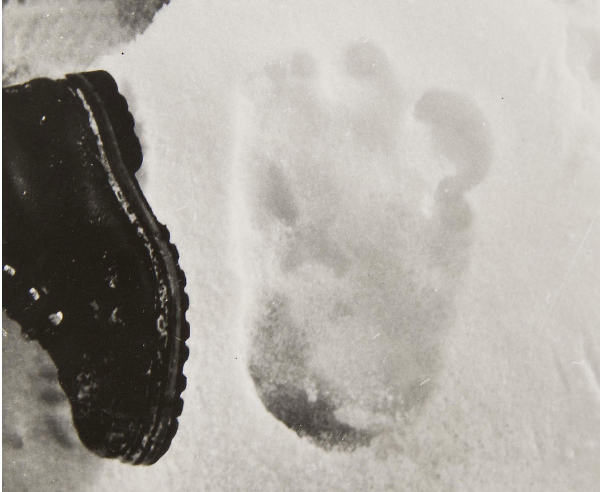
Comparison photograph showing a mountaineering boot positioned beside the alleged Yeti footprint photographed by Eric Shipton in 1951.
Status: Verified
Investigation timeline
- 2026-11-01 — Historical file submitted.
- 2026-11-01 — Historical file accepted and published.
Research notes
No curated research notes.
Propose evidence & media, a source citation, further reading, a research note, a correction, a related case, or a series link. Staff review before anything is added. An accepted correction does not replace the file by itself.