GG-2026-143
Sauchie Poltergeist
- Phenomenon Physical & Poltergeist Activity, Auditory & Acoustic Events
- Documentation
Rating B
- A — Strong dossier: several independent sources plus primary evidence (original media, records, measurements) a researcher could use without interviewing anyone.
- B — Well documented: multiple independent witnesses with at least some contemporary primary material, or one witness with substantial primary corroboration (photos, recordings, contemporaneous notes, documents).
- C — Multi-source but soft: several witnesses or a long run of reports, but mostly testimony and after-the-fact secondary sources (newspapers, folklore collections, later interviews). Little or no primary physical evidence. Regional legend clusters such as the Bridgewater Triangle land here.
- D — Thin: single witness (or one household), little or no support beyond the account. Normal for a sincere personal experience.
- E — Incomplete or not yet assessed. Every new submission starts here until staff have read it.
- Evidence & media 3 items
- Status Historic
- Location Sauchie, Scotland · exact location withheld
- Occurred 22 November 1960
This case is associated with private or restricted property. Do not trespass, disturb residents, remove artifacts, or conduct an investigation without explicit permission.
Activity period
- Earliest claimed event 22 November 1960
- Earliest documented report December 1960
- Latest documented report 2 December 1960
- Pattern Historic wave
Summary
Between November 22 and December 2, 1960, a household in Sauchie, Clackmannanshire, Scotland, became the focus of a short but unusually well-documented series of poltergeist reports centered on 11-year-old Virginia Campbell. Family members and outside witnesses described persistent knocking sounds, moving furniture, disturbed bedding, and household objects apparently moving without visible cause. Contemporary newspaper coverage documented the case while it was unfolding, and psychical researcher A. R. G. Owen investigated soon afterward, interviewing family members as well as clergy, physicians, and Virginia's teacher who reported witnessing portions of the activity. The testimony gives the case an unusually strong historical record for a household poltergeist report, but no surviving physical or instrumental evidence independently establishes a paranormal cause.
Background
The Sauchie Poltergeist began in late November 1960 in Sauchie, Clackmannanshire. Eleven-year-old Virginia Campbell had recently come from Ireland and was staying with family in Scotland. According to the later case reconstruction, the first disturbances occurred on the evening of November 22, when Virginia and a young cousin sharing a bedroom began hearing repeated noises resembling a ball bouncing or striking a wall. The sounds reportedly followed them into other parts of the house and stopped after Virginia fell asleep.
Reports expanded over the following days. Family members described scratching and knocking sounds, objects changing location, bedding and pillows being disturbed, and furniture apparently moving without anyone visibly responsible. One incident described by A. R. G. Owen involved a sideboard moving several inches away from a wall and then moving back while family members watched.
The repeated association between the activity and Virginia Campbell became one of the case's most distinctive features. Owen's later reconstruction noted that the phenomena repeatedly stopped when Virginia fell asleep. This pattern contributed to later discussion of Sauchie as a possible example of a person-centered poltergeist rather than a haunting associated independently with the house itself.
Word of the disturbances spread quickly through the community. Contemporary newspaper coverage shows that the case had become public by December 1, 1960. A Daily Record report described Virginia as the focus of unexplained knocking and furniture movement while also recording the family's concern about sensational rumors that were already developing around the story.
That contemporary report is particularly useful because it demonstrates how quickly the story began accumulating exaggeration. A local doctor quoted in the article rejected dramatic rumors involving floating furniture and apparitions while acknowledging that some reported manifestations still required explanation. The distinction is important: skepticism about exaggerated versions of the story existed while the case was still unfolding and was not invented decades later by debunkers.
The case also attracted several outside witnesses whose testimony later became central to its reputation. Psychical researcher A. R. G. Owen investigated soon afterward and interviewed Virginia and family members together with five professional witnesses: Rev. T. W. Lund, Dr. W. H. Nisbit, Dr. William Logan, Dr. Sheila Logan, and Virginia's teacher Margaret Stewart. These witnesses reported observing or hearing portions of the disturbances themselves rather than merely repeating the family's account.
Their involvement makes Sauchie better documented than many household haunting stories. Multiple people outside the immediate household were associated with reported incidents, and contemporary press coverage survives alongside Owen's later investigation. That material provides substantial evidence that unusual events were sincerely reported and witnessed.
It does not, however, establish their cause.
Moving furniture, unexplained noises, disturbed bedding, and displaced household objects were described primarily through witness testimony. No surviving photograph, measurement, audio recording, or physical artifact independently demonstrates that these effects occurred through paranormal means.
The intense public attention also complicated the situation. Contemporary newspaper reporting describes the effect that publicity and local rumors were having on Virginia Campbell, while school discussion surrounding the case became sufficiently disruptive that adults attempted to limit it.
This social environment matters when evaluating the later narrative. Public expectation, repeated questioning, press attention, family concern, and community rumor can influence how ambiguous events are interpreted without requiring that witnesses consciously fabricate their experiences.
The concentrated disturbances reportedly ended in early December. The Psi Encyclopedia reconstruction places the principal activity between November 22 and December 2, 1960, making Sauchie a short and bounded historical outbreak rather than a phenomenon demonstrably recurring across decades.
Later paranormal literature kept the story alive and sometimes connected subsequent local reports with the original case. Those later traditions belong to Sauchie's cultural history but should not automatically extend the Activity Period of the 1960 Campbell-family outbreak.
The Sauchie Poltergeist is therefore best understood as a well-documented historic poltergeist wave with substantial testimonial evidence but limited physical corroboration. Family members, neighbors, clergy, physicians, and a teacher supplied accounts, while contemporary newspaper coverage demonstrates that the disturbances had become a public controversy almost immediately.
What that record establishes most securely is that multiple people reported and investigated unusual disturbances centered on Virginia Campbell. It does not establish that those disturbances were produced by recurrent spontaneous psychokinesis, a spirit, or any other paranormal mechanism.
Witness statement
No statement on file.
Evidence & media
 Scotland's Ultimate Poltergeist Case?
Status: Verified
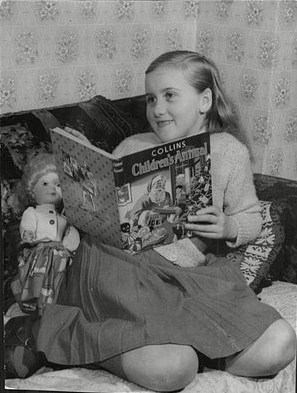
Virginia Campbell, aged 11
Status: Verified
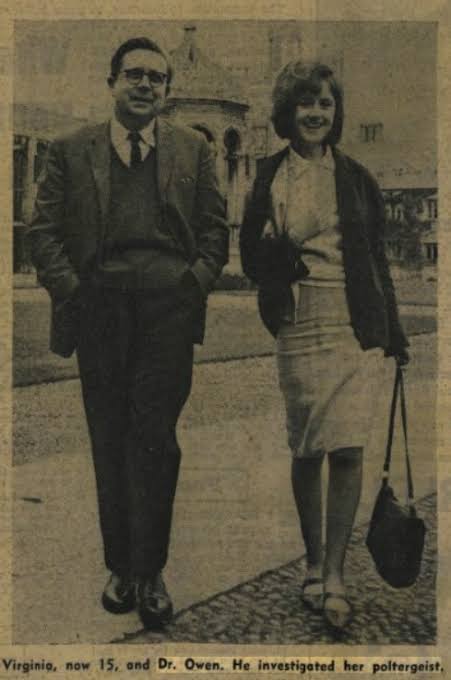
June 1965 Sunday Mirror of Dr. A.R.G. Owen and Virginia Campbell (aged 15)
Status: Verified
Investigation timeline
- 2026-11-02 — Historical file submitted.
- 2026-11-02 — Research question opened: Were all reported disturbances independently witnessed?
- 2026-11-02 — Research question opened: How much of the surviving narrative derives from contemporary reporting versus later retellings?
- 2026-11-02 — Research question opened: Do any original witness statements, photographs, or recordings remain accessible?
- 2026-11-02 — Historical file accepted and published.
Research notes
No curated research notes.
Open research questions
A specific gap in the file. An accepted source, research note, or further-reading link closes it.
Were all reported disturbances independently witnessed?
How much of the surviving narrative derives from contemporary reporting versus later retellings?
Do any original witness statements, photographs, or recordings remain accessible?
Propose evidence & media, a source citation, further reading, a research note, a correction, a related case, or a series link. Staff review before anything is added. An accepted correction does not replace the file by itself.