GG-2026-145
Ilkley Moor Alien Photograph
- Phenomenon UFOs/UAPs
- Documentation
Rating D
- A — Strong dossier: several independent sources plus primary evidence (original media, records, measurements) a researcher could use without interviewing anyone.
- B — Well documented: multiple independent witnesses with at least some contemporary primary material, or one witness with substantial primary corroboration (photos, recordings, contemporaneous notes, documents).
- C — Multi-source but soft: several witnesses or a long run of reports, but mostly testimony and after-the-fact secondary sources (newspapers, folklore collections, later interviews). Little or no primary physical evidence. Regional legend clusters such as the Bridgewater Triangle land here.
- D — Thin: single witness (or one household), little or no support beyond the account. Normal for a sincere personal experience.
- E — Incomplete or not yet assessed. Every new submission starts here until staff have read it.
- Evidence & media 4 items
- Status Historic
- Location Ilkley Moor, England · approximate placement
- Occurred 1 December 1987
The photograph was reportedly taken on Ilkley Moor near Ilkley, West Yorkshire, during heavy fog on the morning of December 1, 1987. The precise location of the encounter has never been publicly established.
Activity period
- Earliest claimed event 1 December 1987
- Earliest documented report 1 December 1987
- Latest documented report 1 December 1987
- Pattern Single event
Summary
On December 1, 1987, a person identified publicly by the pseudonym Philip Spencer reported encountering a small, unusual figure while walking across Ilkley Moor in West Yorkshire, England. Spencer photographed the figure shortly before it reportedly disappeared into the fog and later claimed to have seen an unidentified craft rise from the moor. Spencer also reported arriving at a destination substantially later than expected and finding that the compass carried during the walk behaved abnormally. UFO investigators subsequently examined the photograph and interviewed Spencer, while skeptical interpretations proposed that the indistinct figure could depict an ordinary person, a cut-out, or another conventional subject. A more elaborate abduction narrative emerged later under hypnosis. The surviving photograph is authentic as an image associated with Spencer's account, but its limited detail does not establish what the photographed figure actually was.
Background
On the morning of December 1, 1987, a person later publicly identified by the pseudonym Philip Spencer was walking across Ilkley Moor in West Yorkshire. Spencer had brought a camera and a compass while crossing the moor in foggy conditions. According to the account later published by investigators, Spencer noticed an unusual figure ahead on the path.
Spencer described the figure as small, with an unusually large head and long, thin limbs. Spencer said the figure appeared to gesture before Spencer took a single photograph. The figure then moved away and disappeared into the fog.
The photograph became the central physical artifact associated with the case. It shows a distant dark figure against the moorland landscape, but the image contains too little detail to identify the subject reliably. Conventional interpretations have included an ordinary person or a deliberately positioned cut-out, while UFO researchers have argued that the figure's proportions appeared unusual. The photograph itself cannot establish the subject's height or distance from the camera without independently verified information about precisely where the subject stood.
Spencer said the encounter did not end with the photograph. After following the figure through the fog, Spencer reported seeing a whitish unidentified craft rise from the moor and disappear into the sky. No photograph of that reported craft was obtained.
Spencer later reported another unusual element: a substantial discrepancy between the amount of time expected for the journey and the time actually shown on arrival. Spencer also said the compass carried across the moor appeared to point incorrectly. These details subsequently became important to investigators, but they depend upon Spencer's account rather than an independently preserved instrument record.
In the days following the reported incident, Spencer contacted UFO investigators Jenny Randles and Peter Hough. Their investigation and later publication became the principal route through which the case entered UFO literature. This creates an important evidentiary distinction: much of what is known about Ilkley Moor comes through the investigators' presentation of one witness's experience rather than through contemporary police, military, medical, or independent eyewitness records.
Various analyses of the photograph have subsequently been reported. Supporters have argued that examination showed the photographed figure was present in the original image rather than being added later. Even if accepted, that conclusion addresses photographic manipulation rather than the identity of the subject. A genuine photograph of an unidentified figure is not, by itself, evidence that the figure was non-human.
This distinction is especially important because a more elaborate account developed later. Several months after the original report, hypnosis was used in an attempt to explore Spencer's reported period of missing time. The resulting narrative introduced a claimed abduction experience and additional details that were not part of the immediate photographic record. Hypnotically recovered material should therefore be kept separate from what Spencer consciously reported closer to the alleged encounter.
The surviving evidence also has significant archival limitations. A recent source-led review notes that the original negative and complete laboratory analysis report are not publicly available. That restricts the ability of later researchers to repeat earlier photographic analyses or independently evaluate precisely what testing was performed.
The Ilkley Moor case is therefore narrower than later “alien abduction” descriptions sometimes suggest. One witness reported seeing and photographing an unusual figure, later reported seeing an unidentified craft, and described unexplained missing time and compass behavior. A photograph associated with the account survives, but its subject cannot be identified from the available image.
Witness statement
No statement on file.
Evidence & media
 Ilkley Moor 1987: Kodak Confirmed This Photo Was Not Faked
Modern video discussing the Ilkley Moor photograph and reported historical analysis of the image. The video's title reflects the creator's characterization of that analysis; Gothic.Black has not independently verified the complete original laboratory report or the identity of the photographed figure.
Status: Verified
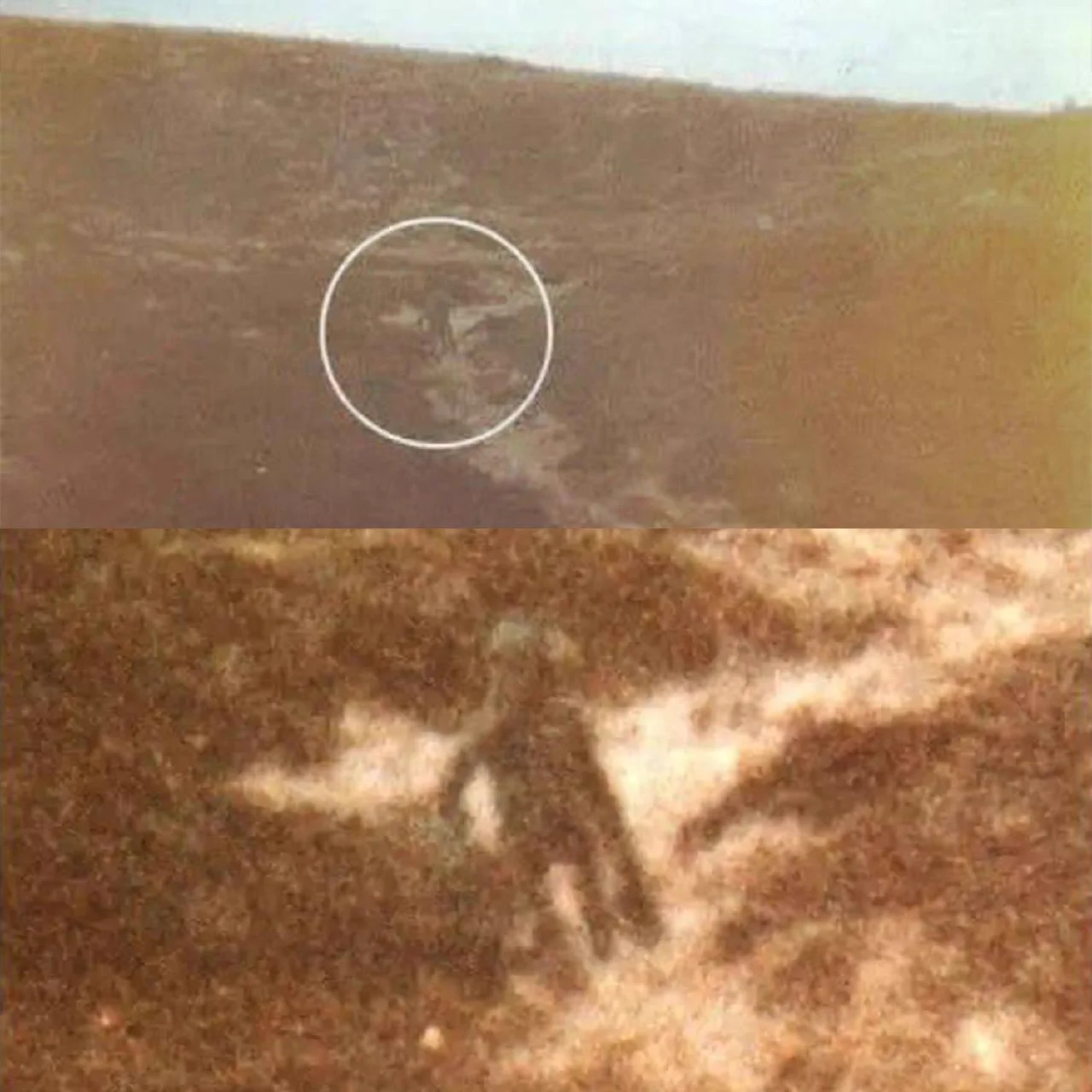
The photograph taken by Philip Spencer on Ilkley Moor on December 1, 1987.
Reproduction of the photograph attributed to “Philip Spencer” and associated with the reported December 1, 1987 Ilkley Moor encounter. The image shows a distant dark figure on the moor but contains insufficient detail to identify the subject or determine its size from the photograph alone.
Status: Attributed
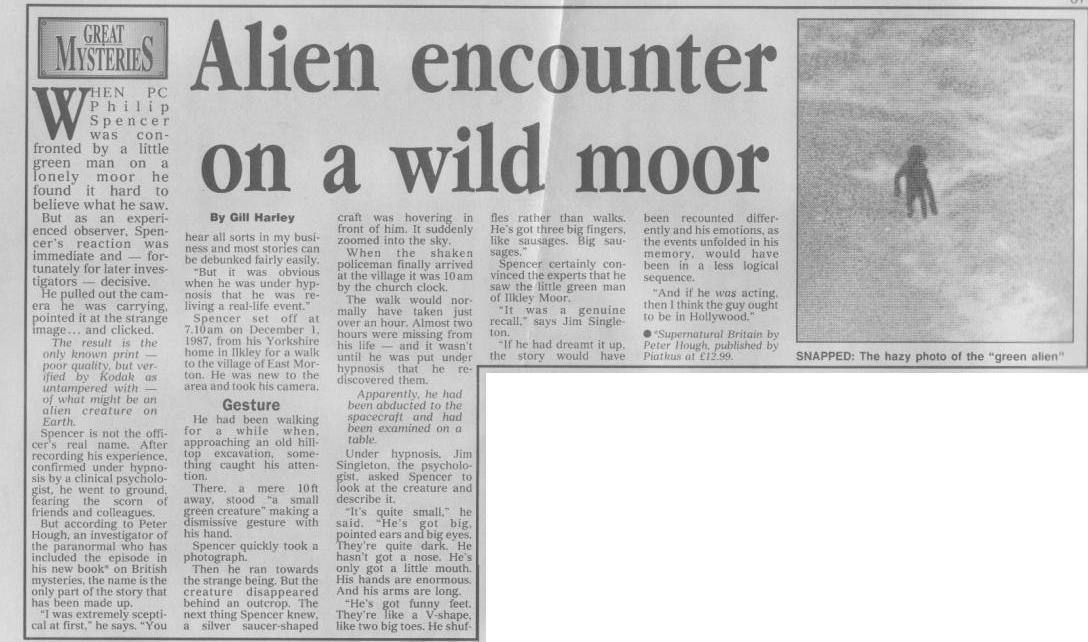
Press coverage of the Ilkley Moor Alien Photograph.
Illustrating how the image and Spencer's account became one of Britain's most discussed UFO cases during the late twentieth century.
Status: Attributed
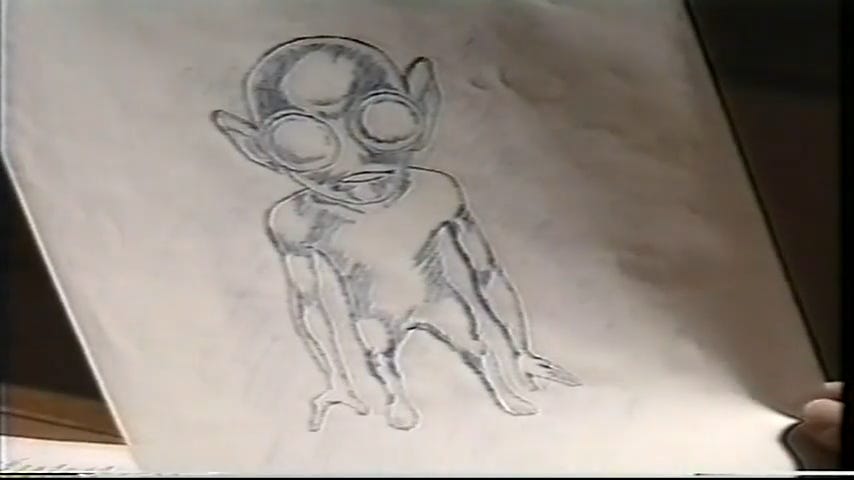
Philip Spencer’s Ilkley Moor Entity Sketch (1987)
Former police officer Philip Spencer displays his original hand-drawn sketch of the small humanoid entity encountered during the December 1, 1987, Ilkley Moor sighting in West Yorkshire, England.
Status: Attributed
Investigation timeline
- 2026-11-03 — Historical file submitted.
- 2026-11-03 — Research question opened: Can the figure's height or distance be reliably determined?
- 2026-11-03 — Research question opened: Are the compass anomalies independently documented?
- 2026-11-03 — Research question opened: What exactly is depicted in the photograph?
- 2026-11-03 — Historical file accepted and published.
Research notes
No curated research notes.
Open research questions
A specific gap in the file. An accepted source, research note, or further-reading link closes it.
Can the figure's height or distance be reliably determined?
Are the compass anomalies independently documented?
Can the figure in the Ilkley Moor photograph be identified or constrained using the original negative, verified camera data, terrain measurements, or contemporary photographic analysis?
Propose evidence & media, a source citation, further reading, a research note, a correction, a related case, or a series link. Staff review before anything is added. An accepted correction does not replace the file by itself.