GG-2026-149
Utsuro-bune
- Phenomenon Folklore & Cultural Encounters
- Documentation
Rating C
- A — Strong dossier: several independent sources plus primary evidence (original media, records, measurements) a researcher could use without interviewing anyone.
- B — Well documented: multiple independent witnesses with at least some contemporary primary material, or one witness with substantial primary corroboration (photos, recordings, contemporaneous notes, documents).
- C — Multi-source but soft: several witnesses or a long run of reports, but mostly testimony and after-the-fact secondary sources (newspapers, folklore collections, later interviews). Little or no primary physical evidence. Regional legend clusters such as the Bridgewater Triangle land here.
- D — Thin: single witness (or one household), little or no support beyond the account. Normal for a sincere personal experience.
- E — Incomplete or not yet assessed. Every new submission starts here until staff have read it.
- Evidence & media 4 items
- Status Historic
- Location Hitachi Province, Japan · regional placement
- Occurred 1803
The surviving Edo-period accounts place the alleged event somewhere on the coast of Hitachi Province, in modern Ibaraki Prefecture. Historical texts do not preserve a universally accepted modern event location, so Gothic.Black does not display a precise public map point.
This file is placed as a region or body of water, not a single exact event location.
Activity period
- Earliest claimed event 1803
- Earliest documented report Circa 1815
- Latest documented report Circa 1815
- Pattern Single event
Summary
The Utsuro-bune, or “hollow ship,” is an Edo-period Japanese story describing a strange vessel said to have drifted ashore in Hitachi Province in 1803. According to versions recorded in several nineteenth-century texts, local fishermen encountered a round or bowl-like vessel constructed from unfamiliar combinations of wood, metal, and transparent panels. Inside was a young foreign-looking woman who spoke an unknown language and closely guarded a box that she would not allow others to touch. The vessel was also described as containing unfamiliar writing or symbols. Unable to communicate with the passenger, the people in the story eventually returned the woman and vessel to the sea. Multiple Edo-period texts and illustrations preserve variations of the tale, making Utsuro-bune unusually well documented as historical folklore. They do not, however, provide contemporary physical or administrative evidence establishing that the alleged 1803 encounter occurred exactly as later recorded. Modern UFO interpretations are therefore later readings of an older Japanese maritime and folkloric tradition rather than an identification supported by the original sources.
Background
The story now known as Utsuro-bune, literally “hollow ship” or “hollow boat,” appears in multiple Japanese texts from the late Edo period. The accounts describe an event supposedly occurring in 1803 on the coast of Hitachi Province, part of present-day Ibaraki Prefecture. Although modern versions often give a precise February date and specific beach, researcher Tanaka Kazuo has emphasized that the surviving documents differ in their dates and other details. The exact historical setting should therefore be treated as part of the tradition rather than as a completely settled event record.
Among the surviving sources are Ōshuku zakki, generally dated to around 1815; Tōen shōsetsu, compiled in 1825 by the literary circle associated with Kyokutei Bakin; and later works including Hyōryū kishū and Ume-no-chiri. The Public Domain Review notes that versions of the Utsuro-bune narrative appear in at least twelve late-Edo literary sources, several accompanied by striking illustrations of the vessel and its passenger.
The central narrative is broadly recognizable across versions even though individual details differ. Fishermen encounter an unfamiliar vessel drifting near the coast and bring it ashore. The object is described as round or bowl-like, and some versions compare its shape with an incense burner or covered vessel. Its construction combines materials that the storytellers regarded as unusual, including wood, metal plating, and transparent windows or panels.
Inside is an unfamiliar young woman. Accounts describe an appearance, hairstyle, clothing, and language that set the woman apart from the local population. Communication proves impossible. The passenger also keeps possession of a box or container and refuses to allow the people around her to handle it. Illustrations accompanying some versions depict unfamiliar marks or writing associated with the vessel.
The mysterious box generated speculation within the story tradition itself. In Tōen shōsetsu, people discussing the incident propose a distinctly earthly explanation: the passenger might have been a foreign noblewoman or princess punished and sent away after a scandal, with the guarded box possibly containing something connected with that history. Rather than resolving her identity, these speculations demonstrate that the Edo-period storytellers themselves were trying to interpret an unfamiliar foreign visitor within recognizable narrative conventions.
The story ends without an investigation capable of identifying either woman or vessel. The people in the account return the passenger and the hollow ship to the sea, after which she disappears from the narrative.
That ending is one reason Utsuro-bune must be approached primarily through source history rather than physical evidence. No surviving craft, artifact, passenger record, official contemporary investigation, or independently preserved witness statement is presently available to test the story. What survives is a collection of literary records written after the alleged event.
Those records are nevertheless valuable because Utsuro-bune is not simply a twentieth-century flying-saucer story retroactively placed in old Japan. The nineteenth-century texts and illustrations genuinely predate the modern UFO era. What came later was the interpretation that their rounded vessel resembles the twentieth-century conception of a flying saucer. Tanaka Kazuo was drawn to the story partly because the Edo-period illustrations look unexpectedly modern to contemporary eyes, while also studying Utsuro-bune within Japanese folklore rather than treating resemblance as proof of extraterrestrial technology.
The wider folkloric context is particularly important. Stories involving hollow boats and mysterious people arriving from the sea existed elsewhere in Japan, and folklorists have compared Utsuro-bune with a broader tradition of maritime arrival stories. This raises the possibility that the Hitachi narrative represents a localization or elaboration of an existing story pattern rather than a straightforward eyewitness chronicle.
A historical incident could still lie behind the tradition. Japan during the Tokugawa period maintained strict controls over foreign contact, and the arrival of an unfamiliar foreign castaway could plausibly have generated confusion and storytelling. The surviving texts, however, cannot establish that explanation any more conclusively than they can establish a non-human visitor.
The Utsuro-bune case is therefore strongest as a documented example of Edo-period Japanese mystery folklore whose imagery later attracted UFO interpretations. The surviving manuscripts establish that versions of the hollow-ship story circulated during the nineteenth century and preserve enough variation for scholars to study how the narrative developed.
Witness statement
No statement on file.
Evidence & media
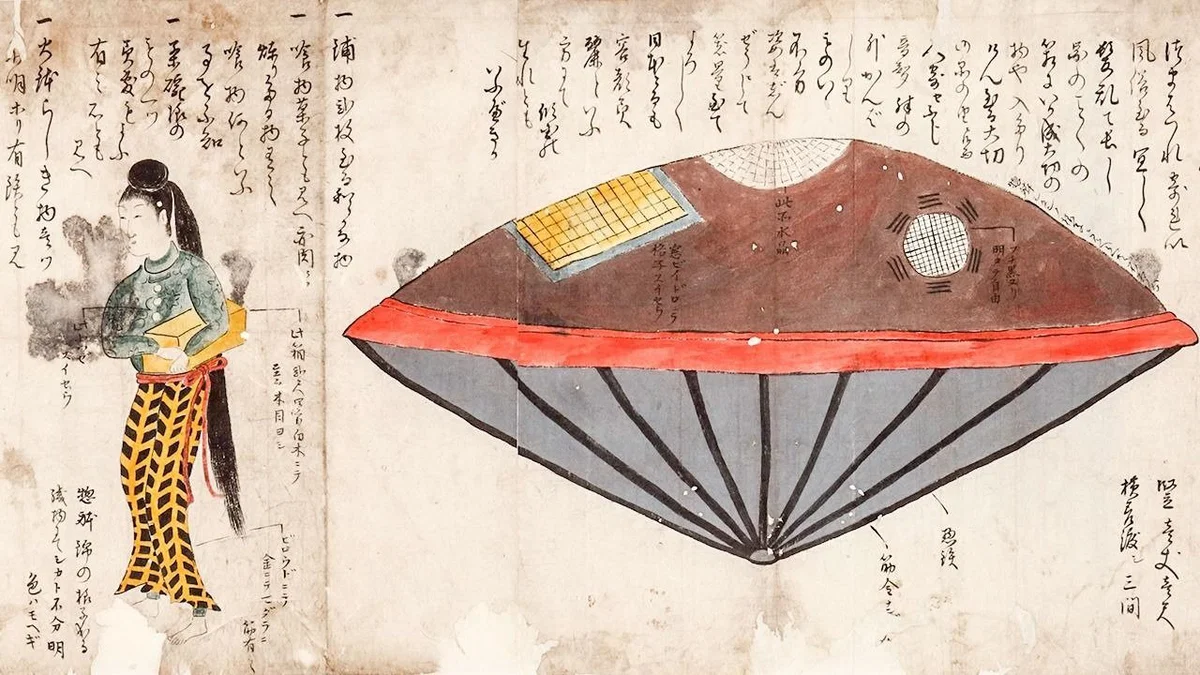
“The Strange Boat Drifted Ashore on the Fief of Lord Ogasawara”
Historical illustration of a hollow vessel and unfamiliar passenger from Hyōryū Kishū (“Archive of Castaways”), dating to approximately 1868 or earlier. The image documents the wider Edo-period tradition of strange vessels and foreign castaways and provides comparative context for the Utsuro-bune story; it is not a contemporary depiction of the alleged 1803 Hitachi event.
Status: Verified
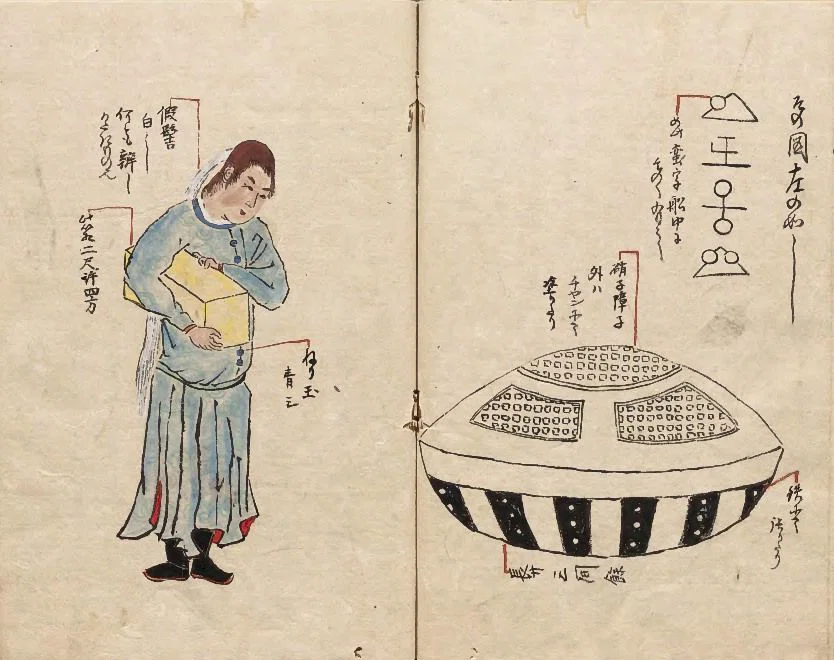
Bakin Kyokutei’s Tōen shōsetsu (1825)
Illustration accompanying the Utsuro-bune account in Bakin Kyokutei’s Tōen shōsetsu (1825), depicting the unfamiliar passenger and rounded hollow vessel described in that version of the story. The image documents nineteenth-century transmission of the legend and was created years after the alleged 1803 event rather than as a contemporary eyewitness image.
Status: Verified
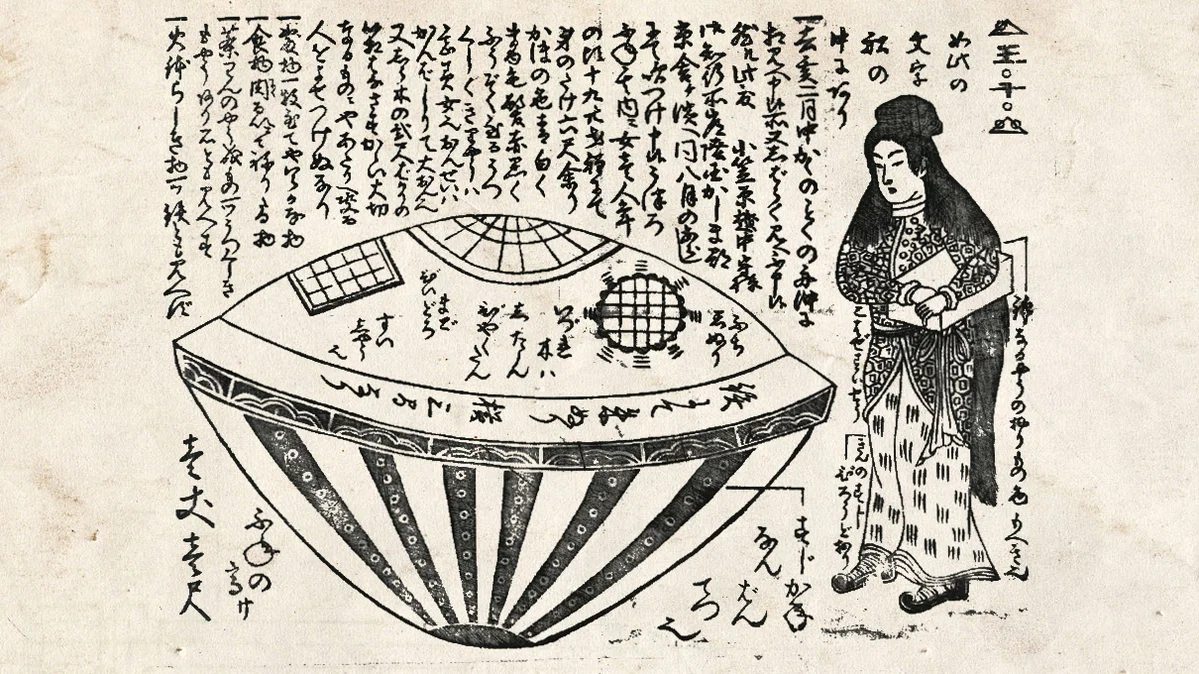
Matajirō Nagahashi’s Umemon chiri / Ume-no-chiri (1845)
Illustration from Matajirō Nagahashi’s 1845 account of the Utsuro-bune tradition, showing the hollow vessel and unfamiliar passenger as represented in that version of the story. Differences between this image and earlier illustrations help document how the vessel and passenger were depicted differently as the narrative circulated through nineteenth-century Japan.
Status: Verified
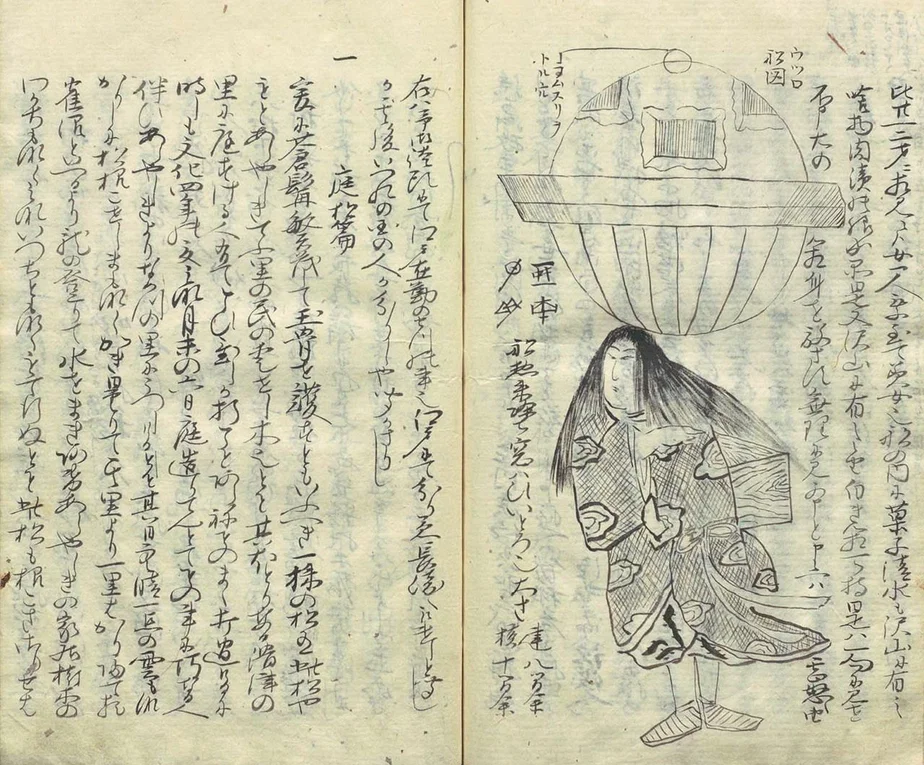
Komai Norimura’s Ōshuku zakki
Illustration from Komai Norimura’s Ōshuku zakki, one of the earlier surviving textual versions associated with the Utsuro-bune story. The drawing depicts the unusual vessel described in the account and helps document the early nineteenth-century development of the tradition. It should not be interpreted as a contemporary sketch made at the alleged 1803 landing.
Status: Verified
Investigation timeline
- 2026-11-03 — Historical file submitted.
- 2026-11-03 — Research question opened: Which surviving Edo-period text contains the earliest identifiable version of the specific 1803 Hitachi Utsuro-bune story, and when was that manuscript actually written?
- 2026-11-03 — Research question opened: Can the place names used in the surviving Utsuro-bune texts be reliably matched to a specific modern location on the Ibaraki coast?
- 2026-11-03 — Research question opened: Which elements of the modern extraterrestrial interpretation are present in the Edo-period sources themselves, and which first appear in twentieth-century UFO literature?
- 2026-11-03 — Historical file accepted and published.
Assigned GG-2026-149
Research notes
No curated research notes.
Open research questions
A specific gap in the file. An accepted source, research note, or further-reading link closes it.
Which surviving Edo-period text contains the earliest identifiable version of the specific 1803 Hitachi Utsuro-bune story, and when was that manuscript actually written?
Can the place names used in the surviving Utsuro-bune texts be reliably matched to a specific modern location on the Ibaraki coast?
Which elements of the modern extraterrestrial interpretation are present in the Edo-period sources themselves, and which first appear in twentieth-century UFO literature?
How do the dates, locations, vessel descriptions, passenger descriptions, symbols, and endings differ among Ōshuku zakki, Tōen shōsetsu, Hyōryū kishū, Ume-no-chiri, and other surviving Utsuro-bune accounts?
Propose evidence & media, a source citation, further reading, a research note, a correction, a related case, or a series link. Staff review before anything is added. An accepted correction does not replace the file by itself.