GG-2026-161
Delhi Monkey-Man Panic
- Phenomenon Cryptids & Unknown Zoology, Folklore & Cultural Encounters, Unclassified & Other
- Documentation
Rating A
- A — Strong dossier: several independent sources plus primary evidence (original media, records, measurements) a researcher could use without interviewing anyone.
- B — Well documented: multiple independent witnesses with at least some contemporary primary material, or one witness with substantial primary corroboration (photos, recordings, contemporaneous notes, documents).
- C — Multi-source but soft: several witnesses or a long run of reports, but mostly testimony and after-the-fact secondary sources (newspapers, folklore collections, later interviews). Little or no primary physical evidence. Regional legend clusters such as the Bridgewater Triangle land here.
- D — Thin: single witness (or one household), little or no support beyond the account. Normal for a sincere personal experience.
- E — Incomplete or not yet assessed. Every new submission starts here until staff have read it.
- Evidence & media 2 items
- Status Historic
- Location Delhi, India · regional placement
- Occurred April 2001
Regional marker representing Delhi, where the principal Monkey-Man panic occurred in 2001. Reported incidents were distributed across multiple neighborhoods, particularly in eastern and northeastern Delhi, and the marker should not be interpreted as the location of any specific alleged encounter.
This file is placed as a region or body of water, not a single exact event location.
Activity period
- Earliest claimed event April 2001
- Earliest documented report April 2001
- Latest documented report June 2001
- Pattern Historic wave
Summary
The Delhi Monkey-Man Panic was a brief wave of alleged attacks and sightings that spread through Delhi and surrounding communities in 2001. Witness descriptions varied dramatically, ranging from a hairy monkey-like creature to a helmeted or masked figure with glowing eyes, metal claws, mechanical features, and other unusual characteristics. Police deployed officers, investigated reported attacks, and offered a ₹50,000 reward, while frightened residents organized neighborhood patrols and several people were injured or killed during panic-related incidents. No creature or single attacker was identified, and subsequent investigation attributed the wider episode largely to rumor, inconsistent testimony, hoaxes, misidentification, and mass hysteria. The precise circumstances behind every individual report remain uncertain, making the episode better documented as a genuine social panic surrounding an unidentified supposed attacker than as evidence for a single unknown creature.
Background
Reports of a strange nocturnal attacker began circulating around Delhi and neighboring communities during the spring of 2001. The phenomenon became widely known as the “Monkey-Man,” although descriptions supplied by supposed witnesses showed little consistency. Some accounts described a small, hairy, monkey-like animal, while others described a human-sized or mechanical figure with glowing eyes, metallic claws, a helmet or mask, illuminated buttons, and unusual methods of movement. These considerable differences became one of the central problems facing investigators attempting to determine whether witnesses were describing a common source.
By May, fear of the supposed attacker had spread through parts of eastern and northeastern Delhi. Residents reported scratches, bites, or attacks occurring primarily at night, and rumors spread rapidly between densely populated neighborhoods. Contemporary reports record that police initially considered several possibilities, including an animal, a human attacker, pranksters, and incidents being incorrectly attributed to the increasingly famous Monkey-Man.
The response became substantial. Delhi police deployed hundreds of personnel and established a dedicated effort to investigate the reported attacks. Authorities also offered a ₹50,000 reward for information leading to the capture of the supposed attacker. Meanwhile, frightened residents formed neighborhood patrols, sometimes carrying sticks, hockey sticks, and other improvised weapons while searching streets and rooftops.
The resulting panic itself produced real harm regardless of whether a Monkey-Man existed. Contemporary reporting documented people falling from rooftops, balconies, buildings, or stairs while attempting to escape a creature they believed was nearby. At least some deaths were directly associated with these panic-related falls, and contemporary CNN reporting ultimately described three deaths connected with the episode. One innocent person was also reportedly attacked by a crowd after being mistaken for the creature.
Police faced difficulty corroborating many of the alleged attacks. Descriptions frequently contradicted one another, some supposed injuries did not correspond convincingly with witness accounts, and reports multiplied as publicity surrounding the Monkey-Man increased. Investigators also encountered hoaxes and incidents in which ordinary people or other circumstances were suspected of having been mistaken for the supposed attacker. No physical specimen, identifiable costume, photograph, biological evidence, or captured attacker emerged that could establish a single source behind the wave of reports.
By June 2001, an investigation involving forensic specialists and psychiatrists reportedly concluded that the Monkey-Man phenomenon was primarily a case of mass hysteria. Investigators emphasized contradictory witness testimony and a lack of physical evidence supporting the existence of the extraordinary creature described in popular accounts. As publicity and fear diminished, reports also subsided, ending the intense phase of the panic.
That conclusion does not necessarily provide a single explanation for every report made during the episode. Individual incidents may have involved known animals, ordinary people, deliberate hoaxes, unrelated injuries, misidentification, or panic-driven perception. Some reports are too poorly documented to reconstruct confidently. The evidence does, however, fail to establish that one unknown creature or attacker was responsible for the numerous and often mutually incompatible accounts.
The Delhi Monkey-Man Panic is therefore significant less because an extraordinary creature was established than because of how rapidly reports of an unidentified attacker developed into a genuine public emergency. Police investigations, rewards, neighborhood patrols, injuries, deaths, press coverage, rumors, and contradictory eyewitness descriptions are all part of the documented historical event. What remains uncertain is what initiated the earliest reports and whether any individual encounters within the broader panic originated with a real but misidentified attacker or animal.
Witness statement
No statement on file.
Evidence & media
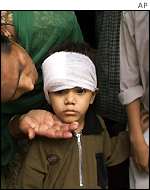
_1331940_boy150
Contemporary photographs published by BBC News during the May 2001 Delhi Monkey-Man panic, showing people reported at the time as victims of the alleged attacks. The photographs document the contemporary reporting and claimed injuries, but do not establish that the injuries were caused by an unidentified creature.
Status: Verified
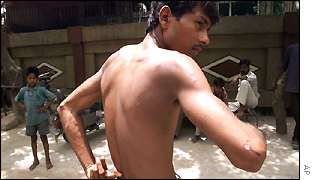
_1331940_injuries300
Contemporary photographs published by BBC News during the May 2001 Delhi Monkey-Man panic, showing people reported at the time as victims of the alleged attacks. The photographs document the contemporary reporting and claimed injuries, but do not establish that the injuries were caused by an unidentified creature.
Status: Verified
Investigation timeline
- 2026-11-05 — Historical file submitted.
- 2026-11-05 — Research question opened
What is the earliest contemporary police or newspaper report documenting the incidents that developed into the Delhi Monkey-Man panic?
- 2026-11-05 — Research question opened
How did descriptions of the Monkey-Man change as newspaper, television, and neighborhood coverage increased during May 2001?
- 2026-11-05 — Research question opened
What proportion of reported Monkey-Man injuries can be independently documented, and what causes were identified by contemporary medical examinations?
- 2026-11-05 — Historical file accepted and published.
Assigned GG-2026-161
Research notes
No curated research notes.
Open research questions
A specific gap in the file. An accepted source, research note, or further-reading link closes it.
What is the earliest contemporary police or newspaper report documenting the incidents that developed into the Delhi Monkey-Man panic?
How did descriptions of the Monkey-Man change as newspaper, television, and neighborhood coverage increased during May 2001?
What proportion of reported Monkey-Man injuries can be independently documented, and what causes were identified by contemporary medical examinations?
Propose evidence & media, a source citation, further reading, a research note, a correction, a related case, or a series link. Staff review before anything is added. An accepted correction does not replace the file by itself.