GG-2026-172
Dalnegorsk Height 611 Incident
- Phenomenon UFOs/UAPs, Unclassified & Other
- Documentation
Rating C
- A — Strong dossier: several independent sources plus primary evidence (original media, records, measurements) a researcher could use without interviewing anyone.
- B — Well documented: multiple independent witnesses with at least some contemporary primary material, or one witness with substantial primary corroboration (photos, recordings, contemporaneous notes, documents).
- C — Multi-source but soft: several witnesses or a long run of reports, but mostly testimony and after-the-fact secondary sources (newspapers, folklore collections, later interviews). Little or no primary physical evidence. Regional legend clusters such as the Bridgewater Triangle land here.
- D — Thin: single witness (or one household), little or no support beyond the account. Normal for a sincere personal experience.
- E — Incomplete or not yet assessed. Every new submission starts here until staff have read it.
- Evidence & media 2 items
- Status Historic
- Location Dalnegorsk, Primorsky Krai, Russia · approximate placement
- Occurred 29 January 1986
Public location identifying Height 611, also known as Mount Izvestkovaya, above Dalnegorsk. The mountain is associated with the reported January 29, 1986 descent and subsequent material search; the marker identifies the geographic feature rather than independently verifying an exact impact point.
Activity period
- Earliest claimed event 29 January 1986
- Earliest documented report 22 February 1986
- Latest documented report 22 February 1986
- Pattern Single event
Summary
On 1986-01-29, residents of Dalnegorsk in the Soviet Far East reported a bright reddish spherical object crossing the town before descending toward Height 611, also known as Mount Izvestkovaya. A near-contemporary account by local investigator Valery Dvuzhilny described two school-age witnesses observing the object descend, apparently strike the hillside, and leave a glow or fire that remained visible for approximately an hour. Subsequent examination of the site produced scorched material, metallic droplets, glassy or spherical particles, and fragments described as mesh-like, some of which were later submitted for technical analysis. Later retellings attributed highly unusual compositions and physical properties to the samples, but incomplete provenance and chain-of-custody documentation make it difficult to establish which analyzed materials actually came from Height 611 or were connected with the observed object. The incident therefore remains a documented Soviet-era luminous-object report with disputed physical evidence rather than a verified crash of an extraterrestrial craft.
Background
On the evening of 1986-01-29, an unusual luminous object was reported above Dalnegorsk, a mining community in Primorsky Krai in the Soviet Far East. One of the strongest early documentary anchors is an article attributed to local investigator Valery Dvuzhilny, published in the newspaper Trudovoye Slovo on 1986-02-22, less than a month after the event. The account identified the principal observation as beginning at approximately 19:55 and described two young witnesses, Sergei Olkhov and Alyosha Maslov, observing a bright red ball traveling toward the hill locally called Height 611.
According to that account, the object moved from the southwest on a relatively low, slightly inclined trajectory. The witnesses described its apparent size as comparable to a football and reported a trail involving sparks and white smoke. As the object approached Height 611, it reportedly descended sharply, apparently struck the rocky terrain, produced a flash, rebounded or moved again, and then came down among the rocks. A bright glow or fire was subsequently visible on the hillside for approximately an hour.
Additional witnesses were reported afterward, and later accounts sometimes place the witness population in the dozens or even hundreds. Those larger figures should be treated cautiously unless supported by identifiable contemporary statements. The strongest surviving public evidence establishes that multiple observations were reported, rather than providing a complete independently authenticated roster of every person later counted as a witness.
Valery Dvuzhilny subsequently examined the reported site. Later reconstruction places the organized visit roughly two to three days after the event. The investigated area was a relatively small portion of the rocky summit where signs interpreted as heating or burning were reported. Material collected from the area was described as including scorched rock or vegetation, small droplets of metal, dark or glassy spherical particles, and extremely thin fragments that came to be described in the literature as “mesh.”
These materials became the most controversial part of the case. Later UFO literature frequently states that samples were analyzed by numerous Soviet scientific institutions and showed extraordinary concentrations of metals, unusual microscopic structures, exceptional resistance to heat or chemical treatment, and other properties interpreted as evidence of advanced technology. Some accounts go considerably further, describing gold-bearing microscopic filaments, materials changing elemental composition during heating, or structures that supposedly could not have been manufactured using known terrestrial technology.
The surviving technical record is substantially less definitive. A 1991 materials-related abstract describes Dalnegorsk lead droplets and charred wood being delivered to the E. O. Paton Institute for Electric Welding in 1989, providing documentary evidence that material attributed to the case did reach a recognized scientific institution. However, that publication does not provide an uninterrupted chain of custody linking every tested specimen to the 1986-01-29 observation or demonstrate that the material originated from the luminous object.
This distinction is especially important because materials from different locations became mixed together in later descriptions of the case. A frequently discussed iron sphere, for example, was associated with Kerch rather than Dalnegorsk, yet some later retellings incorporated its analysis into the Height 611 evidence. Technical findings concerning material from separate locations cannot legitimately be combined and presented as the composition of a single crashed object.
The famous mesh-like material presents a similar evidentiary problem. Reports describe microscopic strands and various metallic constituents, but the available public documentation does not establish a continuous provenance from collection at Height 611 through each laboratory examination subsequently attributed to the sample. The reported material remains potentially interesting physical evidence, but claims that it constitutes verified extraterrestrial debris are unsupported by the surviving public record.
Several conventional explanations have been proposed for the original observation. These include a meteor or bolide, rocket or space debris, an unusual atmospheric phenomenon such as ball lightning, and terrestrial industrial material unrelated to the luminous object. A later local-journalistic interpretation proposed that ball lightning may have struck the hillside and that some material subsequently collected there had already been present. None of these explanations has been demonstrated conclusively for every component of the incident.
The geography also deserves consideration. Dalnegorsk is a long-established mining and industrial community associated with lead, zinc, and other mineral extraction. Terrestrial metal, industrial residue, mining-related material, and geological samples cannot therefore be treated as extraordinary solely because they were recovered from the area surrounding the reported observation. At the same time, finding a plausible terrestrial material at the site would not by itself identify the luminous phenomenon observed in the sky.
Later reports added another layer to the Height 611 story. UFO literature describes subsequent unidentified objects near Dalnegorsk, particularly a conspicuous wave on 1987-11-28, when numerous aerial phenomena were reportedly observed in the region and some were said to have approached or circled Height 611. These later reports contributed to the idea that the site remained of interest to unidentified craft, but they should be investigated as separate events rather than used retrospectively to prove the nature of the 1986 object.
As knowledge of the incident spread outside the Soviet Union, Height 611 acquired the nickname “Russian Roswell.” That comparison encouraged increasingly elaborate descriptions of a crashed craft and exotic wreckage. The analogy is useful for understanding the cultural evolution of the case but risks implying that investigators recovered a recognizable vehicle or occupants. No surviving evidence establishes either.
The Dalnegorsk Height 611 Incident is nevertheless more substantial than a simple decades-later UFO legend. A near-contemporary newspaper account documents the reported luminous object, subsequent investigators examined the hillside, material attributed to the site underwent technical examination, and later publications preserve parts of that investigative history. What remains unresolved is whether the observed object had an ordinary atmospheric or technological explanation, whether the collected samples were physically connected with that object, and whether any genuinely unusual properties reported in later literature survive careful examination of provenance and laboratory documentation. Those questions should remain separate rather than allowing ambiguous material evidence to transform an unidentified aerial event into a verified spacecraft crash.
Witness statement
No statement on file.
Evidence & media
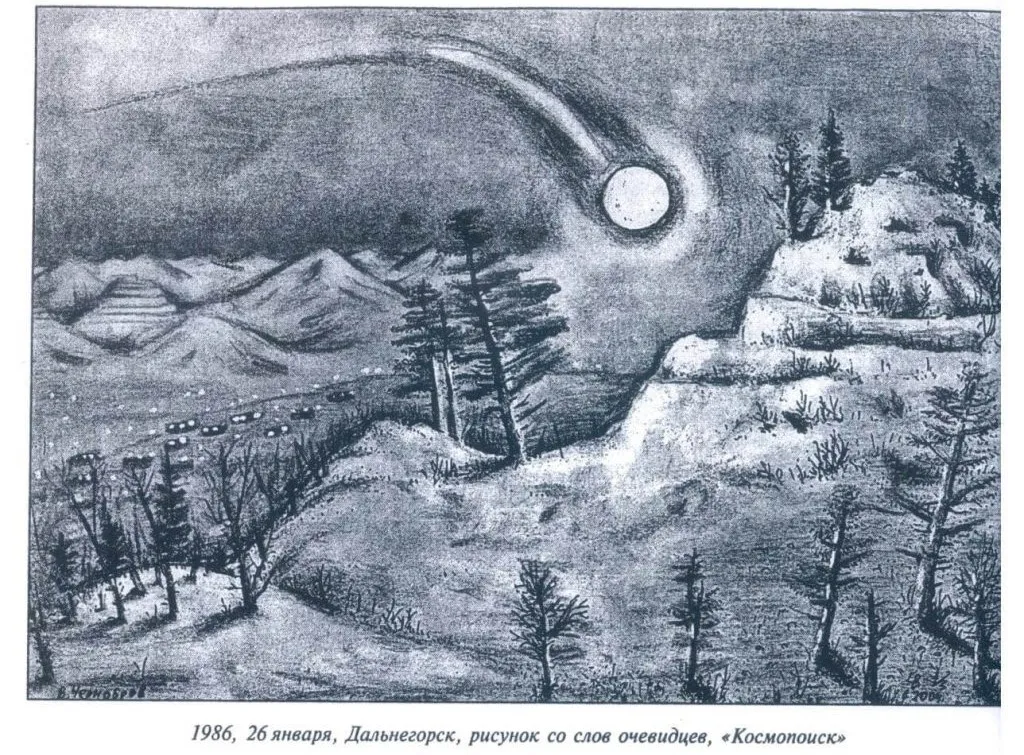
Witness-Informed Illustration of the Dalnegorsk Object
Illustration produced from witness descriptions of the luminous object reportedly observed over Dalnegorsk on January 29, 1986. The drawing depicts the object descending toward Height 611 prior to the reported impact and subsequent fire observed by local residents. This image is an artistic reconstruction based on witness testimony and should not be interpreted as a contemporaneous photograph of the event. Source: Philip Mantle.
Status: Verified
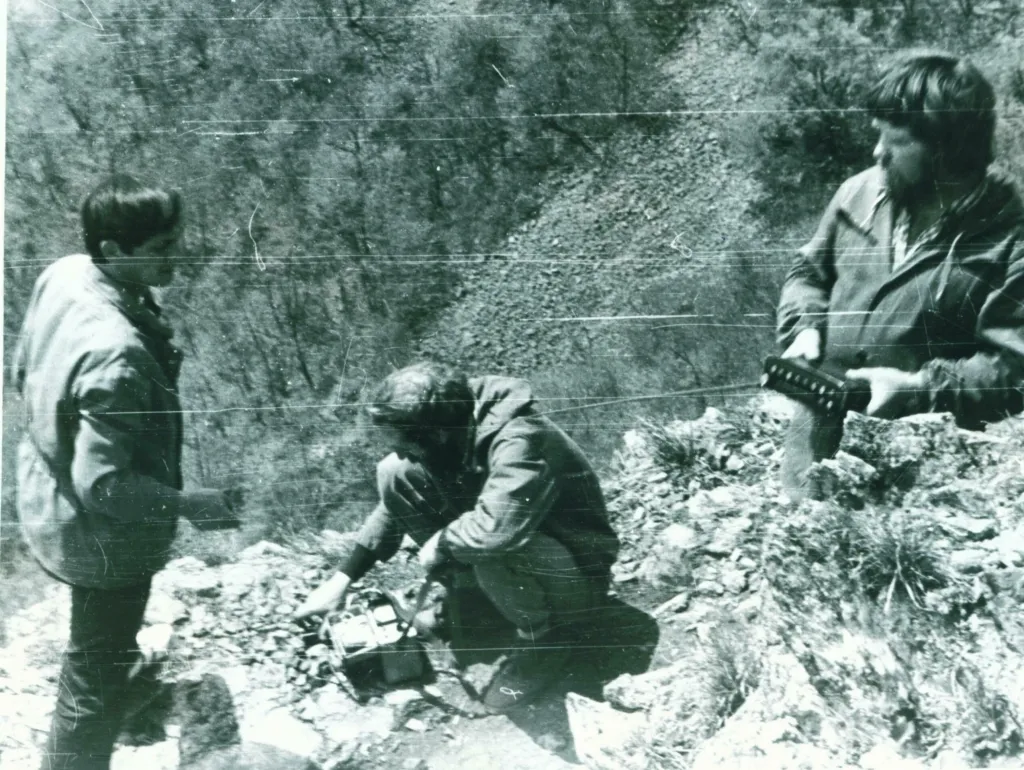
Researchers Examining the Height 611 Impact Site
Photograph showing investigators conducting field examinations at the reported impact site on Height 611 near Dalnegorsk, Russia. Following the January 29, 1986 incident, researchers collected soil samples, burned vegetation, metallic residues, and other materials for laboratory analysis. The image documents investigative activity at the location and does not by itself establish the nature or origin of the reported object. Source: Philip Mantle.
Status: Verified
Further reading
Continue exploring — Wikipedia, documentaries, podcasts, museum pages. Not treated as proof, and not independently verified by this archive.
Investigation timeline
- 2026-11-06 — Historical file submitted.
- 2026-11-06 — Research question opened
Can the original February 22, 1986 Trudovoye Slovo article by Valery Dvuzhilny be located and preserved in full?
- 2026-11-06 — Research question opened
Which published laboratory reports specifically analyze material collected at Height 611, rather than samples from other locations later associated with the case?
- 2026-11-06 — Research question opened
How closely do later descriptions of the Height 611 object match the earliest witness accounts?
- 2026-11-06 — Research question opened
Which later Dalnegorsk UFO reports can be independently documented, and when did claims that unidentified objects repeatedly returned to Height 611 first appear?
- 2026-11-06 — Research question opened
Which physical samples attributed to Height 611 have a documented chain of custody from collection through laboratory analysis?
- 2026-11-07 — Historical file accepted and published.
Assigned GG-2026-172
Research notes
No curated research notes.
Open research questions
A specific gap in the file. An accepted source, research note, or further-reading link closes it.
Can the original February 22, 1986 Trudovoye Slovo article by Valery Dvuzhilny be located and preserved in full?
Which published laboratory reports specifically analyze material collected at Height 611, rather than samples from other locations later associated with the case?
How closely do later descriptions of the Height 611 object match the earliest witness accounts?
Which later Dalnegorsk UFO reports can be independently documented, and when did claims that unidentified objects repeatedly returned to Height 611 first appear?
Which physical samples attributed to Height 611 have a documented chain of custody from collection through laboratory analysis?
Propose evidence & media, a source citation, further reading, a research note, a correction, a related case, or a series link. Staff review before anything is added. An accepted correction does not replace the file by itself.