GG-2026-100
Beast of Whitehall
- Phenomenon Cryptids & Unknown Zoology
- Documentation
Rating C
- A — Strong dossier: several independent sources plus primary evidence (original media, records, measurements) a researcher could use without interviewing anyone.
- B — Well documented: multiple independent witnesses with at least some contemporary primary material, or one witness with substantial primary corroboration (photos, recordings, contemporaneous notes, documents).
- C — Multi-source but soft: several witnesses or a long run of reports, but mostly testimony and after-the-fact secondary sources (newspapers, folklore collections, later interviews). Little or no primary physical evidence. Regional legend clusters such as the Bridgewater Triangle land here.
- D — Thin: single witness (or one household), little or no support beyond the account. Normal for a sincere personal experience.
- E — Incomplete or not yet assessed. Every new submission starts here until staff have read it.
- Evidence & media 2 items
- Status Active
- Location Whitehall, New York · regional placement
- Occurred 24 August 1976
Regional marker using Whitehall, New York as a public reference point. Contemporary reports describe multiple encounter locations associated with the 1976 sighting flap rather than a single incident site.
This file is placed as a region or body of water, not a single exact event location.
Activity period
- Earliest claimed event August 1976
- Earliest documented report Unknown
- Latest documented report September 1976
- Pattern Historic wave
Summary
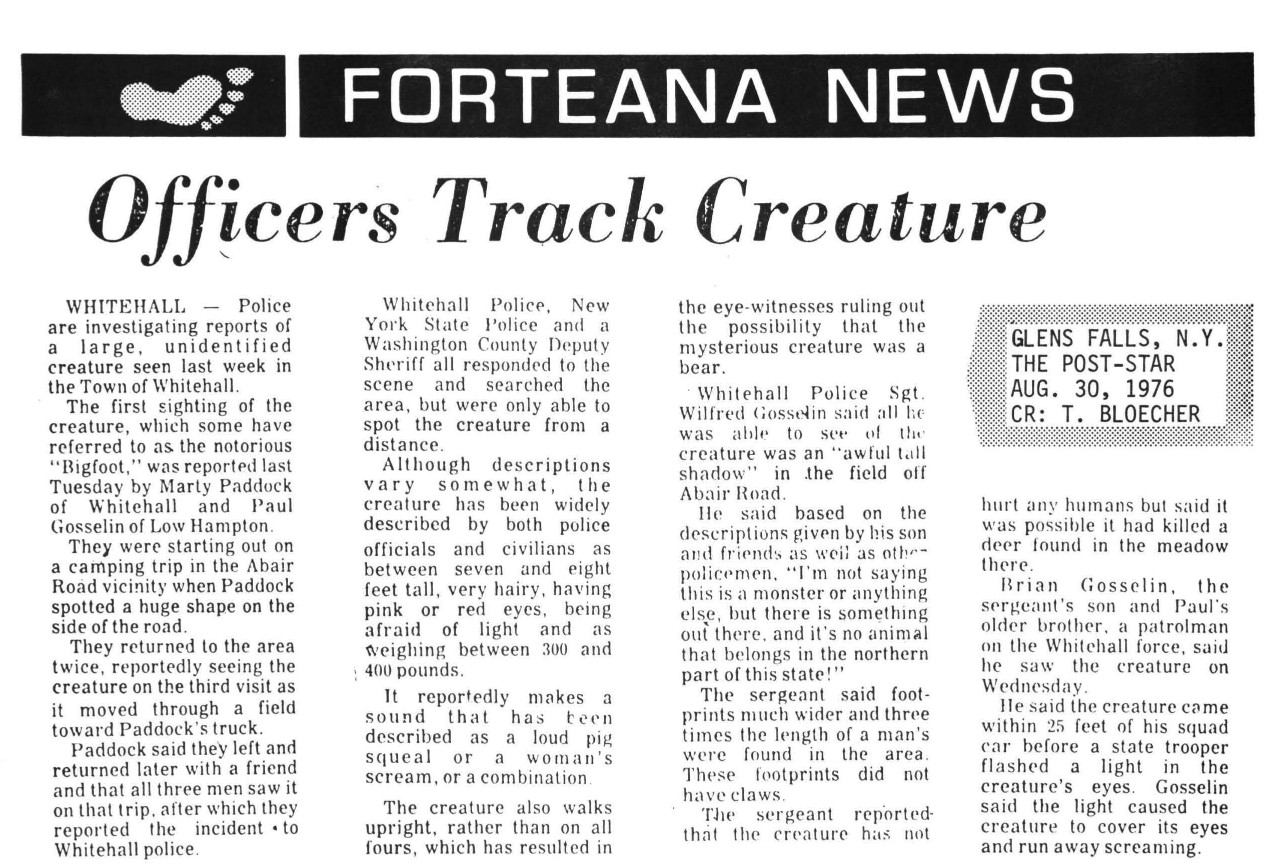
The Whitehall Monster is a series of Bigfoot-like sightings reported around Whitehall, New York, beginning in August 1976. Witnesses, including several law-enforcement officers, described a large hairy biped observed near Abair Road and the Poultney River. Reports of footprints and other possible physical traces attracted investigators and media attention, helping establish Whitehall's reputation as a center of Sasquatch folklore in the northeastern United States. No verified specimen or conclusive evidence has been produced, and the sightings remain unexplained.
Background
The Whitehall sightings began during the summer of 1976 in the rural border region between New York and Vermont. Reports centered primarily on the area surrounding Abair Road and the nearby wetlands of the Poultney River valley.
According to witness accounts, several local residents reported observing a large, hairy, upright figure near roads, fields, and wooded areas. One of the earliest and most frequently cited reports involved a group of teenagers who claimed to encounter an unusual creature while driving near Abair Road.
The incident gained wider attention when local law-enforcement officers investigated the area. Among those associated with the case was Officer Brian Gosselin, who later reported observing a large, dark figure while conducting a nighttime patrol. Other officers and officials participated in searches and follow-up investigations during the period of increased activity.
Witness descriptions generally portrayed a large bipedal creature covered in dark hair and observed under low-light conditions. Accounts differed in some details but shared broad similarities, leading investigators and researchers to treat the reports as potentially related.
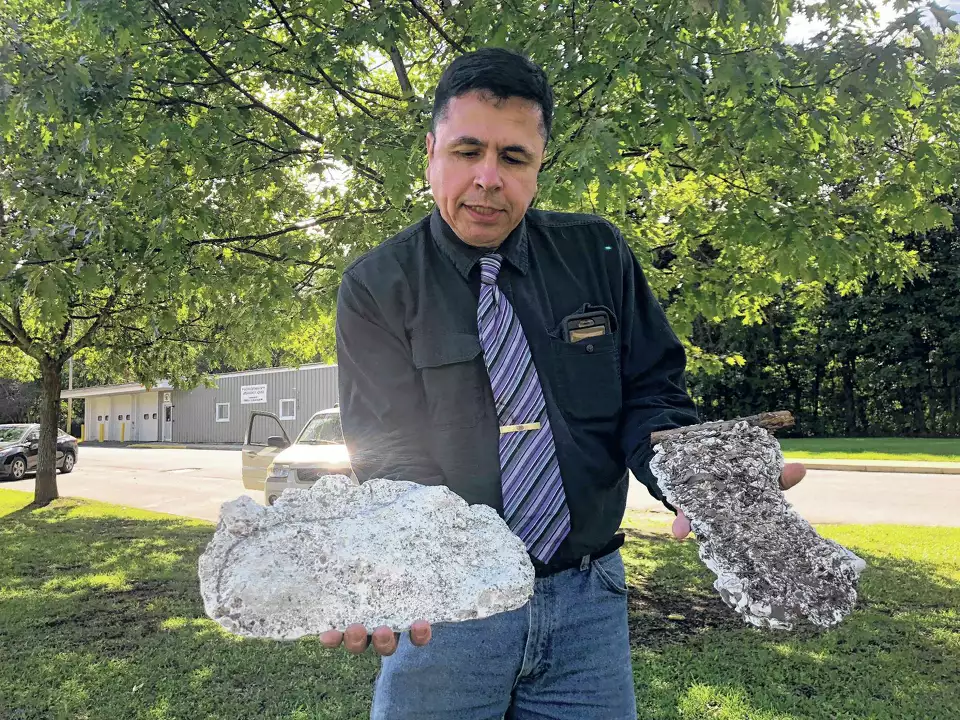
As public interest grew, residents and researchers searched for additional evidence. Reports emerged of footprints, unusual sounds, and possible physical traces found near waterways and wooded locations. Some footprint casts were collected and examined by investigators and later researchers. Debate continues regarding the significance and authenticity of these traces.
The Whitehall reports became an important subject of study for regional cryptozoologists, including Paul Bartholomew, who documented sightings and witness testimony across several decades. Additional reports continued to emerge from the area after the original 1976 events, helping sustain Whitehall's association with Sasquatch folklore.
Researchers have proposed a variety of explanations, including misidentification, hoaxes, folklore development, and the possibility that witnesses observed an unknown animal. No explanation has achieved universal acceptance.
Today, Whitehall is often associated with Bigfoot traditions and hosts events celebrating its role in cryptid folklore. The witness accounts, law-enforcement involvement, and continuing reports are well documented. The identity of the creature reported by witnesses remains unresolved.
Witness statement
No statement on file.
Evidence & media
Screenshot 2026-09-30 151639
Post-Star article. Aug 30, 1976
960x0
Paul Bartholomew, an investigator and researcher of unexplained phenomena, took a reporter on Sept. 25, 2018, to various spots in Whitehall where Bigfoot has been spotted.
Further reading
Continue exploring — Wikipedia, documentaries, podcasts, museum pages. Not treated as proof, and not independently verified by this archive.
Investigation timeline
- 2026-09-30 — Historical file submitted.
- 2026-09-30 — Historical file accepted and published.
Assigned GG-2026-100
Research notes
Historical research: Patrol Car Headlight Illuminance, Red Eyeshine Physics, and Officer Witness Reliability
From a forensic and investigative standpoint, the Whitehall incident holds exceptional weight due to the involvement of trained law enforcement observers acting under official duty.
Officer Brian Gosselin operated a standard 1970s police cruiser equipped with high-intensity sealed-beam halogen lamps. At a distance of 30 feet, illuminance was sufficient to evaluate anatomical details, eliminating common low-light distance distortion. The "glowing red eyes" reported by Gosselin and civilian witnesses represent tapetum lucidum retro-reflection—a biological layer behind the retina found in nocturnal predators (such as bears, panthers, and deer) that reflects light back toward the source. However, the physical height (over 7 feet) and erect bipedal locomotion rule out native quadrupedal fauna like the white-tailed deer (Odocoileus virginianus).
Historical research: American Black Bear (Ursus americanus) Bipedalism vs. Unclassified Primates
From a zoological perspective, skeptical analysis focuses on the population dynamics of the Adirondack black bear.
Black bears frequently exhibit short-distance bipedal standing to survey terrain or scent the wind. In rare instances of paw injury or anatomical deformation, bears have been documented walking on their hind legs for extended distances. A large male black bear standing erect can reach heights of 6.5 to 7 feet. However, witness statements from experienced outdoorsmen and police officers specifically emphasize human-like shoulder movement, longer facial hair, and rapid bipedal strides across open fields—locomotion mechanics distinct from the awkward, shuffling waddle of a standing bear.
Open research questions
A specific gap in the file. An accepted source, research note, or further-reading link closes it.
Can the earliest contemporary newspaper report of the Whitehall sightings be identified and dated?
Which physical descriptions appear consistently in the earliest reports and which emerge only in later retellings?
Propose evidence & media, a source citation, further reading, a research note, a correction, a related case, or a series link. Staff review before anything is added. An accepted correction does not replace the file by itself.