GG-2026-103
Trans-en-Provence Case
- Phenomenon UFOs/UAPs
- Documentation
Rating A
- A — Strong dossier: several independent sources plus primary evidence (original media, records, measurements) a researcher could use without interviewing anyone.
- B — Well documented: multiple independent witnesses with at least some contemporary primary material, or one witness with substantial primary corroboration (photos, recordings, contemporaneous notes, documents).
- C — Multi-source but soft: several witnesses or a long run of reports, but mostly testimony and after-the-fact secondary sources (newspapers, folklore collections, later interviews). Little or no primary physical evidence. Regional legend clusters such as the Bridgewater Triangle land here.
- D — Thin: single witness (or one household), little or no support beyond the account. Normal for a sincere personal experience.
- E — Incomplete or not yet assessed. Every new submission starts here until staff have read it.
- Evidence & media 4 items
- Status Historic
- Location Trans-en-Provence, France
- Occurred 8 January 1981
Summary
On the afternoon of January 8, 1981, 55-year-old farmer Renato Nicolaï was building a small concrete shelter on his property in rural Trans-en-Provence when he heard a faint whistling sound and observed a metallic, saucer-shaped craft descend rapidly onto a terraced orchard roughly 50 meters away. The vessel—described as dull lead-grey, approximately 2.5 meters in diameter and 2 meters in height, with a prominent central ridge—rested on the ground for less than a minute before emitting a slight dust cloud and ascending rapidly over the tree line. Uniquely inufological history, the incident was reported immediately to the French National Gendarmerie, prompting an official scientific investigation by GEPAN (Groupe d'Étude des Phénomènes Aériens Non-identifiés), the specialized UAP research unit of the French space agency CNES. GEPAN's multi-year laboratory analysis of soil and vegetation samples confirmed localized mechanical compression (equivalent to a 4 to 5-ton load), thermal heating up to 600°C, and unprecedented biochemical degradation of chlorophyll and amino acid structures in surrounding wild alfalfa plants, leaving the case as one of the most rigorously documented physical trace cases in modern UAP archives.
Background
The Primary Observation (January 8, 1981)The event unfolded rapidly on a private residential property with a single primary eyewitness:Observation Sequence: While working outdoors, Nicolaï heard a soft whistling sound resembling a small wind turbine. Looking up, he observed a rigid, rigid metallic object dropping quickly toward the lower terrace of his garden.
Craft Characteristics: The object was shaped like two inverted saucers or an oblong sphere surrounded by a central rim. Nicolaï noted four lower apertures or pads on its underside, though no extended landing gear legs were visible. The surface was dull gray, resembling unpolished iron or lead.Departure: The craft touched down on a dirt driveway path, remained stationary for 30 to 40 seconds without any motor roar or light flashes, and then lifted straight up into the air, kicking up a light layer of soil before veering off toward the forest.
The GEPAN Investigation & Site Protocol
Unlike cases relying on delayed civilian interviews, law enforcement and government scientists secured the Trans-en-Provence location within 24 hours:January 9, 1981 (Gendarmerie Arrival): Local Gendarmerie officers inspected the site, documenting a circular imprint approximately 2.2 meters in diameter on the dirt road. The ring displayed scraped, hardened earth with dark carbon-like residue traces.February 1981 (GEPAN Deployment): GEPAN director Alain Esterle initiated a scientific survey protocol. Scientists extracted soil cores, physical crust samples, and control vegetation (Medicago sativa, wild alfalfa) at varying radii (0.5m, 1.5m, 3m, 5m, and 10m) from the center of the touchdown circle.
Timeline of Key Events
├── Jan 8, 1981 (05:00 PM) : Renato Nicolaï witnesses 2.5m metallic saucer land and depart his garden.
├── Jan 9, 1981 : Draguignan Gendarmerie secures site; measures 2.2m ground compression ring.
├── Feb 12, 1981 : GEPAN scientists collect standardized soil and vegetation transect samples.
├── 1983 : INRA laboratory completes biochemical analysis on alfalfa plants.
└── Mar 1983 : GEPAN publishes "Technical Note 16", officially classifying the
Witness statement
No statement on file.
Evidence & media
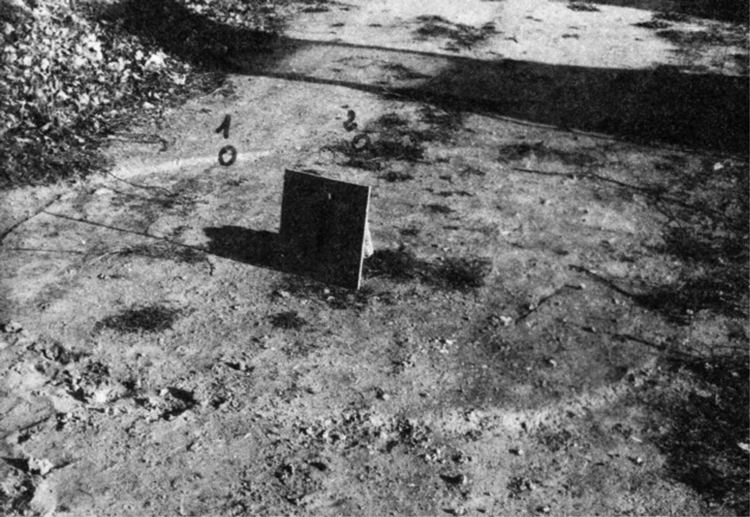 Ground compression trace photographed by GEPAN investigators.
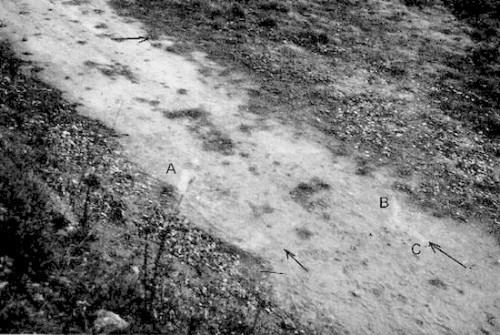 Ground compression trace photographed by GEPAN investigators.
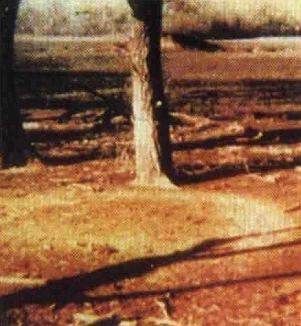 Ground compression trace photographed by GEPAN investigators.
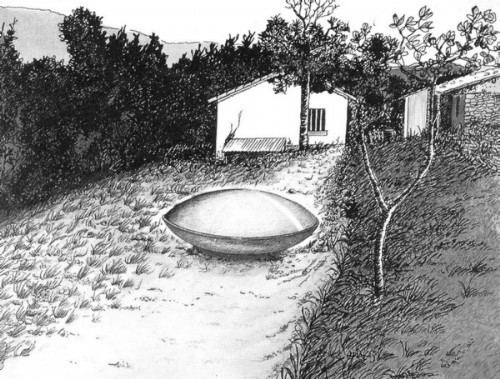 Artist rendition of the craft per the witness description.
Investigation timeline
- 2026-09-30 — Historical file submitted.
- 2026-09-30 — Historical file accepted and published.
Research notes
Historical research: Micro-Indentation Hardness, Tribological Friction Marks, and Thermal Effects
From a physical chemistry and civil engineering perspective, soil samples from the touchdown zone exhibited extreme mechanical stress.
Analysis conducted by the official French laboratories (SFP and CNRS) revealed that the circular ring was produced by a combination of heavy friction and mechanical pressure. Micro-penetrometer testing showed the earth within the ring had been compacted under a localized weight estimated between 4 to 5 metric tons, with shear stress scraping iron oxide particles from surrounding pebbles. Furthermore, striation patterns indicated the contact surface had undergone rotational friction while heated to temperatures between 300°C and 600°C—heat sufficient to bake the soil matrix without scorching organic roots beneath the surface layer.
Historical research: Chlorophyll Breakdown, Photosynthetic System Alteration, and Distance Decay Profiles
From a plant physiology standpoint, the analysis led by Professor Michel Bounias at INRA (Institut National de la Recherche Agronomique) yielded unique empirical data.Bounias analyzed the concentration of photosynthetic pigments (Chlorophyll A and B) and free amino acids in wild alfalfa plants collected from the site. The findings demonstrated a precise, mathematical correlation between distance from the trace center and biological trauma:Plants collected from the immediate rim lost up to 80% of their chlorophyll content.The age-dependent enzyme activity of the leaves had been artificially accelerated, mimicking extreme biological aging within seconds of exposure.The physiological damage decayed smoothly as a function of 1/r2 (inverse-square law) out to 10 meters, indicating exposure to an intense, localized electromagnetic or ionizing radiation field coming from a point source at ground level.
Propose evidence & media, a source citation, further reading, a research note, a correction, a related case, or a series link. Staff review before anything is added. An accepted correction does not replace the file by itself.