GG-2026-104
Kaikoura Lights
- Phenomenon UFOs/UAPs
- Documentation
Rating A
- A — Strong dossier: several independent sources plus primary evidence (original media, records, measurements) a researcher could use without interviewing anyone.
- B — Well documented: multiple independent witnesses with at least some contemporary primary material, or one witness with substantial primary corroboration (photos, recordings, contemporaneous notes, documents).
- C — Multi-source but soft: several witnesses or a long run of reports, but mostly testimony and after-the-fact secondary sources (newspapers, folklore collections, later interviews). Little or no primary physical evidence. Regional legend clusters such as the Bridgewater Triangle land here.
- D — Thin: single witness (or one household), little or no support beyond the account. Normal for a sincere personal experience.
- E — Incomplete or not yet assessed. Every new submission starts here until staff have read it.
- Evidence & media 6 items
- Status Historic
- Location Kaikōura, New Zealand · regional placement
- Occurred 21 December 1978
Regional marker using Kaikōura as a public reference point. Reports involved multiple aerial observations and radar events associated with flight paths in the region rather than a single encounter site.
This file is placed as a region or body of water, not a single exact event location.
Activity period
- Earliest claimed event 21 December 1978
- Earliest documented report 21 December 1978
- Latest documented report 31 December 1978
- Pattern Historic wave
Summary
The Kaikoura Lights were a series of unusual aerial sightings reported off the coast of New Zealand's South Island during December 1978. Pilots, aircrew, radar operators, and journalists described observing bright lights that appeared near aircraft operating in the region. Several sightings were photographed and filmed aboard commercial cargo flights, while radar returns were reportedly observed by both ground and airborne operators. The combination of visual observations, recorded footage, and reported radar contacts made the case one of the most widely discussed UFO incidents in New Zealand aviation history.
Background
The Kaikoura Lights incidents occurred during a series of cargo flights operating between Wellington and destinations on New Zealand's South Island in December 1978. Reports primarily involved crews flying Armstrong Whitworth Argosy freighters for Safe Air Limited, along with air traffic controllers monitoring regional airspace.
The first widely reported sightings occurred on December 21, 1978, when flight crews reported observing unusual lights while flying over the northeastern portion of the South Island. According to witness accounts, the lights appeared brighter than ordinary aircraft lights and displayed movements that the observers considered unusual. Air traffic controllers in Wellington also reported radar contacts that were later associated with the same events.
Public interest increased significantly after additional sightings on the night of December 30-31, 1978. An Australian television news crew accompanied a cargo flight after learning of the earlier reports. During the flight, crew members, journalists, and air traffic controllers reported observing unusual lights near the aircraft. Portions of the event were recorded on film and audio, creating one of the most extensively documented UFO cases of the era.
A central feature of the case is the reported correlation between visual observations and radar contacts. Witnesses stated that lights were observed from the aircraft while radar operators simultaneously tracked unusual returns. Researchers have debated the significance of these reported correlations for decades, with disagreement over what the radar data actually indicated and whether all reported observations were related to the same phenomenon.
The sightings attracted investigation from aviation authorities, scientists, and the Royal New Zealand Air Force. Various explanations were proposed, including bright celestial objects, atmospheric effects, squid boats operating offshore, radar anomalies, and combinations of conventional phenomena occurring simultaneously. Supporters of these explanations argue that the available evidence can be explained without invoking an unidentified craft, while critics contend that some reported observations remain difficult to reconcile with conventional causes alone.
Today, the Kaikoura Lights remain one of the best-known UFO cases in the Southern Hemisphere. The witness reports, radar observations, filmed footage, and official investigations are matters of record. The nature of the lights observed during the December 1978 incidents remains a subject of debate.
Witness statement
No statement on file.
Evidence & media
 The Kaikoura UFOs - 1978
Kaikoura Lights, December 31 1978 (23623047260)
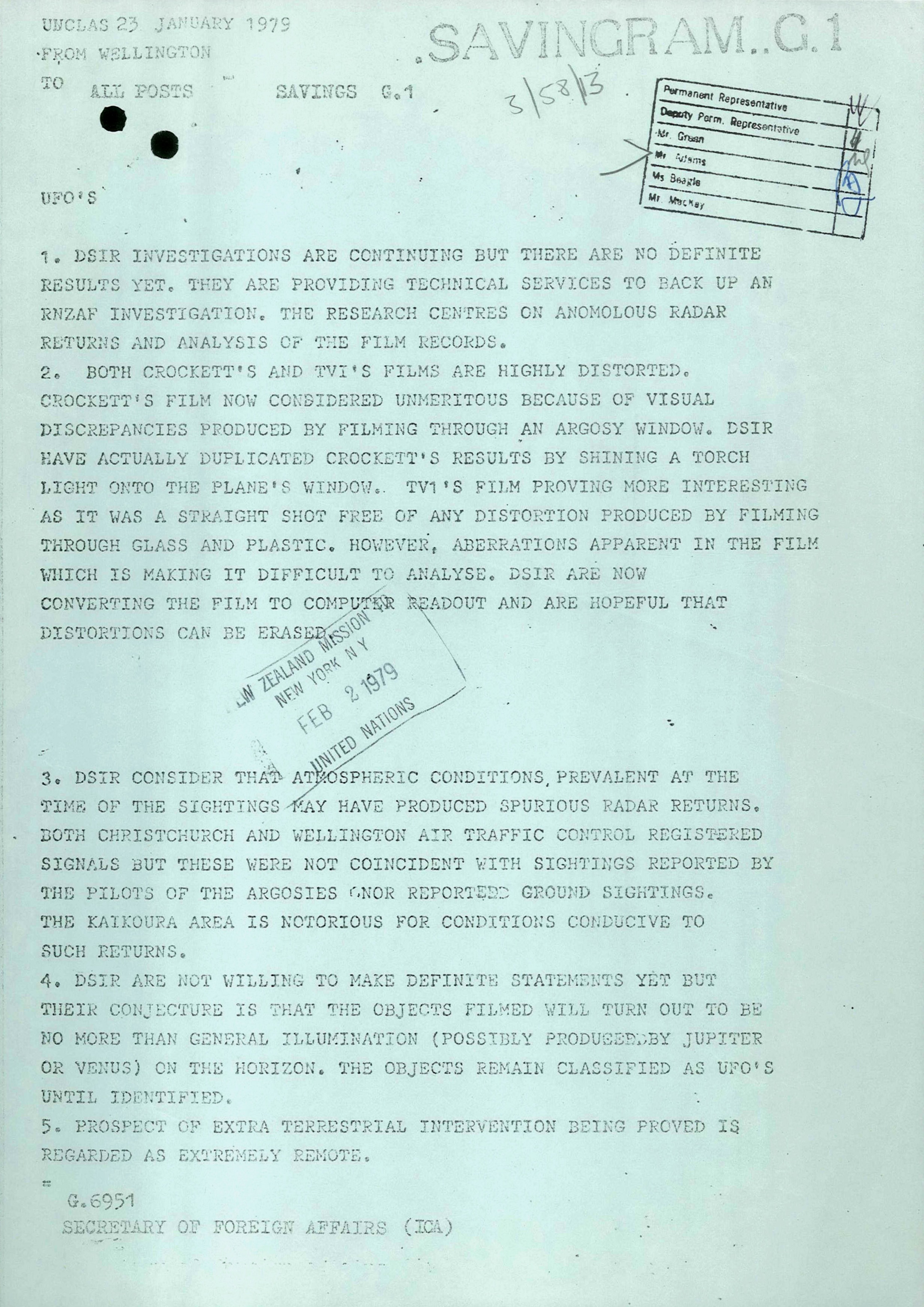
Document from the New Zealand Permanent Mission to the United Nations relating to the Kaikoura Lights (1979)
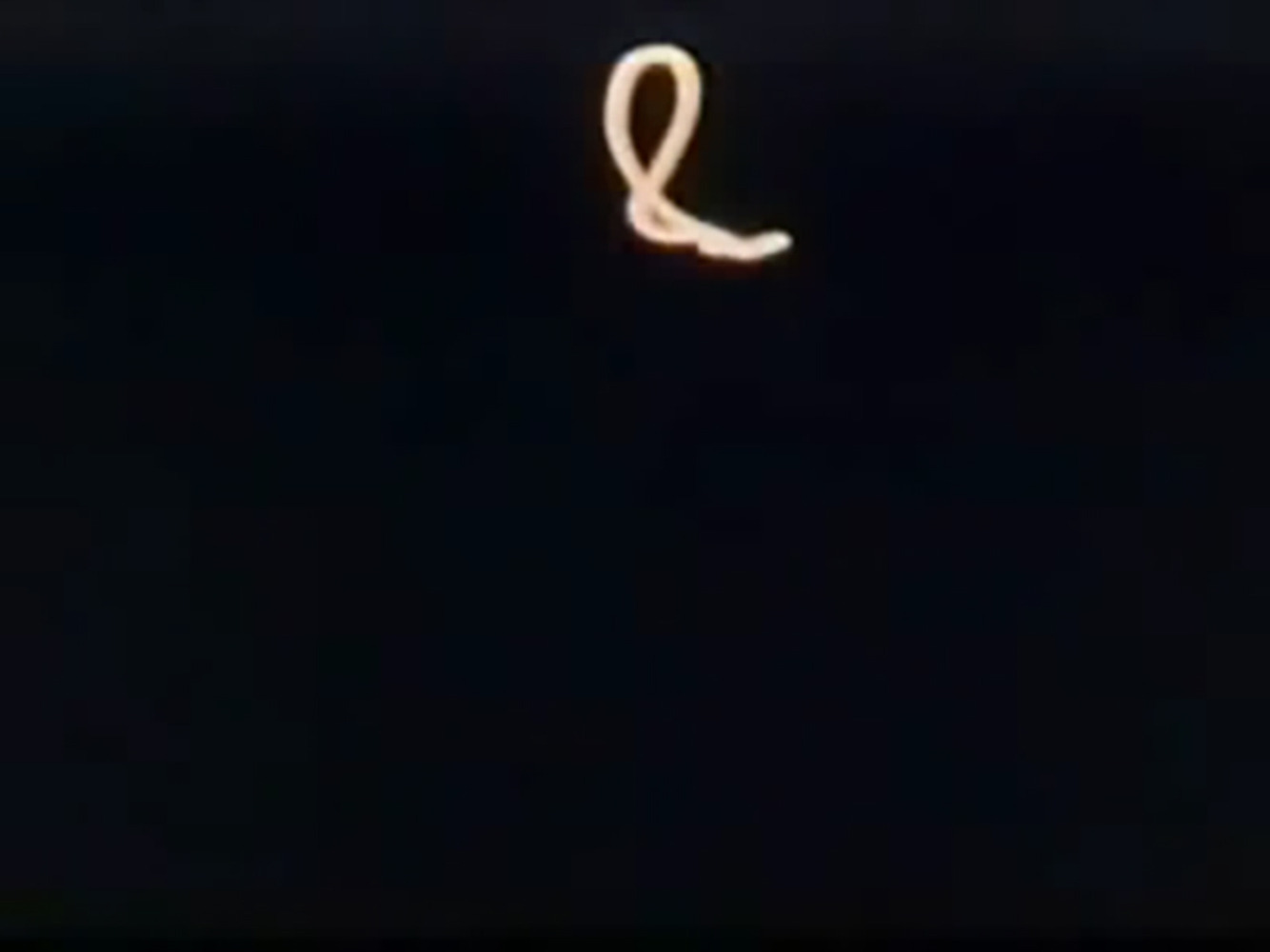
Untitled Photo
A single frame from the Channel 0 footage.
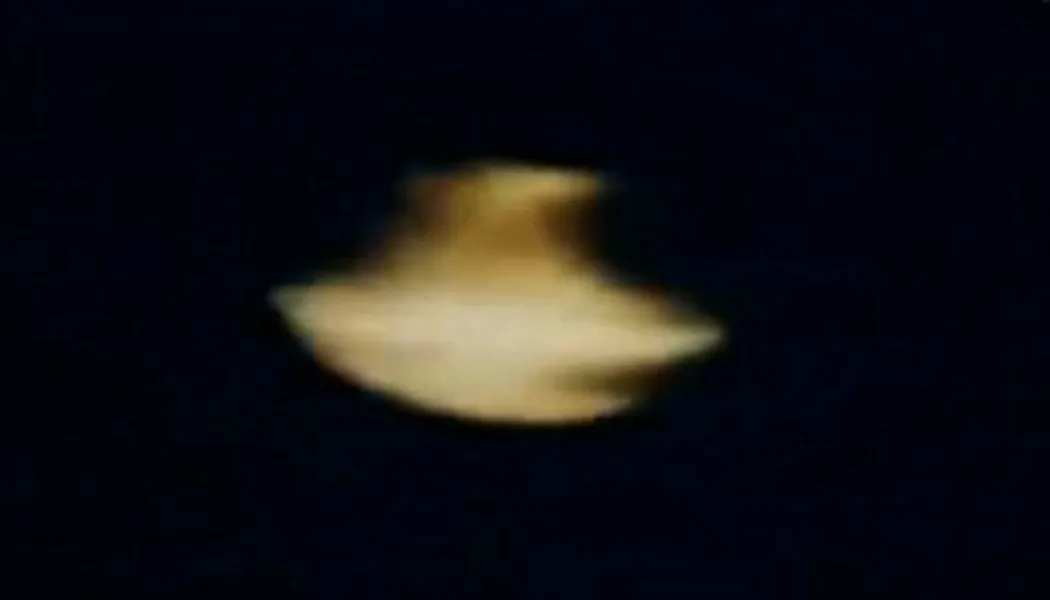
4Nr8i1w Image Crop 61843
A single frame from the Channel 0 footage.
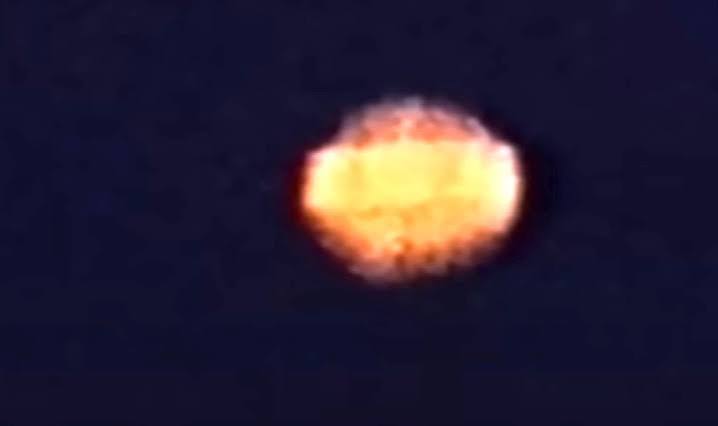
images
A single frame from the Channel 0 footage.
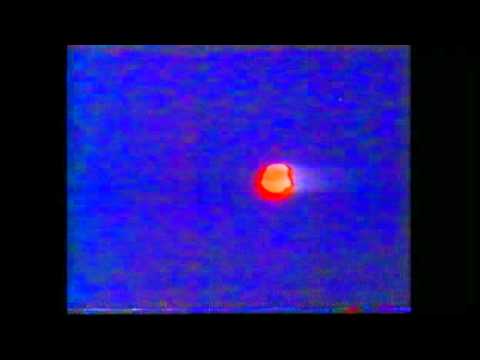 The Kaikoura Lights video
Further reading
Continue exploring — Wikipedia, documentaries, podcasts, museum pages. Not treated as proof, and not independently verified by this archive.
Investigation timeline
- 2026-09-30 — Historical file submitted.
- 2026-09-30 — Historical file accepted and published.
Assigned GG-2026-104
Research notes
Historical research: Ground/Airborne Radar Propagation, Anomalous Propagation (AP), and Thermal Inversions
From an atmospheric physics and radar engineering perspective, official skeptical critiques focused heavily on coastal meteorological anomalies.
The official Royal New Zealand Air Force (RNZAF) investigation concluded that many of the radar returns were generated by Anomalous Propagation (AP)—a condition where temperature inversion layers over the ocean bend radar beams downward, causing ground or ocean surface clutter (such as large waves or coastal bluffs) to appear on air traffic screens as airborne targets. Skeptics, including Dr. Donald Menzel and Philip Klass, argued that the visual lights were misidentified astronomical bodies (such as the planet Venus or Jupiter) or squid-fishing boat lights reflected through anomalous atmospheric refraction ("mirages"). However, atmospheric physicists noted that standard AP rarely produces clean, isolated targets that track along the exact moving trajectory of an aircraft while simultaneously displaying matching airborne radar returns.
Historical research: Photometric Film Analysis, Cockpit Reflection Physics, and Multi-Sensor Convergence
From an optical analysis standpoint, independent scientific reviews evaluated the 16mm film footage and flight logs.
Physicist Dr. Bruce Maccabee conducted a frame-by-frame photometric analysis of Denis Connell's 16mm film footage. His findings established that the light sources recorded on camera were far brighter than any astronomical object or distant ship light, exhibiting intrinsic luminosity shifts and distinct shape changes. Furthermore, the geometric relationship between the ground radar vectors, airborne radar range displays, cockpit audio commentary, and film frame timestamps indicated that all three sensors (visual/optical, ground radar, airborne radar) were reacting to the same physical point-source phenomenon in three-dimensional space, ruling out simple internal cockpit reflections or camera artifacts.
Open research questions
A specific gap in the file. An accepted source, research note, or further-reading link closes it.
Which radar observations can be independently confirmed through surviving documentation?
Propose evidence & media, a source citation, further reading, a research note, a correction, a related case, or a series link. Staff review before anything is added. An accepted correction does not replace the file by itself.