GG-2026-109
Snallygaster
- Phenomenon Cryptids & Unknown Zoology, Folklore & Cultural Encounters
- Documentation
Rating C
- A — Strong dossier: several independent sources plus primary evidence (original media, records, measurements) a researcher could use without interviewing anyone.
- B — Well documented: multiple independent witnesses with at least some contemporary primary material, or one witness with substantial primary corroboration (photos, recordings, contemporaneous notes, documents).
- C — Multi-source but soft: several witnesses or a long run of reports, but mostly testimony and after-the-fact secondary sources (newspapers, folklore collections, later interviews). Little or no primary physical evidence. Regional legend clusters such as the Bridgewater Triangle land here.
- D — Thin: single witness (or one household), little or no support beyond the account. Normal for a sincere personal experience.
- E — Incomplete or not yet assessed. Every new submission starts here until staff have read it.
- Evidence & media 2 items
- Status Historic
- Location Middletown Valley, Frederick County, Maryland · regional placement
- Occurred February 1909
Regional marker using the Middletown Valley as a public reference point. The 1909 Snallygaster reports were associated with multiple locations across Frederick County rather than a single encounter site.
This file is placed as a region or body of water, not a single exact event location.
Activity period
- Earliest claimed event February 1909
- Earliest documented report February 1909
- Latest documented report March 1909
- Pattern Historic wave
Summary
The Snallygaster is a legendary creature associated with the folklore of western Maryland, particularly Frederick County. Typically described as a winged, dragon-like beast, the creature became widely known through newspaper reports published in 1909. Stories surrounding the Snallygaster drew national attention and became an enduring part of Mid-Atlantic folklore. No evidence has verified the creature's existence.
Background
The Snallygaster legend is rooted in the folklore of German-speaking communities that settled parts of Maryland during the eighteenth and nineteenth centuries. The name is generally linked to German-derived traditions describing frightening supernatural beings or creatures associated with remote rural areas.
Although elements of the legend may have existed in local folklore earlier, the Snallygaster became widely known in 1909 through a series of newspaper reports published in the Middletown Valley area. These accounts described a large flying creature with unusual physical features, including wings, claws, and a pointed beak. Reports quickly spread beyond Maryland and attracted attention throughout the United States.
As coverage increased, stories surrounding the creature became increasingly elaborate. Newspaper accounts attributed livestock attacks, strange noises, mysterious tracks, and alleged attacks on people to the Snallygaster. Modern researchers have noted that many of these reports appear to blend local folklore, sensational journalism, humor, and public speculation.
One of the most persistent stories associated with the legend claimed that Theodore Roosevelt was considering hunting the creature. No evidence has been found to support this claim, and historians generally regard the story as a product of newspaper exaggeration or satire.
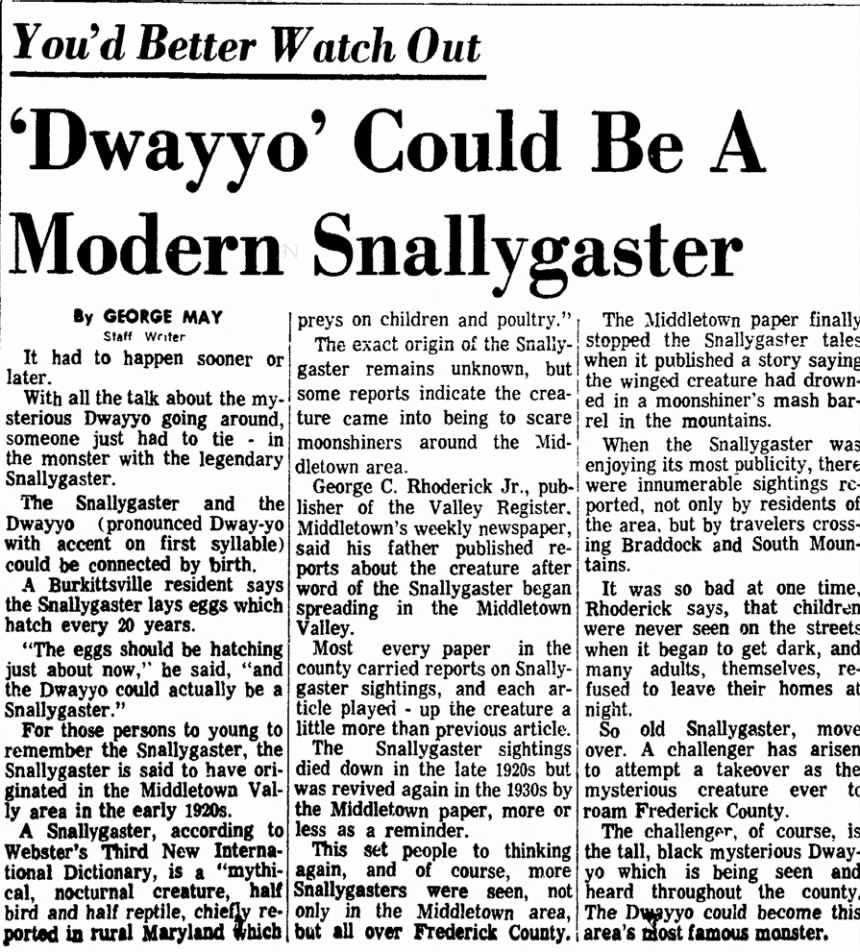
The Snallygaster experienced periodic revivals throughout the twentieth century as newspapers and local storytellers revisited the legend. Additional creatures, including the Dwayyo, later became associated with the same regional folklore traditions, creating a broader network of monster stories in western Maryland.
Today, the Snallygaster remains one of the best-known legendary creatures of the Mid-Atlantic region. The newspaper reports, folklore traditions, and cultural impact are well documented. Whether the legend originated in earlier folk beliefs, journalistic invention, or a combination of multiple influences remains a subject of historical discussion.
Witness statement
No statement on file.
Evidence & media
img
The News, 1965
External linkCBS News - History of the Snallygaster
Further reading
Continue exploring — Wikipedia, documentaries, podcasts, museum pages. Not treated as proof, and not independently verified by this archive.
No further reading links.
Investigation timeline
- 2026-10-01 — Historical file submitted.
- 2026-10-02 — Historical file accepted and published.
Assigned GG-2026-109
Research notes
Historical research: A Legendary Monster With Strong Historical Documentation
The Snallygaster differs from many cryptid cases because its folklore clearly predates the major sighting wave. Unlike the Lake Worth Monster or the Van Meter Visitor, which largely emerged through newspaper reports, the Snallygaster already existed within regional tradition before the famous sightings of 1909. This gives the case historical significance beyond the creature itself.
The strongest evidence associated with the legend is the existence of documented reports and extensive newspaper coverage during the early twentieth century. The principal weakness is the complete absence of physical evidence. No specimen, track evidence, biological material, or accepted photograph has ever been produced. Under Gothic.Black standards, the witness reports and folklore tradition are historically established, while the existence of the creature remains unverified.
Earliest Documented Tradition
The Snallygaster legend appears in German-American folklore dating to at least the eighteenth century.
Earliest Major Documented Sighting Wave
1909 in and around Frederick County, Maryland.
Earliest Exact Sighting Date
A precise first sighting date for the folklore tradition has not been reliably established.
Historical research: Yellow Journalism, Folkloric Evolution, and Apotropaic Symbols
From a socio-historical perspective, the Snallygaster illustrates the transition from oral folk protectionism to media-driven sensationalism.
The original Schneller Geist functioned as a moral and physical warning mechanism within rural farming communities. However, the 1909 press outbreak coincided with the height of "yellow journalism," when small-town newspapers used sensational monster reports to boost circulation and compete with big-city wire services. Writers like Thomas C. Harbaugh deliberately took existing oral traditions and serialized them into dramatic horror narratives, introducing absurd physical details (such as metallic beaks and tentacles) to maintain public engagement.
Historical research: Avian Misidentification, Silhouettes, and Acoustic Distortion
From an avian zoological standpoint, sightings of a large, screeching aerial predator in rural Maryland can be attributed to several native species observed under sub-optimal conditions:
The primary biological candidates include the Great Horned Owl (Bubo virginianus), the Great Blue Heron (Ardea herodias), and late-surviving flocks of the American White Pelican (Pelecanus erythrorhynchos) or Sandhill Crane (Antigone canadensis). A Great Blue Heron flying at night emits a harsh, guttural croak that can terrify observers unfamiliar with nocturnal wetland calls. Furthermore, when viewed at dusk against a tree line, a large heron's trailing legs and broad wingspan can easily create the visual illusion of a long, reptilian tail and bat-like wing structure.
Open research questions
A specific gap in the file. An accepted source, research note, or further-reading link closes it.
Can the first Snallygaster article published by the Middletown Valley Register in February 1909 be identified by exact issue date?
Can the reported final March 1909 sighting near Emmitsburg be traced to its original newspaper account and exact date?
Propose evidence & media, a source citation, further reading, a research note, a correction, a related case, or a series link. Staff review before anything is added. An accepted correction does not replace the file by itself.