GG-2026-142
Zaragoza Goblin
- Phenomenon Auditory & Acoustic Events, Folklore & Cultural Encounters
- Documentation
Rating A
- A — Strong dossier: several independent sources plus primary evidence (original media, records, measurements) a researcher could use without interviewing anyone.
- B — Well documented: multiple independent witnesses with at least some contemporary primary material, or one witness with substantial primary corroboration (photos, recordings, contemporaneous notes, documents).
- C — Multi-source but soft: several witnesses or a long run of reports, but mostly testimony and after-the-fact secondary sources (newspapers, folklore collections, later interviews). Little or no primary physical evidence. Regional legend clusters such as the Bridgewater Triangle land here.
- D — Thin: single witness (or one household), little or no support beyond the account. Normal for a sincere personal experience.
- E — Incomplete or not yet assessed. Every new submission starts here until staff have read it.
- Evidence & media 4 items
- Status Historic
- Location Zaragoza, Spain · approximate placement
- Occurred 27 September 1934
This case is associated with private or restricted property. Do not trespass, disturb residents, remove artifacts, or conduct an investigation without explicit permission.
The original apartment building where the events reportedly occurred was demolished in 1977, and the exact apartment can no longer be examined.
Activity period
- Earliest claimed event 27 September 1934
- Earliest documented report 27 September 1934
- Latest documented report December 1934
- Pattern Recurring
Summary
The Zaragoza Goblin, also known as El Duende de Zaragoza or The Goblin of the Stove, was a strange auditory phenomenon reported in Zaragoza, Spain, during late 1934. Residents of an apartment building claimed to hear laughter and a disembodied voice apparently emanating from a kitchen stove and chimney system. The voice allegedly answered questions, insulted visitors, and responded to people in the room. The case attracted police, judges, government officials, journalists, and large crowds, becoming one of Spain's most famous paranormal mysteries. Despite extensive investigation, no universally accepted explanation was established.
Background
The case began in September 1934 at an apartment building located on Gascón de Gotor Street in Zaragoza. Residents first reported hearing disturbing laughter with no obvious source. Weeks later, maid Pascuala Alcocer claimed to hear a voice emerging from the kitchen stove while preparing a meal. According to reports, the voice exclaimed:
"For heaven's sake, don't light it, you're burning me!"
The incident escalated rapidly when neighbors and family members allegedly heard the same voice. Authorities were called, and the apartment became the focus of intense public attention.
Investigation
The case is often described as the first large-scale official investigation of a paranormal claim in Spain. Police officers, engineers, judges, and government representatives examined the apartment. Floors were lifted, pipes inspected, walls searched, and the chimney system dismantled. No mechanism capable of producing the voice was identified.
Reports indicate that investigators attempted direct conversations with the voice:
Police: "Who are you?"
Voice: "I am not a man."
The voice allegedly commented on individuals entering the room and sometimes insulted visitors. Numerous newspapers documented these exchanges.
Eventually authorities focused suspicion on Pascuala Alcocer. Some experts suggested "unconscious ventriloquism" as a possible explanation, although the theory never fully satisfied all observers and remains debated today.
Interpretation and Legacy
The Zaragoza Goblin occupies a unique place in paranormal history because the phenomenon was allegedly:
Heard by numerous witnesses.
Investigated by authorities.
Extensively documented in newspapers.
Reported internationally.
Unlike many haunting cases, the primary phenomenon was auditory rather than visual. Witnesses described hearing voices, laughter, and conversations rather than seeing an apparition.
Skeptical explanations focus on ventriloquism, hoaxing, acoustics, or social contagion. Paranormal interpretations typically view the case as a form of poltergeist activity or unexplained vocal phenomenon. No explanation has achieved universal acceptance.
Witness statement
No statement on file.
Evidence & media
 The Voice in the Stove | Zaragoza's Unfinished Case
Status: Verified
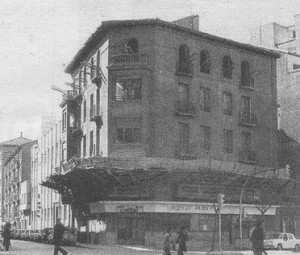
The apartment building on Gascón de Gotor Street where reports of the Zaragoza Goblin originated in 1934. The structure was later demolished in 1977.
Status: Verified
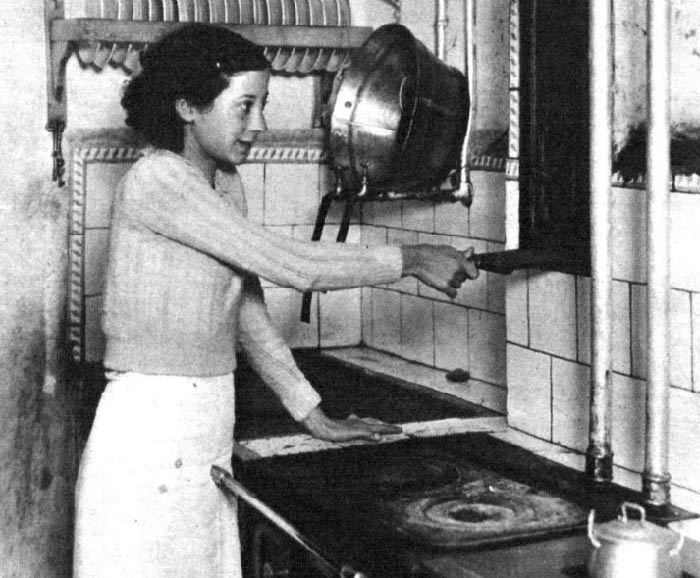
A young girl, often identified as Pascuala Alcocer, poses beside the chimney where witnesses claimed the mysterious voice originated.
Status: Verified
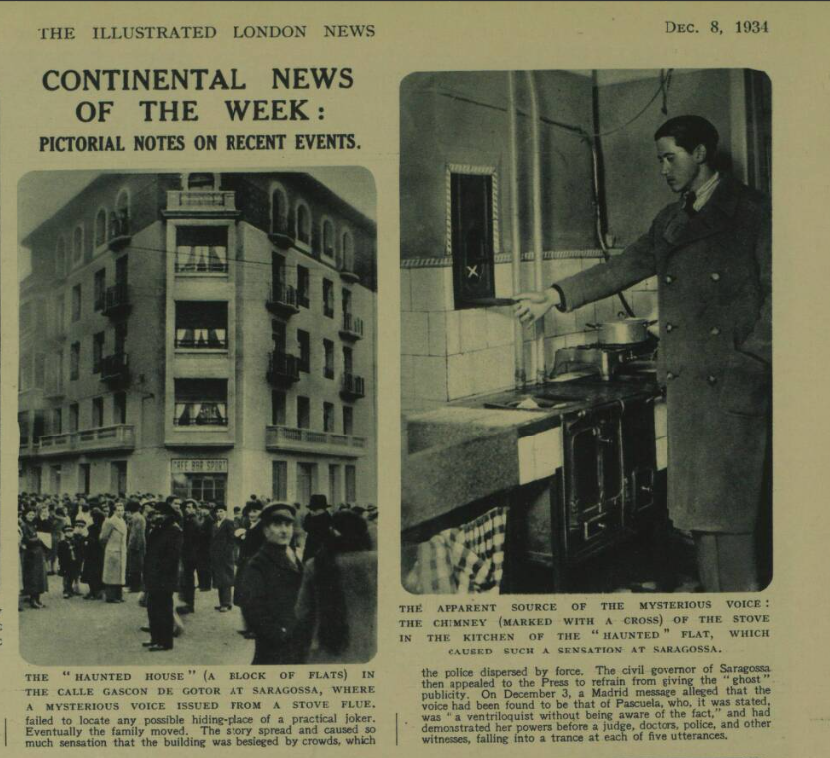
Illustrated London News - Dec 8, 1934
Status: Verified
Investigation timeline
- 2026-11-01 — Historical file submitted.
- 2026-11-01 — Research question opened: What records survive from the official investigation?
- 2026-11-01 — Research question opened: How reliable are the surviving newspaper accounts?
- 2026-11-01 — Research question opened: Did witnesses independently verify hearing the voice, or were reports influenced by publicity?
- 2026-11-02 — Historical file accepted and published.
Research notes
No curated research notes.
Open research questions
A specific gap in the file. An accepted source, research note, or further-reading link closes it.
What records survive from the official investigation?
How reliable are the surviving newspaper accounts?
Did witnesses independently verify hearing the voice, or were reports influenced by publicity?
Propose evidence & media, a source citation, further reading, a research note, a correction, a related case, or a series link. Staff review before anything is added. An accepted correction does not replace the file by itself.