GG-2026-146
Emilcin UFO Encounter
- Phenomenon UFOs/UAPs
- Documentation
Rating C
- A — Strong dossier: several independent sources plus primary evidence (original media, records, measurements) a researcher could use without interviewing anyone.
- B — Well documented: multiple independent witnesses with at least some contemporary primary material, or one witness with substantial primary corroboration (photos, recordings, contemporaneous notes, documents).
- C — Multi-source but soft: several witnesses or a long run of reports, but mostly testimony and after-the-fact secondary sources (newspapers, folklore collections, later interviews). Little or no primary physical evidence. Regional legend clusters such as the Bridgewater Triangle land here.
- D — Thin: single witness (or one household), little or no support beyond the account. Normal for a sincere personal experience.
- E — Incomplete or not yet assessed. Every new submission starts here until staff have read it.
- Evidence & media 2 items
- Status Historic
- Location Emilcin, Poland · approximate placement
- Occurred 10 May 1978
The encounter reportedly occurred near the village of Emilcin while Jan Wolski was traveling by horse-drawn cart. A UFO monument was later erected in the area associated with the reported encounter, making it one of the few UFO encounter sites marked by a permanent memorial.
Activity period
- Earliest claimed event 10 May 1978
- Earliest documented report 10 May 1978
- Latest documented report 10 May 1978
- Pattern Single event
Summary
On May 10, 1978, 71-year-old Polish farmer Jan Wolski reported an extraordinary encounter near Emilcin, Poland. Wolski said two short figures joined him while he was traveling by horse-drawn cart and accompanied him to a clearing where a large white object hovered above the ground. According to Wolski, he voluntarily entered the object on a platform and underwent a brief examination before being allowed to leave. Polish UFO researchers documented his account later that month, and a 1978 television production preserved an early version of his testimony. No authenticated photograph, sensor record, biological sample, or securely documented physical trace independently confirms Wolski's encounter. The case became Poland's best-known UFO encounter and was later commemorated with a public monument near Emilcin.
Background
On the morning of May 10, 1978, Jan Wolski, a 71-year-old farmer from Emilcin, Poland, said he was traveling by horse-drawn cart when two unfamiliar figures approached and joined him. Wolski described the figures as short, dressed in dark clothing, and speaking rapidly in a language he could not understand. He initially interpreted them as unusual-looking foreigners rather than extraterrestrial beings.
According to Wolski, the two figures remained with him until the cart reached a clearing where a large white object was hovering above the ground. He compared its size and shape with a bus and described a platform extending from the object toward the ground. Wolski said he followed the figures onto the platform and entered voluntarily.
Inside, Wolski reported seeing additional beings and simple furnishings or benches. He said the figures indicated that he should remove some of his clothing and then examined him using objects resembling round plates or dishes. Wolski did not describe the encounter as violent and reported that he was subsequently allowed to dress and leave. He then returned home and told family members what he believed had happened.
These details form the core of the Emilcin case, but they come from Wolski's testimony. No independent witness is known to have observed Wolski enter the reported object or undergo the examination. The familiar description of Emilcin as an “alien abduction” is therefore partly a later UFO classification: Wolski's own account describes a voluntary entry and examination rather than forced captivity.
The case came to the attention of Polish UFO researcher Zbigniew Blania-Bolnar, who interviewed Wolski later in May and helped preserve the account. A 1978 Polish television production also recorded an early retelling, giving researchers material produced much closer to the alleged encounter than the decades-later recollections available for many other famous UFO cases.
Investigators subsequently visited the reported location. Claims concerning disturbed vegetation, footprints, and other possible traces became associated with the case, but the surviving public record does not provide authenticated physical evidence capable of establishing that an unknown craft or biological entity had been present.
Another frequently cited element is a report attributed to a young local child who supposedly observed an unusual object. The account has often been presented as independent corroboration of Wolski's experience. Its surviving documentation is insufficient, however, to treat it as an independently verified observation matching Wolski's event in the way later summaries sometimes imply.
Medical, psychological, and credibility assessments have likewise become part of the Emilcin literature. Such material may help establish that investigators regarded Wolski as sincere or did not identify an obvious reason to dismiss his testimony, but assessments of sincerity cannot determine whether an extraordinary event objectively occurred as the witness perceived it.
This distinction is particularly important at Emilcin. A witness can be honest, consistent, and mistaken at the same time. Conversely, the absence of physical corroboration does not demonstrate that Wolski deliberately invented his experience. The evidentiary question is what the surviving record can establish independently of his testimony.
The case later became an important part of Polish UFO folklore. A monument commemorating the reported encounter was erected near Emilcin in 2005, giving the story a permanent public presence even though the underlying event remains unresolved.
The Emilcin encounter is therefore best understood as a well-preserved single-witness report rather than a verified alien-abduction event. Jan Wolski unquestionably told the story, the account was documented relatively soon after the alleged encounter, and early audiovisual material survives.
What the surviving evidence does not establish is that the reported beings or hovering object were objectively present. No authenticated event image, instrument record, biological sample, or securely documented physical trace independently confirms Wolski's extraordinary interpretation. The central unresolved question remains exactly what produced the experience Wolski described.
Witness statement
No statement on file.
Evidence & media
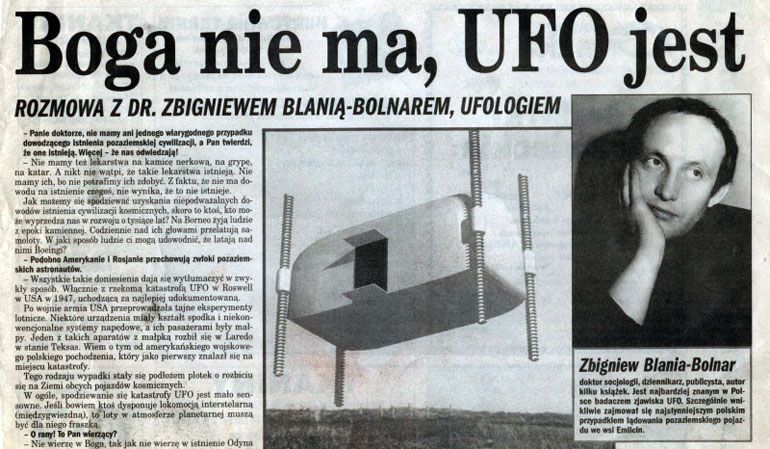
Interview with Zbigniew Blania-Bolnar
Press interview featuring UFO researcher Zbigniew Blania-Bolnar, whose investigation of the Emilcin encounter contributed significantly to the preservation and documentation of Jan Wolski's account in 1978.
Status: Verified
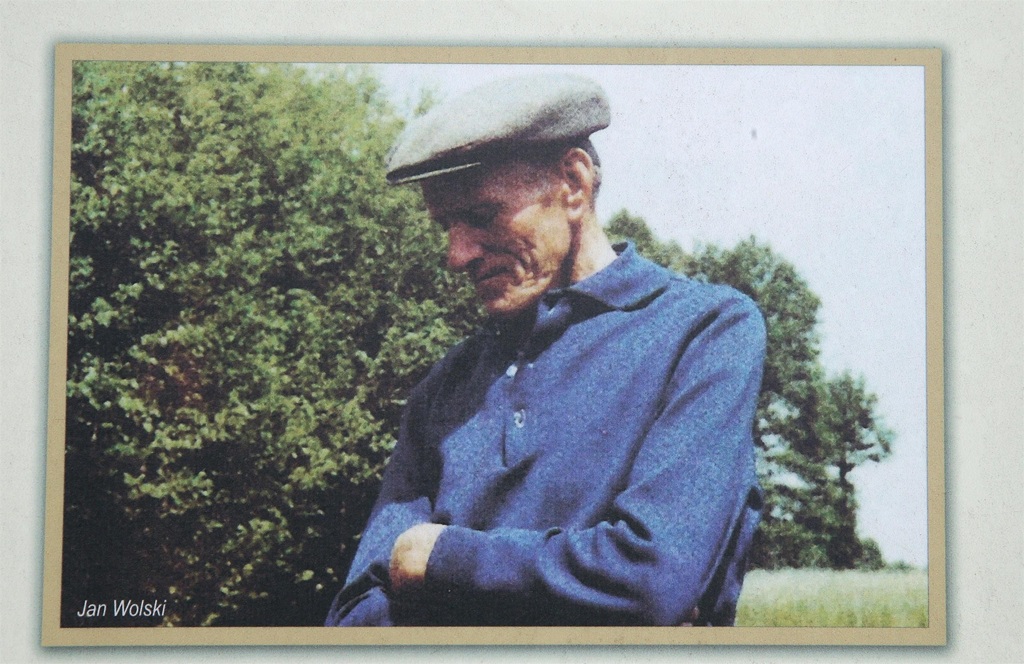
Jan Wolski (1907–1990)
Status: Verified
Investigation timeline
- 2026-11-03 — Historical file submitted.
- 2026-11-03 — Research question opened: What investigative records from 1978 remain available?
- 2026-11-03 — Research question opened: What significance, if any, should be attached to the child witness report?
- 2026-11-03 — Historical file accepted and published.
Research notes
No curated research notes.
Open research questions
A specific gap in the file. An accepted source, research note, or further-reading link closes it.
Which original 1978 interview, police, medical, television, and investigator records concerning the Emilcin encounter survive, and where are they archived?
Can the reported child sighting associated with the Emilcin encounter be traced to a contemporary statement or other independently preserved 1978 record?
Propose evidence & media, a source citation, further reading, a research note, a correction, a related case, or a series link. Staff review before anything is added. An accepted correction does not replace the file by itself.