GG-2026-158
Kongka La UFO Reports
- Phenomenon UFOs/UAPs
- Documentation
Rating C
- A — Strong dossier: several independent sources plus primary evidence (original media, records, measurements) a researcher could use without interviewing anyone.
- B — Well documented: multiple independent witnesses with at least some contemporary primary material, or one witness with substantial primary corroboration (photos, recordings, contemporaneous notes, documents).
- C — Multi-source but soft: several witnesses or a long run of reports, but mostly testimony and after-the-fact secondary sources (newspapers, folklore collections, later interviews). Little or no primary physical evidence. Regional legend clusters such as the Bridgewater Triangle land here.
- D — Thin: single witness (or one household), little or no support beyond the account. Normal for a sincere personal experience.
- E — Incomplete or not yet assessed. Every new submission starts here until staff have read it.
- Evidence & media 1 item
- Status Historic
- Location Ladakh, India · regional placement
- Occurred 2004
Regional marker identifying Kongka La Pass, the geographic focus of the UFO legend. It should not be interpreted as the verified location of any specific reported aerial phenomenon.
This file is placed as a region or body of water, not a single exact event location.
Activity period
- Earliest claimed event Unknown
- Earliest documented report Unknown
- Latest documented report Ongoing
- Pattern Recurring
Summary
The Kongka La UFO Reports concern claims that Kongka La Pass, a remote mountain pass on the disputed India-China frontier, is associated with unidentified aerial phenomena and even a supposed underground UFO base. Stories commonly describe unusual lights, unidentified objects, secret military knowledge, and craft allegedly entering or leaving the surrounding mountains, but reliable documentation tying these claims specifically to Kongka La is limited. Several better-known UFO incidents repeatedly incorporated into the legend, including reports from 2004 and 2012, occurred elsewhere in the broader Himalayan and Ladakh regions rather than at Kongka La itself. The area's actual remoteness, military sensitivity, and restricted accessibility appear to have provided fertile ground for increasingly elaborate speculation. No publicly verified evidence currently establishes the existence of an extraterrestrial facility beneath the pass or confirms extraordinary aerial activity specifically at Kongka La.
Background
Kongka La Pass is a remote high-altitude mountain pass on the Line of Actual Control between India and China in eastern Ladakh, adjacent to the disputed Aksai Chin region. The pass lies at approximately 5,171 meters elevation and has genuine historical significance in the long-running India-China border dispute. In 1959, an armed confrontation near the pass resulted in the deaths and capture of Indian personnel and became an important precursor to the worsening territorial conflict between the two countries.
Against this genuine background of remoteness, disputed territory, military presence, and restricted accessibility, Kongka La acquired a second and much less securely documented reputation as an alleged UFO hotspot. Modern accounts describe local residents, travelers, military personnel, and others supposedly observing unusual lights or unidentified objects in the surrounding region. More elaborate versions claim that objects emerge from or disappear into the mountains and that an underground extraterrestrial facility exists beneath the area. Some versions further claim that both Indian and Chinese authorities know about the alleged activity while deliberately concealing it. These allegations are repeatedly circulated in paranormal and popular-media sources, but publicly available evidence confirming them is lacking.
The development of the Kongka La legend is complicated because several notable UFO reports from elsewhere in the Himalayas and Ladakh have subsequently become associated with it. A frequently repeated 2004 account concerns an expedition of geologists and glaciologists led by Indian Space Research Organisation scientist Anil Kulkarni. The group reportedly observed and filmed a small humanoid or robot-like figure that eventually rose vertically and disappeared. However, accounts place this incident in the Lahaul-Spiti region of Himachal Pradesh, not at Kongka La Pass. Its frequent inclusion in modern Kongka La narratives therefore should not be treated as evidence of an event occurring at the pass itself.
A second group of reports dates to 2012, when Indian military and Indo-Tibetan Border Police personnel were reportedly concerned by repeated observations of luminous objects in Ladakh. Accounts describe an ITBP unit based at Thakung near Pangong Tso reporting numerous observations and subsequent attempts to investigate the objects using radar, spectrum-analysis equipment, and reconnaissance. These reports are geographically relevant to the larger Ladakh UFO tradition but likewise do not establish that the sightings occurred specifically at Kongka La Pass.
As the stories circulated online, Kongka La increasingly became described as India's equivalent of Area 51. Claims expanded beyond unidentified lights to include underground installations, strange satellite imagery, disappearing caves, malfunctioning aircraft navigation equipment, secret military technology, and agreements between India and China concerning the supposed phenomenon. Recent mainstream coverage continues to describe these allegations primarily as theories or popular beliefs and acknowledges the absence of concrete evidence for an extraterrestrial installation.
Possible conventional explanations for individual aerial observations in the wider region include astronomical objects, unusual atmospheric effects, terrestrial aircraft, surveillance systems, drones, military activity, and other phenomena. The region's exceptional geopolitical sensitivity also makes reliable public investigation difficult. At the same time, the absence of sufficient information about an individual observation does not by itself establish what produced it. Reports should therefore be evaluated individually rather than assigning every unexplained light either to extraterrestrial activity or to a single conventional explanation.
The most securely established facts surrounding the Kongka La story concern the pass itself: it is real, remote, strategically sensitive, historically contested, and difficult for ordinary observers to access. The extraordinary claims attached to it are considerably less secure. Available evidence suggests that the modern Kongka La UFO narrative has absorbed incidents from elsewhere in Ladakh and the Himalayas as it developed, making the history of that narrative as important to investigate as the alleged phenomena themselves. At present, no publicly verified evidence demonstrates an extraterrestrial base beneath Kongka La or establishes that the pass itself has experienced the concentration of unexplained aerial events attributed to it in popular retellings.
Witness statement
No statement on file.
Evidence & media
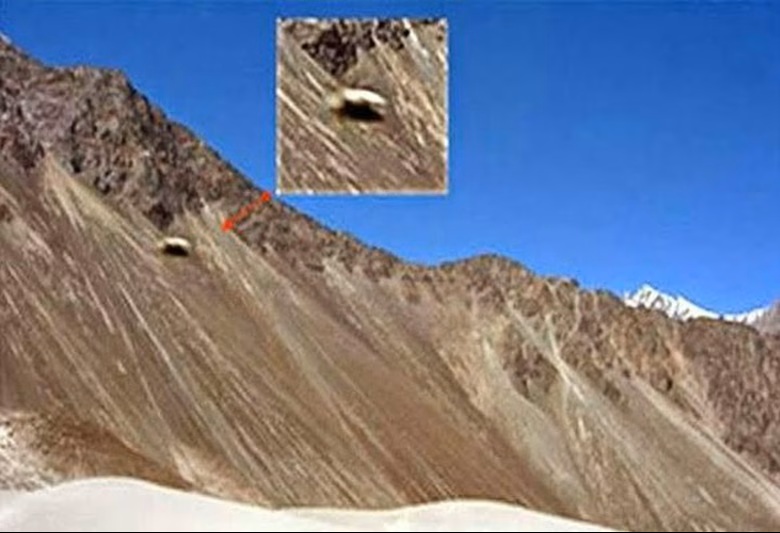
Purported Kongka La UFO Photograph
Widely circulated image purportedly showing an unidentified object near Kongka La Pass. The image appears across numerous later accounts of the Kongka La UFO legend, but its original photographer, capture date, precise location, and provenance have not been independently established.
Status: Attributed
Investigation timeline
- 2026-11-05 — Historical file submitted.
- 2026-11-05 — Research question opened
What is the earliest verifiable published source linking Kongka La Pass to UFO reports?
- 2026-11-05 — Research question opened
Can a documented chronology of Kongka La UFO reports between 2004 and 2012 be reconstructed?
- 2026-11-05 — Research question opened
When did the "underground UFO base" narrative first appear in public reporting?
- 2026-11-05 — Location precision revised from Exact to Regional.
- 2026-11-05 — Historical file accepted and published.
Assigned GG-2026-158
Research notes
No curated research notes.
Open research questions
A specific gap in the file. An accepted source, research note, or further-reading link closes it.
What is the earliest verifiable published source linking Kongka La Pass to UFO reports?
Which documented Himalayan and Ladakh UFO reports were later incorporated into the Kongka La narrative?
When did the "underground UFO base" narrative first appear in public reporting?
Propose evidence & media, a source citation, further reading, a research note, a correction, a related case, or a series link. Staff review before anything is added. An accepted correction does not replace the file by itself.