GG-2026-201
Caleuche Ghost Ship
- Phenomenon Apparitions & Spirits, Folklore & Cultural Encounters
- Documentation
Rating C
- A — Strong dossier: several independent sources plus primary evidence (original media, records, measurements) a researcher could use without interviewing anyone.
- B — Well documented: multiple independent witnesses with at least some contemporary primary material, or one witness with substantial primary corroboration (photos, recordings, contemporaneous notes, documents).
- C — Multi-source but soft: several witnesses or a long run of reports, but mostly testimony and after-the-fact secondary sources (newspapers, folklore collections, later interviews). Little or no primary physical evidence. Regional legend clusters such as the Bridgewater Triangle land here.
- D — Thin: single witness (or one household), little or no support beyond the account. Normal for a sincere personal experience.
- E — Incomplete or not yet assessed. Every new submission starts here until staff have read it.
- Evidence & media 2 items
- Status Historic
- Location Chiloé Archipelago, Los Lagos, Chile · regional placement
Regional marker representing the Chiloé Archipelago and surrounding channels associated with the Caleuche tradition. The legend belongs to a broad maritime cultural landscape rather than a single documented apparition or vessel location; the marker does not identify an exact sighting site.
This file is placed as a region or body of water, not a single exact event location.
Activity period
- Earliest claimed event Unknown
- Earliest documented report Unknown
- Latest documented report Unknown
- Pattern Recurring
Summary
The Caleuche is a legendary ghost or enchanted ship of the Chiloé Archipelago in southern Chile and one of the best-known figures in Chilote maritime mythology. Traditionally described as brilliantly illuminated and filled with music and celebration, the vessel is said to travel the islands and channels of Chiloé at night, sometimes disappearing, submerging or changing form when approached. Different traditions populate the Caleuche with drowned sailors, transformed or abducted mariners, supernatural beings and the brujos, or sorcerers, of Chiloé, while other versions connect it with the wider Chilote mythology of sea spirits such as Millalobo and the Pincoya. Chile's National Library treats the Caleuche as part of a broader mythological tradition shaped through interaction between Spanish and Huilliche cultural elements rather than as a documented historical vessel. The Caleuche is therefore firmly established as an important element of Chilote cultural identity, while claims that the tradition originated in encounters with a literal unidentified ship remain unverified.
Background
The Caleuche belongs to the maritime culture of the Chiloé Archipelago, a chain of islands off the coast of southern Chile whose geography encouraged the development of a distinctive regional identity. For generations, travel, fishing, trade and communication among Chilote communities depended heavily on the surrounding sea and intricate channels separating islands and coastal settlements. Isolation from central Chile also helped preserve and reshape traditions that developed from sustained contact among Indigenous Huilliche culture, Spanish colonial society and later Chilote communities. Memoria Chilena, operated by Chile's Biblioteca Nacional, describes Chilote mythology generally as the result of numerous intersections between Spanish tradition and Huilliche oral tradition.
Within that mythological landscape, the sea is populated not simply by ordinary animals and sailors but by powerful supernatural figures. Chilote traditions include the sea ruler Millalobo, the Pincoya and other beings associated with fishing, fertility, danger, death and the relationship between island communities and the ocean. The Caleuche occupies this same cultural world. Memoria Chilena describes it as a “barco de marineros muertos,” or ship of dead sailors, and classifies it among myths concerned with passage between states or worlds.
Descriptions of the vessel vary considerably. A recurring form portrays the Caleuche as a large sailing ship appearing at night, brilliantly illuminated and accompanied by music, voices or the sounds of celebration. It is said to move at extraordinary speed through the channels around Chiloé and disappear when approached. Other traditions give the ship supernatural abilities including traveling beneath the water or assuming other forms such as a rock or floating tree trunk in order to conceal itself. These characteristics establish the Caleuche as an enchanted or supernatural vessel within folklore rather than merely a conventional ship whose identity remained unknown.
Who or what travels aboard the ship also depends upon the version being told. Some traditions describe the Caleuche as carrying sailors who drowned at sea, connecting the ship directly with death and passage into another existence. Other versions say living sailors or fishermen can be drawn aboard, abducted or transformed and compelled to join its crew. The vessel consequently occupies an ambiguous place between refuge, afterlife, danger and supernatural captivity rather than functioning simply as an ominous ship of the dead.
The Caleuche is also repeatedly associated with the brujos, or sorcerers, of Chiloé. In those traditions the ship may transport supernatural practitioners between islands or serve as a site for secret gatherings and magical activity. These stories belong to the much larger Chilote system of beliefs involving witches, transformations, magical animals and supernatural travel. The connection became particularly influential as later writers attempted to assemble Chiloé's varied traditions into a more unified mythology.
Modern retellings frequently connect the ship more specifically with Millalobo and his children, including the Pincoya and related sea spirits who gather or guide people lost in the ocean. Those connections are consistent with the wider maritime mythology of Chiloé, but surviving variants do not always agree on the Caleuche's origin, purpose or crew. Gothic.Black therefore does not attempt to create one standardized “correct” version by combining every later account into a single narrative. Variation is part of the folklore rather than an error that needs to be repaired.
The name itself has accumulated competing explanations. One commonly repeated etymology derives “Caleuche” from Mapudungun terms relating to transformation or changing condition and people, an interpretation that fits the ship's ability to alter itself and those associated with it. Alternative linguistic explanations have also been proposed, and some writers have suggested historical ship names as possible sources for the legend. None of these competing etymologies should presently be presented as conclusively established.
The tradition did not remain confined to oral storytelling. During the twentieth century the Caleuche increasingly became part of Chilean literature, visual art and organized folkloric study. Writer Magdalena Petit developed the legend in dramatic and literary work during the twentieth century; Chile's Biblioteca Nacional preserves both manuscript material associated with that treatment and later documentation of the published work. Her novel Caleuche received recognition in the 1940s, demonstrating that the legend had entered national literary culture well beyond Chiloé itself.
The Biblioteca Nacional de Chile returned explicitly to the tradition in the 1995 exhibition Chiloé mundo fantástico, based on research by prominent Chilean folklorist Oreste Plath. The exhibition and surviving materials treated the Caleuche alongside the broader myths and cultural identity of Chiloé. This institutional preservation is important evidence for the history and significance of the tradition, but it establishes the Caleuche as folklore and cultural heritage rather than demonstrating the physical existence of an unidentified vessel.
As the legend became internationally known, it increasingly acquired the generic label “ghost ship.” The comparison is understandable but potentially misleading. European maritime folklore contains numerous phantom-ship traditions, most famously the Flying Dutchman, and cross-cultural influence on Chilote storytelling is entirely plausible given centuries of maritime contact and Spanish settlement. Yet treating the Caleuche merely as a Chilean version of a European ghost ship strips away the surrounding Chilote mythology of transformations, sorcery, drowned sailors and specialized sea beings that gives the tradition its local cultural identity.
Likewise, modern attempts to ask whether a particular historical shipwreck, disappearing vessel or optical phenomenon was “the real Caleuche” require caution. Fog, distant ship lights, unusual acoustics over water and vessels appearing or disappearing behind islands could undoubtedly create striking experiences within the Chiloé channels. Such mechanisms may explain individual observations without explaining the cultural tradition as a whole. The Caleuche is not merely an eyewitness report awaiting identification; it is a flexible body of folklore whose supernatural attributes developed through generations of storytelling.
The strongest historical conclusion is consequently straightforward. A rich and enduring Caleuche tradition exists and forms part of the distinctive cultural identity of Chiloé. Its versions changed through oral transmission, Indigenous and colonial cultural interaction, literature, folklore scholarship and modern tourism. Whether some stories preserve memories of unusual real-world maritime events remains open to investigation, but no physical ship or single sequence of independently documented sightings presently explains the tradition. For Gothic.Black, preserving those layers separately is more useful than reducing the Caleuche either to a literal ghost vessel or to a story that becomes meaningless once ordinary ships and fog are acknowledged.
Witness statement
No statement on file.
Evidence & media
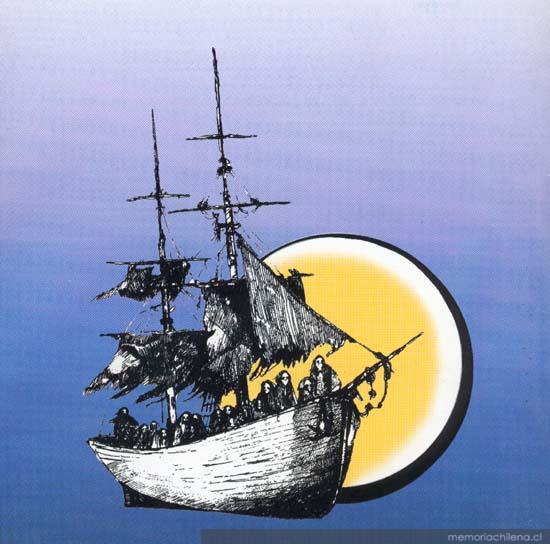
El Caleuche – Chilote Mythology Illustration
Illustration of the Caleuche preserved by Chile's National Library as part of the 1995 exhibition Chiloé mundo fantástico, based on research by folklorist Oreste Plath. The image documents Chilean cultural representation of the legendary vessel and is not presented as an eyewitness depiction or evidence of a physical ship.
Status: Verified
 The CALEUCHE: The CHILEAN GHOST SHIP that is SCARIER than the FLYING DUTCHMAN
Accessible overview of the Caleuche legend and its major variants within the maritime folklore of Chiloé. The video is included as a cultural introduction to the tradition rather than as evidence for sightings of a physical ghost ship.
Status: Verified
Sources
- Magdalena Petit Marfán. The Caleuche (1941) — Archival material associated with writer Magdalena Petit's literary treatment of the Caleuche legend. Petit's twentieth-century work helped carry the Chilote ghost-ship tradition into Chilean national literature and provides a documented stage in the modern cultural history of the legend.
- Religiosity, myth and Chilote identity
Further reading
Continue exploring — Wikipedia, documentaries, podcasts, museum pages. Not treated as proof, and not independently verified by this archive.
Investigation timeline
- 2026-11-11 — Historical file submitted.
- 2026-11-11 — Research question opened
What is the earliest surviving written source explicitly naming the Caleuche?
- 2026-11-11 — Research question opened
Which characteristics of the modern Caleuche tradition appear in the earliest documented versions, and which emerge only in later literary or folkloric treatments?
- 2026-11-11 — Research question opened
How did Huilliche maritime traditions and Spanish or European ghost-ship traditions influence the development of the Caleuche narrative?
- 2026-11-11 — Research question opened
When did the familiar association between the Caleuche, Millalobo, Pincoya and the souls of drowned sailors become standardized?
- 2026-11-11 — Research question opened
Can any claimed sightings of the Caleuche be connected to identifiable witnesses, dates and contemporary records independently of general folklore retellings?
- 2026-11-11 — Historical file accepted and published.
Assigned GG-2026-201
Research notes
Historical research: How Old Is the Caleuche Tradition?
The Caleuche is routinely described as an “ancient” or very old Chilote legend, but establishing the age of an oral tradition requires more than repeating that characterization. Chile's National Library identifies the Caleuche securely within Chilote mythology and preserves significant twentieth-century literary and folkloric treatments, but the earliest surviving written description remains a separate research question.
This distinction matters because Chilote mythology developed through sustained interaction between Huilliche oral culture and Spanish colonial traditions. The modern Caleuche may preserve elements of both, while particular details could have entered or changed through later maritime storytelling, published literature or organized folklore collection.
Recovering the earliest written versions would allow individual traits to be tracked historically: the brilliant lights, music, association with drowned sailors, ability to submerge or transform, connection with Chilote sorcerers and relationships with other maritime beings. Rather than asking only when “the Caleuche” first appeared, research should determine when each major component of the familiar modern tradition becomes traceable.
Open research questions
A specific gap in the file. An accepted source, research note, or further-reading link closes it.
What is the earliest surviving written source explicitly naming the Caleuche?
Which characteristics of the modern Caleuche tradition appear in the earliest documented versions, and which emerge only in later literary or folkloric treatments?
How did Huilliche maritime traditions and Spanish or European ghost-ship traditions influence the development of the Caleuche narrative?
When did the familiar association between the Caleuche, Millalobo, Pincoya and the souls of drowned sailors become standardized?
Can any claimed sightings of the Caleuche be connected to identifiable witnesses, dates and contemporary records independently of general folklore retellings?
Propose evidence & media, a source citation, further reading, a research note, a correction, a related case, or a series link. Staff review before anything is added. An accepted correction does not replace the file by itself.