GG-2026-226
Lake Kölmjärv Ghost Rocket Incident
- Phenomenon UFOs/UAPs
- Documentation
Rating B
- A — Strong dossier: several independent sources plus primary evidence (original media, records, measurements) a researcher could use without interviewing anyone.
- B — Well documented: multiple independent witnesses with at least some contemporary primary material, or one witness with substantial primary corroboration (photos, recordings, contemporaneous notes, documents).
- C — Multi-source but soft: several witnesses or a long run of reports, but mostly testimony and after-the-fact secondary sources (newspapers, folklore collections, later interviews). Little or no primary physical evidence. Regional legend clusters such as the Bridgewater Triangle land here.
- D — Thin: single witness (or one household), little or no support beyond the account. Normal for a sincere personal experience.
- E — Incomplete or not yet assessed. Every new submission starts here until staff have read it.
- Evidence & media 4 items
- Status Historic
- Location Överkalix Municipality, Norrbotten County, Sweden · regional placement
This Regional marker identifies Lake Kölmjärv as a public geographic reference point for the reported July 19, 1946 incident. It does not identify a verified impact point, witness position, object trajectory, or location of recovered debris. Access around the lake may cross private, forested, or environmentally sensitive land; observe local access rules and do not disturb the shoreline or lakebed while attempting to investigate the historical report.
This file is placed as a region or body of water, not a single exact event location.
Activity period
- Earliest claimed event 19 July 1946
- Earliest documented report 19 July 1946
- Latest documented report 19 July 1946
- Pattern Single event
Summary
On July 19, 1946, witnesses near Lake Kölmjärv in northern Sweden reported seeing a small gray, rocket-like object descend toward and apparently enter the lake, producing a substantial disturbance in the water. The report occurred during the wider Scandinavian “ghost rocket” wave, when Swedish authorities were investigating hundreds of unusual aerial observations amid concerns about possible Soviet testing of captured German missile technology. Representatives of Sweden’s Defence Research Establishment visited the alleged impact area on July 20–21 and searched for projectile fragments, physical disturbance, and residual radioactivity, but no object was conclusively recovered. Meteors, aircraft, experimental missiles, perceptual error, and misinterpreted water disturbance remain possible explanations, while the absence of recovered wreckage prevents confident identification. The incident remains one of the better-documented individual cases within the 1946 ghost-rocket wave because the witness report prompted a rapid official investigation preserved in contemporary records.
Background
During the summer and autumn of 1946, Sweden experienced an extraordinary wave of reports involving luminous, rocket-like, cigar-shaped, or otherwise unusual objects moving through the sky. The sightings became popularly known as spökraketer, or “ghost rockets.” The timing was significant. Only months had passed since the end of the Second World War, German V-1 and V-2 missile technology had demonstrated the military potential of long-range unmanned weapons, and Soviet forces controlled former German missile facilities and technical resources. Swedish authorities therefore had legitimate national-security reasons to investigate whether some of the reports represented testing of captured or newly developed missile technology. Close to 1,000 reports were ultimately collected in Sweden during the principal 1946 wave.
One of the most significant individual incidents occurred at Lake Kölmjärv in Norrbotten County on July 19, 1946. Later reconstructions identify Knut Lindbäck, Beda Persson, and Frideborg Tagebo as witnesses near the lakeshore that morning. According to the surviving account, the witnesses were engaged in haymaking when a humming sound drew their attention toward the sky. A gray or ashen-colored, rocket-like object was then reportedly observed descending toward the lake.
The object was described as relatively small compared with conventional aircraft or large military rockets. The surviving Swedish investigation material records an eyewitness estimate of approximately three meters in length, while some later reconstructions place the estimate closer to two meters. Because the dimensions were determined through visual comparison rather than physical measurement, the object's actual size cannot be established with confidence.
The witnesses reported that the object entered or struck the lake. Accounts describe a substantial disturbance of the water associated with the apparent impact. If interpreted literally, the observation differed from many ghost-rocket reports that involved objects simply crossing the sky because it suggested a definite endpoint at a potentially searchable location. This made Lake Kölmjärv particularly interesting to Swedish investigators.
The response was unusually rapid. Representatives from Sweden's defence research establishment traveled to the reported impact area on July 20–21, 1946, only one to two days after the alleged event. A surviving official report explicitly identifies the purpose of the visit as examining the alleged impact location and investigating possible projectile material. The investigators were also interested in determining whether unusual residual radioactivity might be present, partly because the apparently small size attributed to the object raised questions about what propulsion system could have produced the performance witnesses believed they had observed.
The fact that Swedish defence researchers considered radioactivity or advanced propulsion possibilities should not be interpreted as evidence that the object was nuclear-powered or otherwise exotic. Those possibilities reflected investigative questions being considered in an era when rockets, atomic energy, and captured German technology were subjects of intense military interest. No evidence presently available demonstrates that investigators detected radiation proving an unconventional propulsion system.
Searches of the lake and surrounding area failed to recover a projectile that could be conclusively associated with the sighting. No intact rocket, engine, recognizable aircraft component, or other object was recovered that established what the witnesses had observed. Reports from the larger ghost-rocket investigation occasionally mention slag or unidentified fragments associated with alleged impact sites, but surviving intelligence assessments emphasized that no material had been recovered that conclusively demonstrated a guided-missile origin for the broader phenomenon.
The unsuccessful recovery effort created an evidentiary problem that remains central to the Lake Kölmjärv case. A missile or aircraft striking a relatively confined lake might reasonably be expected to leave recoverable debris. At the same time, failure to locate wreckage does not establish that the witnesses fabricated the event. Estimates of trajectory, distance, size, and precise impact position were based on human observation rather than instrument tracking, and the perceived water disturbance may not necessarily have originated where observers believed the object entered.
The incident cannot be separated from the much larger 1946 Scandinavian ghost-rocket wave. Swedish military authorities had already begun systematically collecting reports of unexplained aerial phenomena, and on June 12 the Defence Staff instructed military units to use standardized reporting procedures. A multi-agency committee was subsequently created to analyze the continuing reports. More than 300 sightings were reportedly submitted on August 11 alone.
The most immediate conventional hypothesis was Soviet missile testing. Germany's V-1 flying bomb and V-2 ballistic missile programs had demonstrated technologies that Allied governments expected the Soviet Union to study and develop. Soviet forces had gained access to parts of Germany's missile infrastructure, specialists, and technical material at the end of the war. A top-secret American intelligence memorandum produced during the 1946 wave considered Soviet guided-missile testing in the Baltic region a serious possibility.
That interpretation was never conclusively established. American and Swedish assessments changed as investigators accumulated additional reports. A January 1947 U.S. War Department intelligence review concluded that many observations were probably ordinary phenomena, including meteors, fireworks, flares, or other aerial objects. The same assessment nevertheless considered it possible that a small number of the better reports represented actual low-flying V-1-type missiles. No surviving official analysis identified the Lake Kölmjärv object conclusively as Soviet equipment.
Natural explanations must also be considered. The ghost-rocket wave included numerous reports resembling meteors and bright bolides, particularly during periods of heightened meteor activity. A bright meteor descending toward the horizon can create a strong impression of entering nearby terrain or water even when the object is many kilometers away. Estimating the distance and size of an unfamiliar object seen against an open sky is inherently difficult because observers often lack reliable scale references.
The reported humming sound and relatively slow apparent descent complicate a straightforward meteor explanation if those details are preserved accurately in the earliest witness material. Conversely, later retellings can unintentionally sharpen or standardize details that were more ambiguous in the original testimony. Recovering the complete original witness statements is therefore important before assigning too much weight to individual descriptive elements.
Aircraft, experimental weapons, or other human technology also remain plausible categories. Sweden's postwar geographical position and the rapid development of military aviation and missile technology meant observers could encounter aircraft configurations, contrails, sounds, or trajectories unfamiliar to the general public. The Swedish government's serious examination of missile explanations demonstrates that officials themselves considered terrestrial technology a credible possibility.
Later UFO literature has sometimes interpreted the absence of wreckage at alleged lake-impact sites as evidence that ghost rockets were exotic craft capable of continuing beneath the water, dissolving, self-destructing, or otherwise avoiding recovery. The surviving investigative record does not demonstrate any of those mechanisms. Lack of recovered debris is an unresolved evidentiary absence, not positive evidence for an extraordinary disappearance mechanism.
The Lake Kölmjärv incident nevertheless deserves greater weight than many isolated historical UFO reports. It involved multiple reported witnesses, a narrowly defined date and location, an alleged physical impact, and an official investigation begun almost immediately afterward. The surviving government documentation establishes that Swedish defence researchers regarded the report seriously enough to inspect the site and search for physical evidence.
What that documentation does not establish is equally important. No recovered object proves that a missile entered the lake. No authenticated photograph shows the reported object. No radar record presently available can be tied specifically to this incident. No physical sample demonstrates extraterrestrial, interdimensional, or otherwise exotic technology.
The most defensible conclusion is therefore that the Lake Kölmjärv event represents a well-documented historical report of an unidentified aerial object followed by an unsuccessful official search for physical evidence. Soviet missile testing, natural phenomena, conventional or experimental aircraft, errors in distance and trajectory estimation, and other terrestrial explanations remain viable. The surviving evidence is strong enough to establish the report and investigation, but not strong enough to identify the object that witnesses believed they saw enter the lake.
Witness statement
No statement on file.
Evidence & media
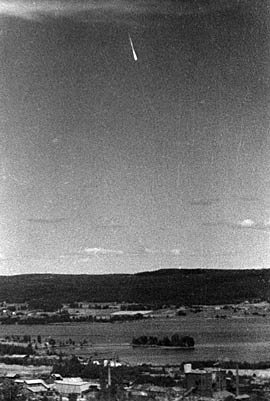
Erik Reuterswärd Ghost Rocket Photograph
Widely circulated 1946 photograph by Erik Reuterswärd showing a bright, elongated object or streak descending through the sky during Sweden's Ghost Rocket wave. Reuterswärd reportedly suspected that the photograph depicted a meteor, while the Swedish Army, which released the image, was less certain of the object's identification. The photograph documents the broader 1946 Ghost Rocket investigation and should not be interpreted as an image of the July 19 Lake Kölmjärv incident itself.
Status: Verified
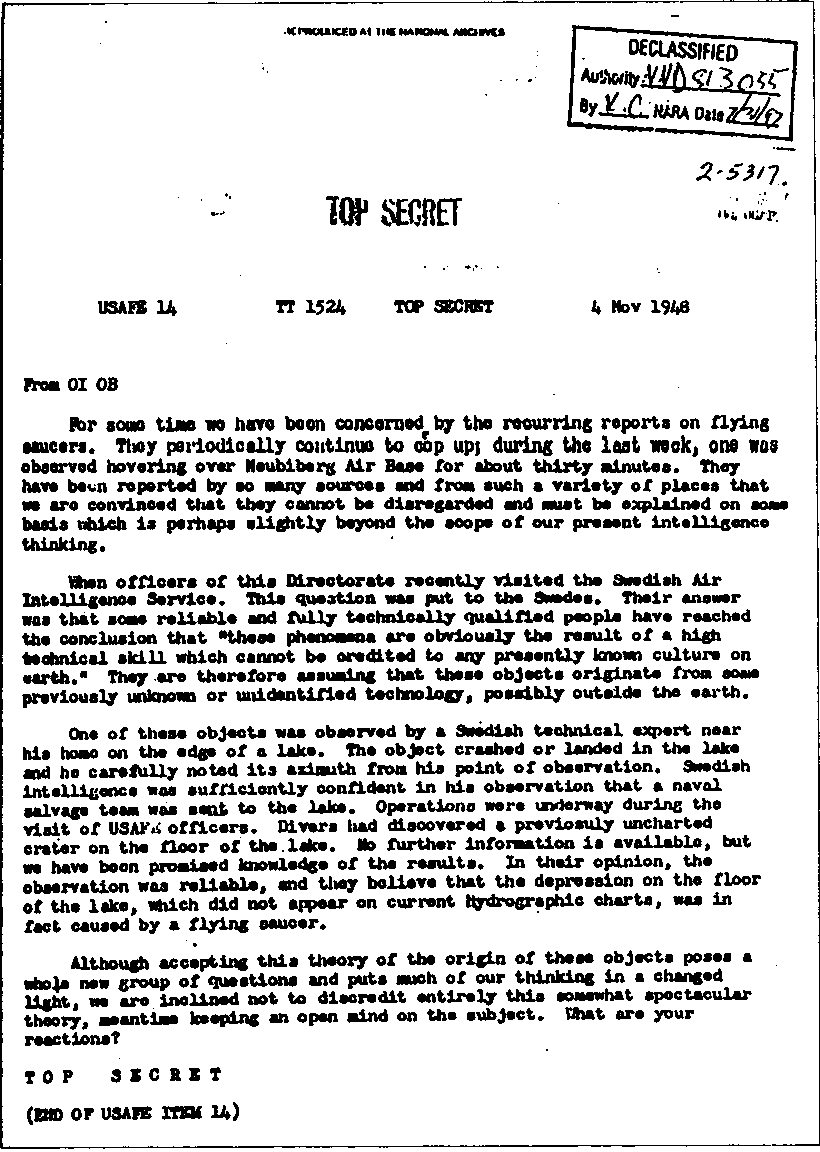
1948 USAF Intelligence Memorandum on the Swedish Ghost Rockets
Declassified U.S. Air Force intelligence memorandum dated November 4, 1948, discussing continuing reports of unidentified flying objects and the earlier Swedish Ghost Rocket investigations. The document states that Swedish Air Intelligence contacts had expressed the opinion that some reliable and technically qualified observers believed certain reported objects could not be explained by presently known terrestrial technology and might originate from previously unknown technology “possibly outside the earth.” The memorandum also refers to a Swedish lake incident in which an object reportedly crashed or landed in the water and a Swedish salvage team searched the lake without recovering it. The document records an intelligence assessment and reported Swedish opinions; it does not establish that the objects were extraterrestrial or that the referenced lake incident was necessarily Lake Kölmjärv.
Status: Verified
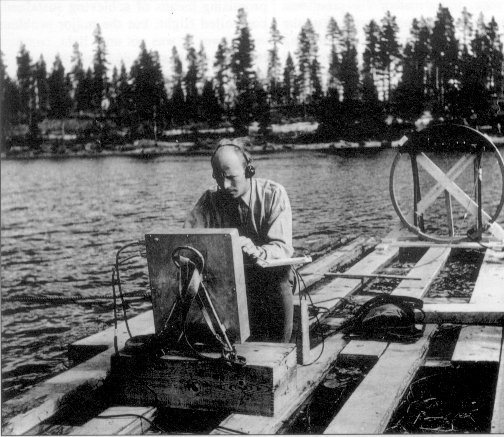
Search of Lake Kölmjärv Following the 1946 Ghost Rocket Report
Swedish investigators search Lake Kölmjärv following the reported July 19, 1946 Ghost Rocket incident. Contemporary accounts state that witnesses reported a rocket-like object descending into the lake, prompting Swedish authorities to search the alleged impact area for wreckage or other physical evidence. This photograph documents the official search operation; despite the investigation, no projectile or debris was conclusively recovered that established the identity of the reported object.
Status: Verified
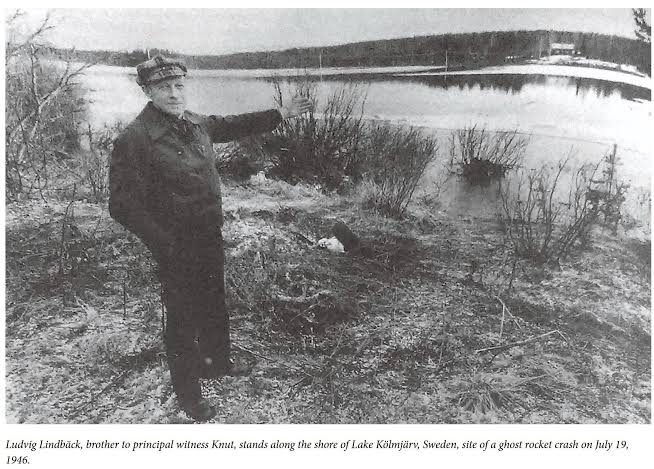
Lake Kölmjärv Shoreline at the Reported Ghost Rocket Site
Historical photograph of the shoreline of Lake Kölmjärv, Sweden, associated with the reported July 19, 1946 Ghost Rocket incident. The original printed caption identifies the person pictured as a relative of one of the principal witnesses and describes the location as the site of the reported lake impact. The photograph provides historical location context for the incident; it does not show the aerial object itself or establish the precise point at which the object reportedly entered the water.
Further reading
Continue exploring — Wikipedia, documentaries, podcasts, museum pages. Not treated as proof, and not independently verified by this archive.
Investigation timeline
- 2026-11-25 — Historical file submitted.
- 2026-11-25 — Research question opened
Can the complete Swedish Defence Staff and Defence Research Establishment file for the Lake Kölmjärv incident be recovered and translated in full?
- 2026-11-25 — Research question opened
Do original signed or recorded statements from Knut Lindbäck, Beda Persson, Frideborg Tagebo, or other witnesses survive in Swedish archives?
- 2026-11-25 — Research question opened
Can the witnesses’ exact positions, sight lines, object trajectory, and reported impact point be reconstructed from contemporary maps and investigation records?
- 2026-11-25 — Research question opened
What physical disturbances were actually documented in the lake or lakebed, and were those observations made before or after intensive searching began?
- 2026-11-25 — Historical file accepted and published.
Assigned GG-2026-226
Research notes
No curated research notes.
Open research questions
A specific gap in the file. An accepted source, research note, or further-reading link closes it.
Can the complete Swedish Defence Staff and Defence Research Establishment file for the Lake Kölmjärv incident be recovered and translated in full?
Do original signed or recorded statements from Knut Lindbäck, Beda Persson, Frideborg Tagebo, or other witnesses survive in Swedish archives?
Can the witnesses’ exact positions, sight lines, object trajectory, and reported impact point be reconstructed from contemporary maps and investigation records?
What physical disturbances were actually documented in the lake or lakebed, and were those observations made before or after intensive searching began?
Propose evidence & media, a source citation, further reading, a research note, a correction, a related case, or a series link. Staff review before anything is added. An accepted correction does not replace the file by itself.