Activity period
- Earliest claimed event Unknown
- Earliest documented report Unknown
- Latest documented report Unknown
- Pattern Recurring
Summary
The Witch House (Jonathan Corwin House), 310 Essex Street, Salem, was the home of magistrate Jonathan Corwin, who examined accused people in 1692 and later sat on the Court of Oyer and Terminer. It is widely described as the only surviving Salem building with a direct connection to the trials. Modern claims include colonial figures, voices, footsteps, cold spots, and a later "Corwin curse." The house and Corwin's role are documented. A popular story that examinations happened inside the house is not supported by surviving records. Haunt reports remain unverified.
Background
Jonathan Corwin, a Salem merchant born in 1640, purchased the house in 1675. Construction is usually placed sometime between the 1640s and 1675. He lived there for more than forty years. The house stayed in the family into the mid-nineteenth century, later faced demolition during a North Street widening, was saved by local fundraising, and opened as a museum in 1948. It interprets seventeenth-century domestic life and Corwin's connection to 1692.
In the witchcraft crisis Corwin, with John Hathorne, conducted preliminary examinations of the accused. Those examinations are documented at the Salem Village meetinghouse, the town meetinghouse, and taverns. The Salem Witch Museum states there is no evidence they were held in this Essex Street house, despite a long tourist tradition that they were. Corwin also served on the Court of Oyer and Terminer, which sent people to the gallows. He later sat on the Superior Court, showed no public remorse, died in 1718, and is buried at Broad Street Cemetery.
Haunt lore, mostly modern and tourism-fed, includes colonial-dressed figures, shadows, whispers, a child's voice, doors, footsteps, cold spots, and a feeling of being watched. Some tellers assign the figures to executed victims; others to the Corwin household. Neither identification is established. A separate "Corwin curse" story treats later family deaths as supernatural payback. Those deaths can be historical without a curse being historical.
Witness statement
No statement on file.
Evidence & media
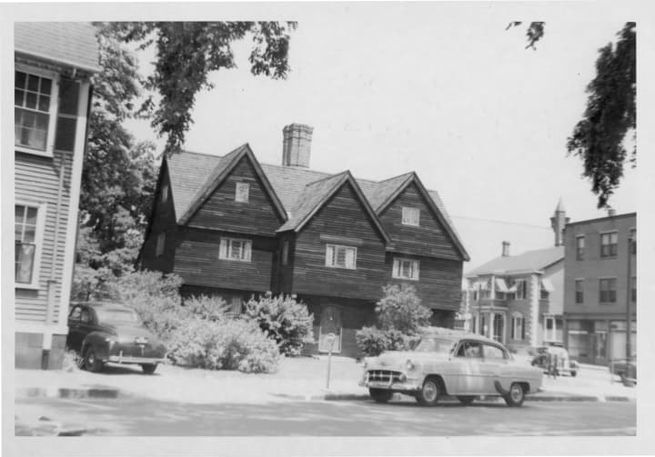 Jonathan Corwin House circa 1950
Investigation timeline
- 2026-09-22 — Historical file submitted.
- 2026-09-22 — Historical file accepted and published.
Research notes
Historical research: Strong house file, soft ghost file
Settled: Corwin's ownership from 1675; his role examining the accused and on the Court of Oyer and Terminer; survival and museum use of the house; no surviving proof that trial examinations were held in the residence.
Not settled: apparitions, voices, cold spots, or a curse. Timber, floors, and crowds explain many sounds without closing the question.
Do not let the trials' documentary strength raise this haunt rating. Link to the Salem Witch Trials file as Related (same historical world, different event), not Same event.
Open research questions
A specific gap in the file. An accepted source, research note, or further-reading link closes it.
Locate the earliest traceable published paranormal account of the Witch House and distinguish documented reports from later stories derived primarily from its association with Jonathan Corwin and the 1692 trials
Propose evidence & media, a source citation, further reading, a research note, a correction, a related case, or a series link. Staff review before anything is added. An accepted correction does not replace the file by itself.