Activity period
- Earliest claimed event Unknown
- Earliest documented report Unknown
- Latest documented report Unknown
- Pattern Recurring
Summary
The Hawthorne Hotel, opened 23 July 1925 on Washington Square in Salem and named for Nathaniel Hawthorne, is a frequent stop on the city’s haunted-hotel circuit. Recurring claims center on Room 612 (a woman in white), Room 325 (a crying child, faucets and lights, touches or pulled sheets), a sudden apple scent, and a ship’s wheel said to turn by itself. The building’s history is documented. Identifying any figure as Bridget Bishop, or placing her orchard under this hotel, is folklore that conflicts with the usual historical placement of that orchard at the Lyceum site.
Background
The Hawthorne Hotel opened on July 23, 1925, overlooking Salem Common and was named in honor of author Nathaniel Hawthorne. Built during a period of civic investment in Salem’s tourism and cultural identity, the Colonial Revival hotel quickly became one of the city’s best-known landmarks. Its location near several Hawthorne-related sites, including the relocated Hawthorne birthplace, further strengthened its connection to Salem’s literary heritage.
The hotel was constructed by a locally organized company that sold stock to investors throughout the region. The project reflected Salem’s desire for a modern hotel that could serve tourists, business travelers, and visitors drawn by the city’s history. From its opening, the hotel became an important social and civic venue that hosted generations of guests and public events.
A notable feature of the hotel is its connection to the Salem Marine Society, which retained a meeting space within the building. That space was designed as a rooftop cabin modeled on the East Indiaman Taria Topan, reflecting Salem’s maritime past. Several decorative nautical elements remain associated with the hotel, including a ship’s wheel that later became part of local ghost stories. According to hotel lore, the wheel occasionally turns on its own, though no independently documented evidence has established a paranormal cause.
Most haunting reports associated with the hotel are twentieth- and twenty-first-century in origin. The best-known stories focus on two guest rooms.
Room 612 is associated with reports of a woman in white seen in hallways or guest rooms before suddenly disappearing. Some paranormal retellings identify the figure as Bridget Bishop, the first person executed during the Salem witch trials. However, this attribution is difficult to support historically. The widely accepted location of Bishop’s orchard is associated with the Church Street and Lyceum area rather than the site occupied by the Hawthorne Hotel. As a result, claims linking Bishop directly to the hotel appear to be later folklore rather than documented history.
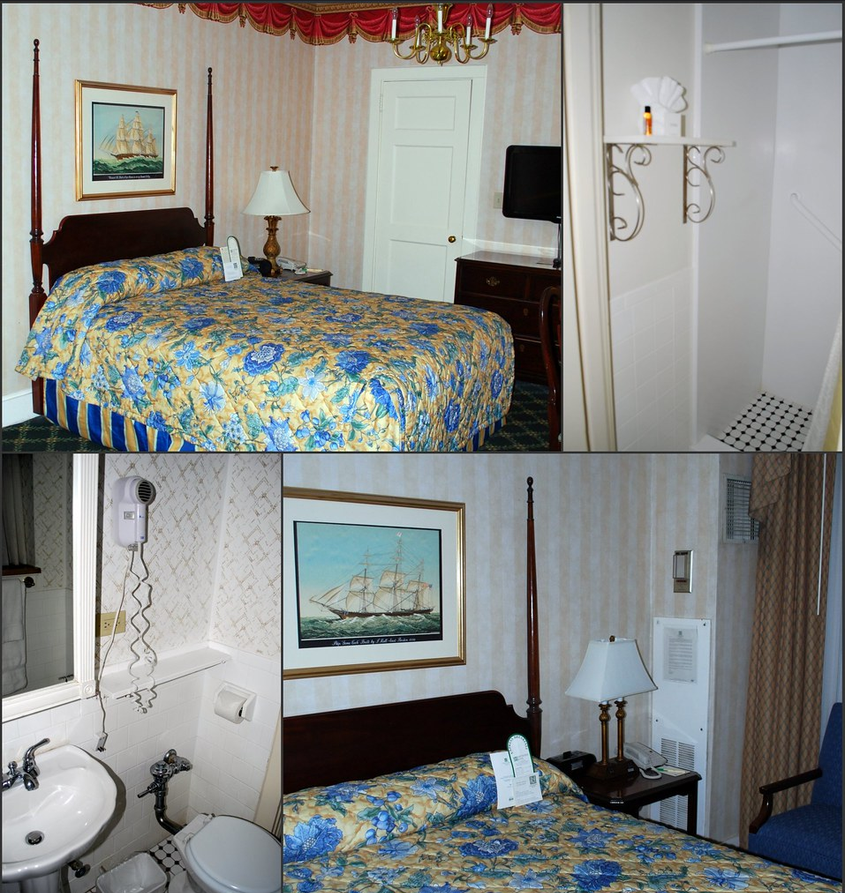
Room 325 is connected to a different collection of reports. Guests and staff have described the sound of a crying child, unexplained operation of lights and faucets, sensations of being touched, and incidents involving bedsheets being pulled or disturbed during the night. These accounts have circulated for years in hotel and tour narratives, though none have been independently verified.
Another frequently repeated claim involves the sudden smell of apples appearing in hallways or guest rooms where no obvious source is present. As with the alleged appearances of Bishop, these reports are often folded into the orchard legend despite the lack of evidence connecting Bishop’s property to the hotel site. The scent reports remain anecdotal and open to multiple interpretations.
Additional stories describe unexplained knocks, footsteps, voices, and shadow figures throughout the building. These reports vary considerably in detail and are typical of the kinds of experiences often reported in historic hotels with long operational histories. Witnesses may sincerely report unusual events, but the available accounts do not establish a paranormal explanation.
The hotel has also become part of modern paranormal media culture. A 2007 investigation by the television series Ghost Hunters brought national attention to the property, and a well-publicized Houdini séance was held in the ballroom in 1990. These events contributed to the hotel’s haunted reputation but did not produce evidence capable of resolving the underlying claims. The hotel also appeared in popular television productions, including Bewitched, though such connections belong to its cultural history rather than its paranormal record.
Today, the Hawthorne Hotel occupies a unique place in Salem’s folklore landscape. Its history as a prominent hotel, its literary and maritime associations, and its long-standing reputation for unusual experiences have combined to make it one of the city’s most discussed haunted locations. The building’s history is well documented; the reported hauntings remain anecdotal and unresolved.
Witness statement
No statement on file.
Evidence & media
Screenshot 2026-09-22 215925
The Hawthorne Hotel, rm 325 - 2010
Further reading
Continue exploring — Wikipedia, documentaries, podcasts, museum pages. Not treated as proof, and not independently verified by this archive.
Investigation timeline
- 2026-09-22 — Historical file submitted.
- 2026-09-22 — Historical file accepted and published.
Assigned GG-2026-020
Research notes
Historical research: Documented hotel, soft rooms, wrong orchard
Settled: 1925 opening, Hawthorne name, Common-edge site, Marine Society cabin, long public ghost reputation.
Not settled: Room 612 or 325 as paranormal; the white lady as Bridget Bishop; apple scent as her orchard. Keep those as guest lore. Point the land claim at GG-2026-018 (Lyceum), Related only.
Steel, plumbing, neighboring rooms, and expectation remain open explanations for cries, water, lights, and a wheel that can be bumped or unbalanced. Investigation traffic and “request the haunted room” booking shape what gets reported.
Open research questions
A specific gap in the file. An accepted source, research note, or further-reading link closes it.
Establish the earliest traceable paranormal report associated with the Hawthorne Hotel and determine when specific room and apparition stories first entered the hotel's folklore.
Propose evidence & media, a source citation, further reading, a research note, a correction, a related case, or a series link. Staff review before anything is added. An accepted correction does not replace the file by itself.