Activity period
- Earliest claimed event Unknown
- Earliest documented report Unknown
- Latest documented report Ongoing
- Pattern Ongoing
Summary
USS Salem (CA-139), a Des Moines-class heavy cruiser commissioned in 1949 and now a museum ship at Quincy, Massachusetts, is among New England’s best-known “haunted” naval vessels. She never fought a major surface action with heavy combat dead aboard; her most-cited historical link to later ghost lore is the August 1953 Ionian Islands earthquake relief, when Salem and other Sixth Fleet ships delivered aid and medical help. As a museum she hosts many paranormal investigations reporting voices, EVPs, shadows, and footsteps. Relief history is real; spirits of quake victims or crew are unverified.
Background
Salem was built at Bethlehem’s Quincy yard, commissioned at Boston Navy Yard on 14 May 1949, and served as a Sixth (and Second) Fleet flagship in the early Cold War. She was decommissioned in 1959, preserved, and opened as the United States Naval Shipbuilding Museum in Quincy in the mid-1990s — the only preserved heavy cruiser of her type.
In August 1953 major earthquakes devastated Cephalonia, Zante, Ithaca and nearby Ionian islands. An international naval armada responded. Contemporary press (e.g. reports filed from Salem in Argostoli Harbor; Time’s coverage) describe Salem and other U.S. ships putting doctors and medical aides ashore, landing stores, and helping evacuate the injured. Death and injury tolls on the islands were high. Museum and ghost-tour narratives later say spaces aboard Salem served as treatment or morgue areas for large numbers of civilian casualties, with estimates of “well over a thousand” treated in a few days and many dying of mortal injuries. That onboard scale is asserted by the museum’s paranormal pages more strongly than by the 1953 news dispatches checked here; treat shipboard morgue/hospital intensity as contested secondary lore built on a documented relief mission.
Haunt reports (especially after museum opening and commercial investigations) include shadow figures in passageways, brief apparitions near former medical spaces, footsteps and metallic sounds on empty decks, and abundant EVP/voice claims. Recurring motifs include a female presence near treatment areas (often tied by tellers to quake victims) and activity in spaces such as the operating room, bakery, and anchor areas (including separate volunteer/crew folklore). Steel hull acoustics, HVAC, visitors, and expectation complicate sound and sight claims. Travel Channel and similar shows have featured the ship; the museum markets ghost tours and investigation nights.
Witness statement
No statement on file.
Evidence & media
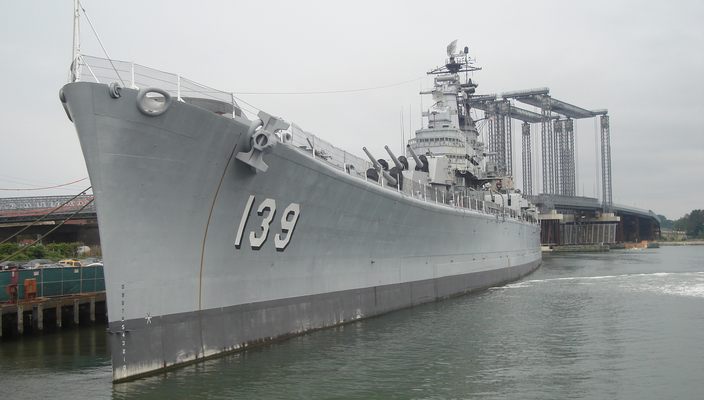 USS Salem
Investigation timeline
- 2026-09-22 — Historical file submitted.
- 2026-09-22 — Historical file accepted and published.
Research notes
Historical research: What makes the USS Salem interesting
The USS Salem differs from many haunted locations because the historical component is unusually clear.
Researchers generally agree:
The ship exists.
Its service history is documented.
Its involvement in the Greek earthquake relief effort is documented.
The vessel has accumulated a large body of paranormal reports.
This creates an unusual situation where the alleged origin story for the hauntings is tied to a real historical event rather than a purely legendary one.
That does not validate the paranormal claims, but it gives them a stronger historical framework than many ghost stories.
Historical research: Documented mission, soft spirits
Settled: hull identity and career; Quincy museum berth; participation in 1953 Greek earthquake relief with medical personnel and supplies.
Not settled: that large numbers died aboard Salem; that any named spirit is a 1953 victim or sailor; that EVPs are postmortem speech. Investigation volume is high because the site invites investigators — quantity ≠ verification.
Do not invent combat ghosts the ship’s record doesn’t support. Keep quake-aid history and ghost packaging in separate sentences.
Related: other Boston-area Active haunts (Majestic, Common, Parker House) — Related only.
Historical research: Naval Architecture, Auditory Anomalies, and Environmental Infrasound
The USS Salem, a heavy cruiser anchored in Quincy, Massachusetts, serves as a prominent field location for maritime ghost research and anomalous auditory phenomena. Witnesses and investigators frequently report full-form apparitions, disembodied commands, and localized temperature drops within the steel-hulled vessel.
From a scientific and anomalous perspective, the ship presents a unique laboratory for studying environmental drivers of paranormal perception versus genuine residual phenomena. Academic research questions focus on how closed-environment steel bulkheads, structural resonance, and low-frequency infrasound (generated by nearby tidal movements and ambient harbor vibrations) influence human temporal lobes to induce hallucinations or feelings of a presence. Concurrently, parapsychologists investigate whether large metal structures act as conductors or physical storage mediums for residual human emotional fields—specifically related to the ship's historic role as a hospital vessel during the 1953 Ionian earthquake.
Open research questions
A specific gap in the file. An accepted source, research note, or further-reading link closes it.
Locate the earliest traceable paranormal report associated with USS Salem and determine whether the haunting tradition began with former crew members, museum staff, visitors, or later paranormal investigations.
Propose evidence & media, a source citation, further reading, a research note, a correction, a related case, or a series link. Staff review before anything is added. An accepted correction does not replace the file by itself.