GG-2026-029
Pascagoula Encounter
- Phenomenon UFOs/UAPs, Spatiotemporal Anomalies (Missing Time)
- Documentation
Rating B
- A — Strong dossier: several independent sources plus primary evidence (original media, records, measurements) a researcher could use without interviewing anyone.
- B — Well documented: multiple independent witnesses with at least some contemporary primary material, or one witness with substantial primary corroboration (photos, recordings, contemporaneous notes, documents).
- C — Multi-source but soft: several witnesses or a long run of reports, but mostly testimony and after-the-fact secondary sources (newspapers, folklore collections, later interviews). Little or no primary physical evidence. Regional legend clusters such as the Bridgewater Triangle land here.
- D — Thin: single witness (or one household), little or no support beyond the account. Normal for a sincere personal experience.
- E — Incomplete or not yet assessed. Every new submission starts here until staff have read it.
- Evidence & media 1 item
- Status Historic
- Location Pascagoula, Mississippi · approximate placement
- Occurred 11 October 1973
Approximate public marker at Lighthouse Park near the Pascagoula River. A historical marker commemorating the 1973 encounter is located in this area, but this pin should not be interpreted as the precise location where Hickson and Parker reported their encounter.
Activity period
- Earliest claimed event 11 October 1973
- Earliest documented report 11 October 1973
- Latest documented report 11 October 1973
- Pattern Single event
Summary
On the night of 11 October 1973, Charles Hickson and Calvin Parker told the Jackson County sheriff they had been taken from a Pascagoula River pier by three beings and examined inside a hovering craft. Officers recorded the interview and then left the recorder running. The two men kept talking about it when they thought they were alone.
Background
The Pascagoula encounter began on the evening of October 11, 1973, when Charles Hickson and Calvin Parker were fishing from a pier near an abandoned shipyard along the Pascagoula River in Mississippi. At the time, Hickson was in his early forties and Parker was eighteen years old.
According to statements later given to Sheriff Fred Diamond and Captain Glenn Ryder of the Jackson County Sheriff's Department, the two men had originally been fishing near a grain elevator before moving to a pier near the former Shaupeter shipyard. Not long after dark, they reported seeing a bright blue light descending nearby. Hickson described the object as hovering a short distance above the ground while emitting a buzzing or humming sound.
The two men claimed that an opening appeared in the object and three unusual beings emerged. Hickson described them as roughly five feet tall with pale skin, no obvious eyes, slit-like mouths, pointed features near where ears would be, and pincer-like hands. He stated that two of the beings took hold of him and carried him into the craft. Once inside, he said he was unable to move except for his eyes while a device resembling a large mechanical eye examined him. Hickson estimated that the experience lasted between twenty and thirty minutes.
Parker later described the event differently, stating that he became overwhelmed with fear and lost consciousness during much of the encounter. According to Hickson, Parker was unconscious when they were returned to the riverbank, and the object departed moments later.
Rather than immediately going to law enforcement, the men spent time deciding what to do. Hickson later stated that they first went to the offices of the Mississippi Press but found no reporters available that night. He also claimed to have contacted Keesler Air Force Base before being directed to local authorities.
The pair arrived at the Jackson County Sheriff's Office at approximately 11:00 p.m. Their story attracted immediate attention. The Mississippi Press published an account on October 12, and national wire services soon carried the story across the country.
One of the most discussed aspects of the case occurred at the sheriff's office. Investigators recorded an interview with Hickson and Parker, then reportedly left a tape recorder running after leaving the room. Believing themselves to be alone, the two men continued discussing the experience. Supporters of the case have pointed to the recording as evidence that the witnesses appeared genuinely frightened and continued describing the event even when they thought no one was listening.
Investigators found no physical evidence conclusively supporting the abduction claim. Hickson acknowledged drinking whiskey after the encounter to calm his nerves, but responding officers stated they did not believe either man was intoxicated. Personnel at Keesler Air Force Base later examined the witnesses and reportedly found no signs of radiation exposure.
The Pascagoula encounter quickly became one of the most famous UFO and alleged alien-abduction cases in American history. Skeptics have proposed misidentification, exaggeration, or other conventional explanations, while supporters point to the consistency of the witnesses' accounts and the recorded interview at the sheriff's office. More than fifty years later, the case remains unresolved, occupying a notable place in both UFO history and Mississippi folklore.
Witness statement
No statement on file.
Evidence & media
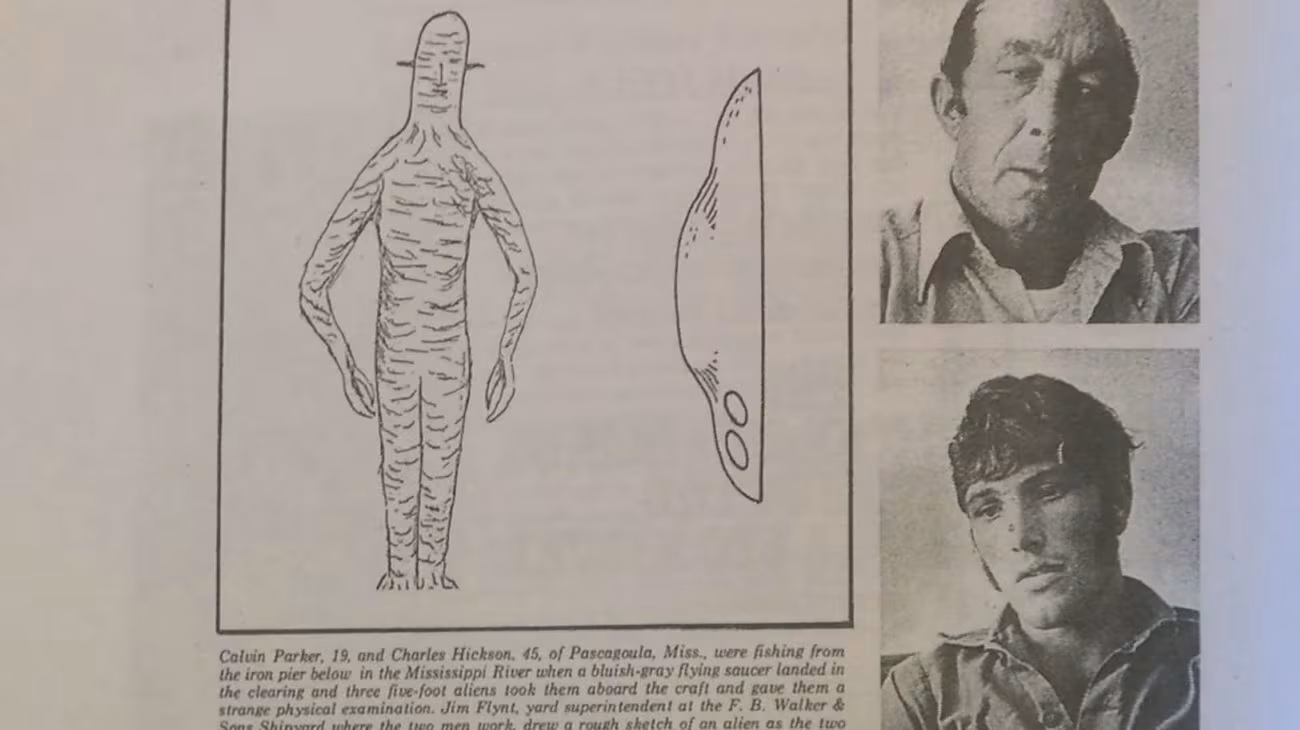
Untitled Document
Parker & Hickson with their drawing - 1973
Further reading
Continue exploring — Wikipedia, documentaries, podcasts, museum pages. Not treated as proof, and not independently verified by this archive.
Investigation timeline
- 2026-09-23 — Historical file submitted.
- 2026-09-23 — Historical file accepted and published.
Assigned GG-2026-029
Research notes
Historical research: The Hidden Tape
The part that holds the file up is the hidden tape. Diamond and Ryder left the room with the recorder still running. Hickson said he could not take much more of the questioning. Parker said his arms had frozen, that he had never passed out in his life before, and that he had watched the door open and the beings come out. He asked for a doctor and prayed when he was left alone. Ryder later said that conversation convinced him they were not inventing it for the deputies. It is a record of two frightened men agreeing on the riverbank. It is not a record of a craft.
Parker’s account that night is thinner than Hickson’s. He remembered the door, the beings coming out, and his arms locking, and he also said he passed out. He did not describe an examination of his own. Joe Nickell later treated Parker’s agreement as suggestibility for that reason. The tape shows Parker was not silent, and it also shows the interior story is Hickson’s.
J. Allen Hynek and James Harder interviewed them within a few days. The Mississippi Press of 14 October reported that the scientists thought the account was based on a real experience. That is an opinion about the witnesses, not a finding of a vehicle. A polygraph examiner later said Hickson was telling the truth as he believed it, and added that the test did not show a ship had landed or that creatures had come out of it. Parker declined the test unless Hickson asked him to take it. His lawyer said he had been in the hospital. Philip J. Klass called the case a hoax and said Hickson would not sit for an examiner Klass considered experienced. A polygraph would not settle it either way.
Hickson’s later career is a different layer. In 1974 he claimed further contact and a message he would carry to Washington. He met Erich von Däniken, appeared on national television, and in 1983 published UFO Contact at Pascagoula. None of that is on the 11 October tape. Parker stayed quiet for decades, then published Pascagoula: The Closest Encounter in 2018. People who said they had seen lights that night came forward after the book. A service-station operator, Larry Booth, did call the sheriff around 8 p.m. on 11 October about a strange light overhead. That call is the same evening. It is not a view of the pier or of three beings. A historical marker went up at the site on 22 June 2019. Hickson had died of a heart attack in September 2011, at 80. Parker died of kidney cancer on 24 August 2023, at 68.
Propose evidence & media, a source citation, further reading, a research note, a correction, a related case, or a series link. Staff review before anything is added. An accepted correction does not replace the file by itself.