GG-2026-036
Travis Walton Incident
- Phenomenon UFOs/UAPs, Spatiotemporal Anomalies (Missing Time)
- Documentation
Rating B
- A — Strong dossier: several independent sources plus primary evidence (original media, records, measurements) a researcher could use without interviewing anyone.
- B — Well documented: multiple independent witnesses with at least some contemporary primary material, or one witness with substantial primary corroboration (photos, recordings, contemporaneous notes, documents).
- C — Multi-source but soft: several witnesses or a long run of reports, but mostly testimony and after-the-fact secondary sources (newspapers, folklore collections, later interviews). Little or no primary physical evidence. Regional legend clusters such as the Bridgewater Triangle land here.
- D — Thin: single witness (or one household), little or no support beyond the account. Normal for a sincere personal experience.
- E — Incomplete or not yet assessed. Every new submission starts here until staff have read it.
- Evidence & media 1 item
- Status Historic
- Location Apache-Sitgreaves National Forest, Arizona · regional placement
- Occurred 5 November 1975
Regional marker representing the Heber and Apache-Sitgreaves National Forest area associated with the November 1975 incident. This pin does not identify the precise clearing where the crew reported the encounter.
This file is placed as a region or body of water, not a single exact event location.
Activity period
- Earliest claimed event 5 November 1975
- Earliest documented report 5 November 1975
- Latest documented report 10 November 1975
- Pattern Single event
Summary
On the evening of 5 November 1975, Travis Walton, 22, disappeared from a woodcutting crew in the Turkey Springs area of the Apache-Sitgreaves National Forests, near Heber, Arizona. The other six told the Navajo County sheriff that a glowing disc had hovered over a clearing and that a blue-green beam had thrown Walton to the ground. He was missing for five days. Late on 10 November he called his sister’s house from a payphone in Heber. He said he had woken inside a craft among short figures with large eyes, then among human-looking people, and that a mask had put him out until he came to on the highway.
Background
Mike Rogers, 28, held a U.S. Forest Service contract to thin timber at Turkey Springs. Walton was one of the men on that crew. They worked for Rogers. Around 6 p.m. on 5 November they were driving out of the site when they said they saw a bright disc over a clearing. Walton got out of the truck and walked toward it. The others said a blue-green beam hit him and threw him backward onto the ground. Rogers drove off. When they came back, Walton and the object were gone. More than two hours after the beam, they reported him missing to the sheriff’s office in Heber. A ground and air search followed. Deputies also treated the crew as suspects in a killing.
On 10 November, hours before Walton reappeared, Arizona Department of Public Safety examiner C. E. Gilson polygraphed the six. He asked whether they had injured or killed Walton, and whether they had told the truth about seeing an object. Five were judged truthful. Allen Dalis was inconclusive. Gilson wrote that those five believed they had seen an object and that they had not harmed Walton. He also wrote that the charts did not prove a craft had been there. If the object was a hoax, he said, five of them had not known of it beforehand.
That night Walton telephoned from a payphone in Heber. He was weak and dehydrated, and he thought only a few hours had passed. The examination noted weight loss and a small mark on his arm like a needle puncture. It did not record burns or broken bones matching a beam. Walton said he had woken on a table among short figures with large eyes, struck at them, and run into another room where taller, human-looking people put a mask over his face. The next thing he remembered was the roadside near Heber.
On 15 November, examiner John J. McCarthy tested Walton for the National Enquirer and scored the charts as deception. That result stayed unpublished until 1976. Later examinations of Walton were read as truthful. The Enquirer paid a $5,000 award, which the crew divided.
Rogers’s thinning contract was already in penalty time. He had underbid the job, fallen behind, and been given an extension. The new completion date was 10 November 1975, the day Walton came back. Philip Klass treated that deadline, and the Enquirer money, as a reason to stage a disappearance. The crew said the light was real. No photograph from that night, and no injury matching the beam, has been produced.
Walton’s book The Walton Experience (1978) is his account of the five days. The 1993 film Fire in the Sky adds an onboard examination Walton has said he never described.
Witness statement
No statement on file.
Evidence & media
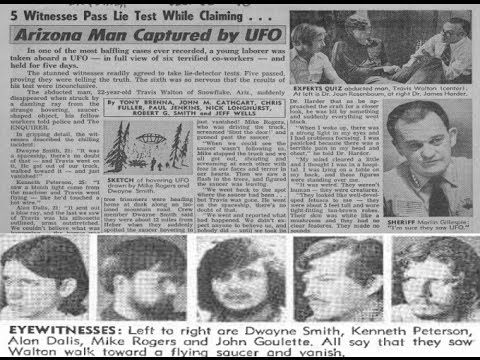 National Enquirer Dec 1975
Investigation timeline
- 2026-09-23 — Historical file submitted.
- 2026-09-23 — Historical file accepted and published.
Research notes
Historical research: The search is on paper; the beings are Walton's account.
Navajo County looked for a missing man for five days. That search, and six men reporting a light the night of 5 November, are the documented part of this file. What happened inside a craft is Walton's account after he called from a Heber payphone.
On 10 November, before he reappeared, DPS examiner C. E. Gilson polygraphed the crew. Five passed on whether they had hurt him and whether they believed they had seen an object. Allen Dalis was inconclusive. Gilson wrote that the charts did not prove a craft existed. Walton failed a 15 November test arranged through the National Enquirer; that score was not public until 1976. Later tests were read as truthful. A polygraph is not a photograph of a disc.
Two other facts sit beside the story and do not settle it. NBC aired The UFO Incident, the Hill television film, on 20 October 1975, sixteen days earlier. Rogers's Forest Service thinning contract was in penalty time, with a completion date of 10 November, the day Walton came back. Philip Klass treated both as a motive for a hoax. The crew denied it. The 1993 film Fire in the Sky is a third layer: Walton has said the examination scenes are the studio's, not his.
Historical research: Physiological Effects and Time-Dilation Anomalies
The 1975 disappearance of forestry worker Travis Walton in the Apache-Sitgreaves National Forest, Arizona, represents one of the most thoroughly cross-examined alleged close encounters of the third/fourth kind. The case is notable because six independent co-workers witnessed a high-energy discharge strike Walton before fleeing, subsequently passing polygraph examinations regarding their account.
Parapsychological and ufological research focuses on the physiological and temporal anomalies documented upon Walton's return five days later. The primary scientific questions concern the reported time dilation—Walton subjectively experienced only a few hours of consciousness during a 120-hour physical absence—and the residual physical radiation signatures reported at the forestry site. Scholars in anomalous physical phenomena analyze whether the case demonstrates an interaction with high-energy microwave/plasma technology, localized space-time distortion, or a severe, unexplained alteration of consciousness involving physical transport.
Open research questions
A specific gap in the file. An accepted source, research note, or further-reading link closes it.
Reconstruct the contemporary November 1975 record of the Walton incident and distinguish statements made during the missing-person investigation from details introduced in later interviews, books, and media adaptations.
Propose evidence & media, a source citation, further reading, a research note, a correction, a related case, or a series link. Staff review before anything is added. An accepted correction does not replace the file by itself.