GG-2026-063
Westall UFO Incident
- Phenomenon UFOs/UAPs
- Documentation
Rating B
- A — Strong dossier: several independent sources plus primary evidence (original media, records, measurements) a researcher could use without interviewing anyone.
- B — Well documented: multiple independent witnesses with at least some contemporary primary material, or one witness with substantial primary corroboration (photos, recordings, contemporaneous notes, documents).
- C — Multi-source but soft: several witnesses or a long run of reports, but mostly testimony and after-the-fact secondary sources (newspapers, folklore collections, later interviews). Little or no primary physical evidence. Regional legend clusters such as the Bridgewater Triangle land here.
- D — Thin: single witness (or one household), little or no support beyond the account. Normal for a sincere personal experience.
- E — Incomplete or not yet assessed. Every new submission starts here until staff have read it.
- Evidence & media 2 items
- Status Historic
- Location Westall, Australia · approximate placement
- Occurred 6 April 1966
Approximate marker representing the Westall High School and The Grange area associated with the April 6, 1966 sighting. Witnesses observed the event from different locations, and accounts differ over whether the object landed or hovered near the ground. This marker does not identify a verified landing site.
Activity period
- Earliest claimed event 6 April 1966
- Earliest documented report 6 April 1966
- Latest documented report 6 April 1966
- Pattern Single event
Summary
On April 6, 1966, students and several staff members at Westall High School and the neighboring primary school in Melbourne reported seeing one or more unusual silver or grey objects in daylight. Witnesses described the object moving near the school before heading toward an open area known as the Grange, with several light aircraft also reported nearby. Students ran toward the area in an attempt to follow it. Contemporary newspaper coverage confirms that the sighting caused a major disruption at the school, and science teacher Andrew Greenwood became one of its best-documented adult witnesses. Later accounts added claims of a landing, ground traces, military personnel, and official intimidation, but those details are less securely supported by the surviving 1966 record. No authenticated photograph, radar record, recovered material, or preserved physical trace establishes what the object was.
Background
On the morning of April 6, 1966, students at Westall High School and the neighboring state primary school in Clayton South, Melbourne, began reporting an unusual object in the sky. The sighting occurred in daylight and quickly drew large numbers of pupils and some staff outside. Contemporary newspaper coverage appeared almost immediately, giving Westall a much stronger historical anchor than cases reconstructed entirely from memories collected decades afterward.
Witnesses generally described a silver, grey, or whitish object moving over or near the school. Accounts differed over its exact shape and the number of objects present. Disc or saucer-like descriptions became strongly associated with the case, while science teacher Andrew Greenwood's own account differed in some respects from those of the students. Several witnesses also reported small aircraft in the vicinity.
The object was reportedly seen moving toward an open area known as The Grange, prompting students to run from the school grounds in that direction. Some later witnesses described the object descending very low or landing there before departing rapidly. The distinction matters: movement or descent toward the Grange belongs more securely to the historical core than a verified landing does.
Andrew Greenwood became one of the case's most important witnesses because he was an adult teacher whose involvement entered the documentary record relatively close to the event. Contemporary newspaper material associates Greenwood with the sighting rather than introducing him only through later documentaries or reunions. His account included an unusual silvery object and light aircraft nearby.
Local and Melbourne newspapers began covering Westall immediately. The Age reported on the event the following day and mentioned a weather balloon as a possible explanation, while the Dandenong Journal subsequently interviewed witnesses including Greenwood. These reports establish that something unusual enough to disrupt the schools and generate substantial local attention genuinely occurred.
The case's evidentiary difficulties emerge when the contemporary record is compared with later recollections.
Former students subsequently described seeing the object much closer to the ground, including accounts in which it landed or nearly landed in the Grange. Stories also developed around an area of flattened or discolored grass interpreted as a possible physical trace. Those accounts are important parts of the witness tradition, but no authenticated physical sample or contemporary evidentiary record of a landing site survives that can independently establish what produced the reported marks.
Claims of an official response became similarly prominent. Later witnesses recalled uniformed personnel at or around the site, and Andrew Greenwood later described being warned by two men not to continue discussing the incident. His testimony is part of the case history, but the surviving record does not establish which agency, if any, those men represented. Nor should later accounts of military personnel inspecting the Grange be presented as documented fact without the corresponding contemporary records.
That distinction is especially important because no stand-alone Royal Australian Air Force investigation file has surfaced publicly. Its absence is interesting, but absence of a surviving file does not itself demonstrate that records were deliberately suppressed.
A conventional explanation that has received considerable attention involves Australia's HIBAL high-altitude balloon program, which used large balloons for atmospheric and radiation research. Researcher Keith Basterfield has explored whether a stray HIBAL balloon or associated equipment could account for aspects of the Westall sighting. The hypothesis potentially fits some features of the event, but the archival record has not established a specific balloon flight as the object seen at Westall. It remains a proposed explanation rather than a solved identification.
Westall therefore contains two evidentiary layers that need to remain separate.
The 1966 core establishes a substantial daylight sighting involving schoolchildren and at least some adult witnesses, immediate local attention, and contemporary newspaper documentation.
The later witness tradition adds much richer detail concerning a landing or near-landing, ground traces, military activity, suppression, and extraordinary flight behavior. Some of those recollections may preserve genuine details omitted from the sparse contemporary record, but their later recording means they cannot automatically be given the same evidentiary weight.
That does not make Westall an invented legend. Quite the opposite. Something unusual was reported over Westall in broad daylight on April 6, 1966, in front of a large school population, and the incident entered newspapers almost immediately.
What the surviving record does not establish is whether the object landed, whether military authorities secretly investigated or recovered anything, or whether the object represented an extraordinary craft. The HIBAL hypothesis remains plausible but unproven. No authenticated image, radar record, preserved trace, or recovered object has subsequently supplied the missing identification.
Westall's significance therefore lies not in proving that a spacecraft landed beside an Australian school, but in preserving a genuine, unusually large daylight UFO/UAP report with contemporary documentary anchors whose underlying object remains unresolved.
Witness statement
No statement on file.
Evidence & media
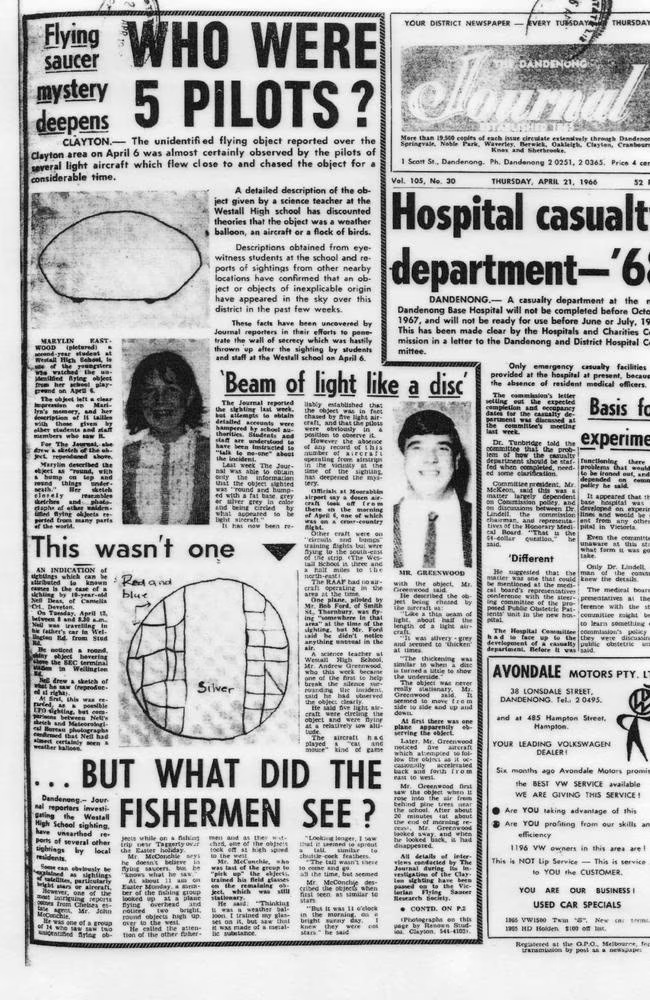
Untitled Newspaper
April 21 1966, page 1 Includes a drawing of the craft by a student at Westall High School.
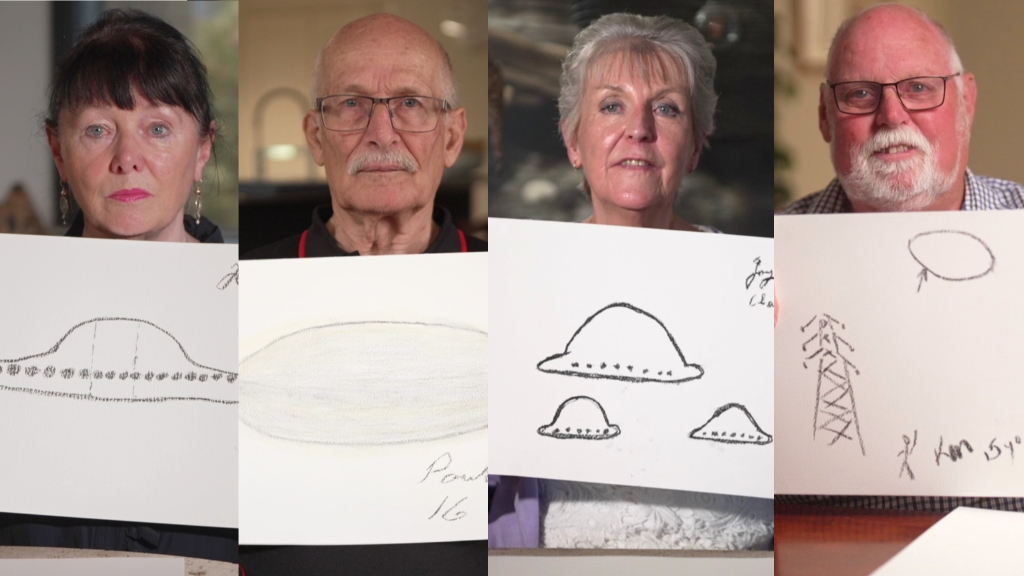
Untitled Photo
Some of the many witnesses to the "Westall incident" draw what they remember seeing in broad daylight.
Further reading
Continue exploring — Wikipedia, documentaries, podcasts, museum pages. Not treated as proof, and not independently verified by this archive.
Investigation timeline
- 2026-09-26 — Historical file submitted.
- 2026-09-26 — Historical file accepted and published.
Assigned GG-2026-063
Research notes
Historical research: Atmospheric Physics, HIBAL Balloons, and Observational Contagion
n atmospheric sciences and observational psychology, the Westall incident is evaluated through atmospheric monitoring testing, sociogenic group dynamics, and observational distortion.
Skeptical researchers, led by ufological archivist Keith Basterfield, hypothesize that the object was a stray American-Australian High Altitude Balloon (HIBAL). Used between 1960 and 1969 to sample the upper atmosphere for fallout following French atmospheric nuclear tests, HIBAL balloons utilized silver-aluminized polyethylene canvas attached to heavy instrument payloads. Project logs show that test flight #292 was launched from Mildura on April 5, 1966, and went missing in transit shortly before the incident. Limnologists and atmospheric analysts suggest the descending payload, suspended beneath a translucent parachute, drifted low over Melbourne suburbs. In a high-arousal environment, excitement and peer reinforcement among hundreds of children distorted visual perceptions, transforming a drifting, silver payload into an accelerating physical craft.
Historical research: High-Density Witness Uniformity, Flight Dynamics, and Physical Anomalies
While atmospheric balloon models offer a prosaic mechanism, anomalistic researchers and historians highlight observational details that challenge a standard balloon hypothesis.
Parapsychologists and anomalists note that a high-altitude balloon payload descending via parachute behaves as a passive, wind-drifted object incapable of controlled horizontal hovering, sharp directional zigs, or rapid, non-ballistic ascents. More than 200 independent observers—including adult faculty members—described active, high-velocity flight maneuvers and interactions with circling light aircraft. Furthermore, ground-level physical traces (a localized ring of flattened, desiccated vegetation) and claims of deliberate government secrecy leave unresolved questions. Research focuses on whether Westall represents an unacknowledged prototype military defense trial or a genuine close encounter involving high-strangeness flight dynamics.
Open research questions
A specific gap in the file. An accepted source, research note, or further-reading link closes it.
Compare the earliest 1966 Westall records, including newspaper reports, school material and witness accounts, with later interviews. Determine when claims of a landing, flattened grass, military or government personnel, witness intimidation and pursuing aircraft first appear, and identify which details are supported by contemporary records versus later recollections.
Propose evidence & media, a source citation, further reading, a research note, a correction, a related case, or a series link. Staff review before anything is added. An accepted correction does not replace the file by itself.