GG-2026-064
Tehran UFO Incident
- Phenomenon UFOs/UAPs
- Documentation
Rating B
- A — Strong dossier: several independent sources plus primary evidence (original media, records, measurements) a researcher could use without interviewing anyone.
- B — Well documented: multiple independent witnesses with at least some contemporary primary material, or one witness with substantial primary corroboration (photos, recordings, contemporaneous notes, documents).
- C — Multi-source but soft: several witnesses or a long run of reports, but mostly testimony and after-the-fact secondary sources (newspapers, folklore collections, later interviews). Little or no primary physical evidence. Regional legend clusters such as the Bridgewater Triangle land here.
- D — Thin: single witness (or one household), little or no support beyond the account. Normal for a sincere personal experience.
- E — Incomplete or not yet assessed. Every new submission starts here until staff have read it.
- Evidence & media 3 items
- Status Historic
- Location Tehran, Iran · regional placement
- Occurred 19 September 1976
Regional marker using Tehran as a public reference point for the September 19, 1976 incident. Civilian observations, control-tower sightings and military interception activity occurred across multiple locations in and around Tehran. This pin does not identify a single encounter or radar-contact position.
This file is placed as a region or body of water, not a single exact event location.
Activity period
- Earliest claimed event 19 September 1976
- Earliest documented report 19 September 1976
- Latest documented report 19 September 1976
- Pattern Single event
Summary
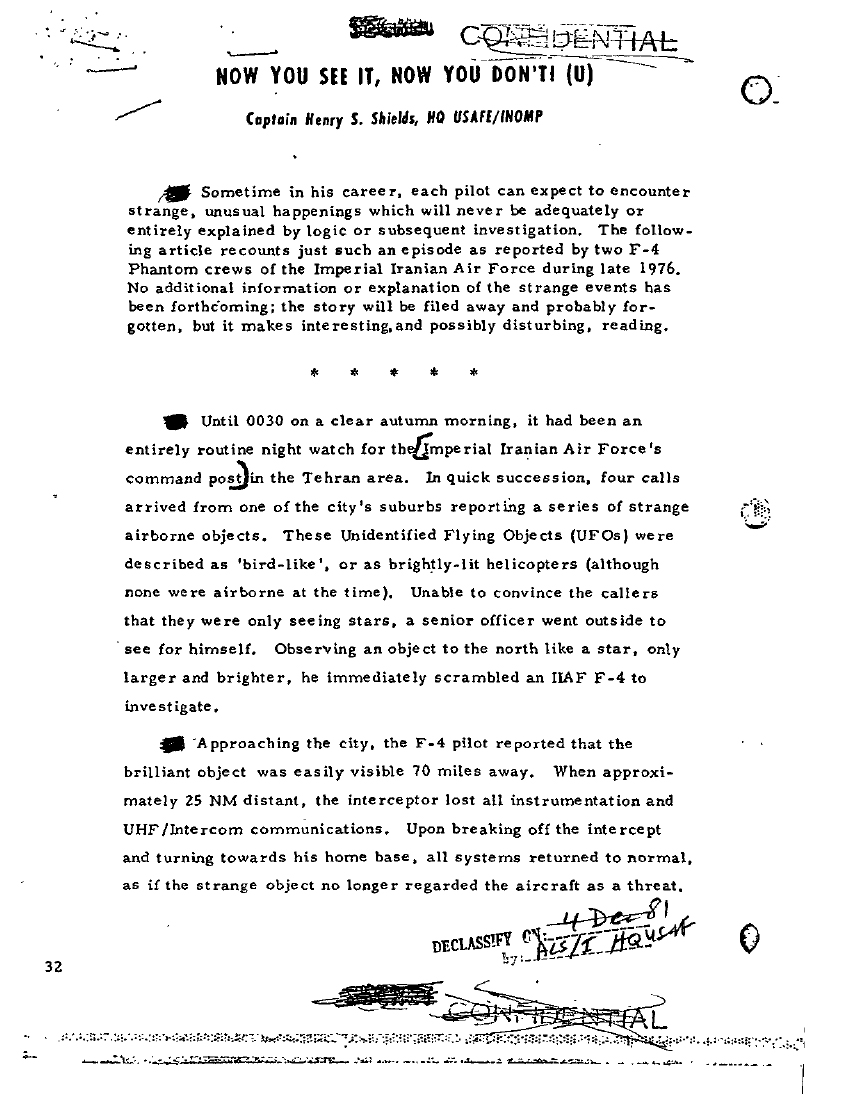
In the early hours of September 19, 1976, civilian callers and aviation personnel in Tehran, Iran, reported an unusually bright object in the night sky. After the object was observed from the ground, the Imperial Iranian Air Force dispatched two F-4 Phantom II interceptors. The first crew reported losing instrumentation and communications while approaching the object, with normal operation returning after the aircraft turned away. A second F-4 crew reported acquiring a radar return along with visual contact and later experienced temporary communications and weapons-control problems during the encounter. The incident was subsequently summarized and distributed through U.S. military and intelligence channels. The surviving official record documents a significant unresolved military UFO report, but no recovered object, raw radar record, or publicly available cockpit data independently identifies what the crews encountered.
Background
The Tehran incident began shortly after midnight on September 19, 1976, when civilians reported an intensely bright object over northern Tehran. Air traffic controller Hossein Pirouzi at Mehrabad Airport received several reports and subsequently observed the object himself. The report was relayed through the Imperial Iranian Air Force, and an interception was authorized.
At approximately 1:30 a.m., the first F-4 Phantom II was dispatched from Shahrokhi Air Base. The crew reported being able to see the object from a considerable distance. As the aircraft approached to roughly 25 nautical miles, the crew reported losing instrumentation along with UHF and intercom communications. After turning away from the object, the systems reportedly returned to normal.
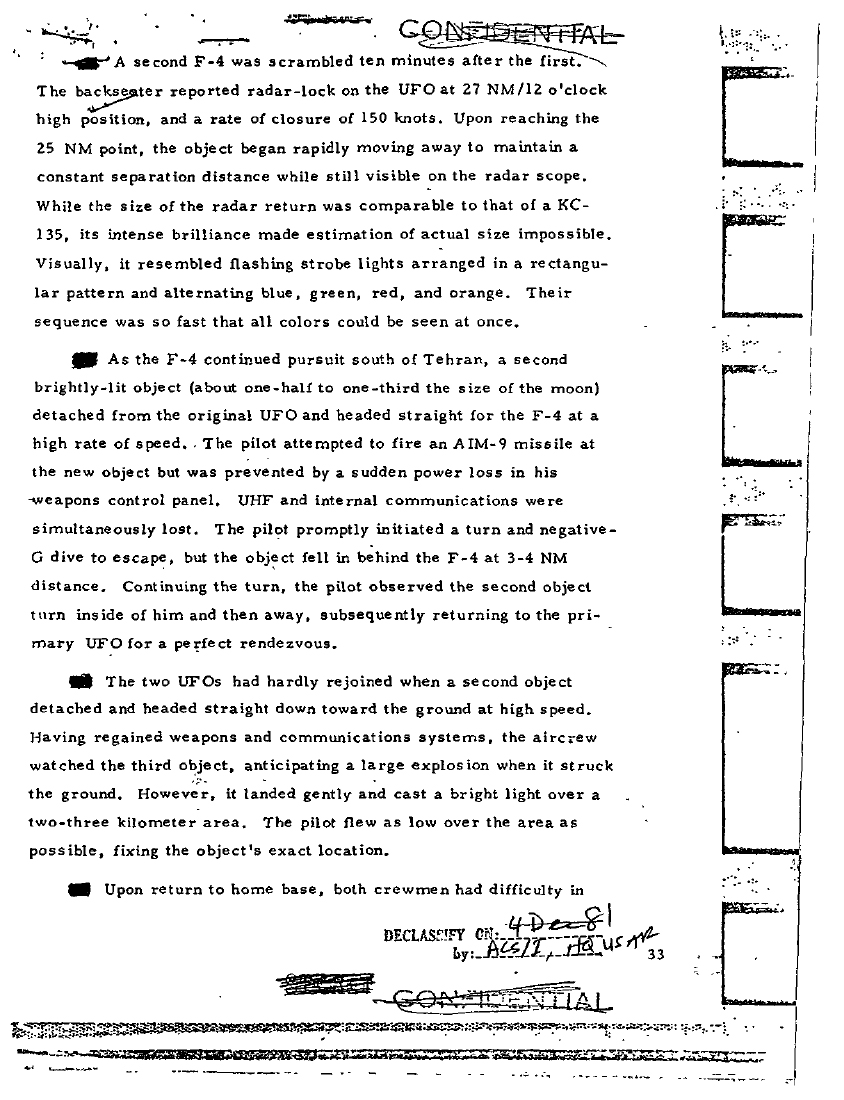
A second F-4 was launched roughly ten minutes later. This aircraft was flown by Parviz Jafari, with Jalal Damirian serving as weapons officer. Unlike the first interception, this crew reported obtaining a radar lock at approximately 27 nautical miles. The radar return was compared in size with that of a large tanker aircraft, while visually the object was described as extremely bright and displaying rapidly changing colors.
As the F-4 attempted to close, the crew said the object maintained separation. The encounter then became considerably stranger. Jafari reported seeing a smaller luminous object apparently separate from the main object and move rapidly toward the aircraft. Interpreting the approaching light as potentially threatening, Jafari prepared to use an air-to-air missile. At that point, according to the report, the aircraft experienced problems affecting its weapons controls and communications. Jafari instead took evasive action, after which the smaller light appeared to move away and eventually rejoin the larger object.
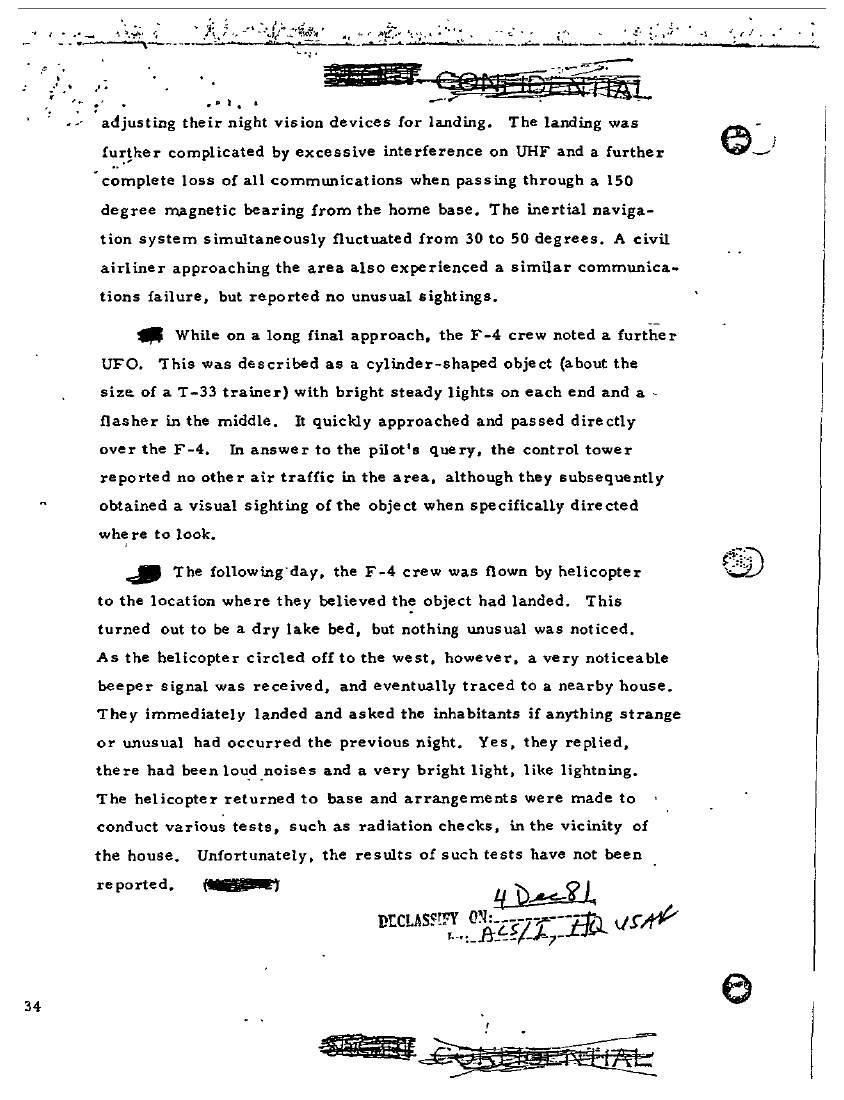
Another luminous object was subsequently reported descending toward the ground south of Tehran. Later versions sometimes describe this episode as though a smaller craft definitively landed. The surviving evidence does not establish that. No craft, debris, or confirmed landing trace was recovered from the reported area.
The reported equipment failures became one of the most important aspects of the case. Both F-4 crews described temporary aircraft-system problems while approaching the phenomenon, while the second crew additionally reported the radar contact and weapons-control problem.
That combination makes Tehran considerably stronger than a simple report of a strange light. It involved civilian observations, aviation personnel, an official military response, two separate interceptor sorties, pilot testimony, a reported airborne radar return, and temporary equipment anomalies.
But the limitations are equally important. The publicly accessible record does not include the raw radar tapes, cockpit recordings, complete maintenance records, weapons-system diagnostics, or flight telemetry that would permit an independent technical reconstruction of the failures. The official documentation establishes that these events were reported through military channels, not that every interpretation subsequently attached to them was independently verified.
The incident became particularly notable in the United States because a Defense Intelligence Agency report summarized the Iranian encounter and circulated through official channels. That document is an important primary source for the case, but it was produced as a report about the incident rather than as a real-time record created during the interception itself.
Conventional explanations have been proposed for various portions of the event, including astronomical objects and ordinary or unrelated aircraft-system failures. Those possibilities must be considered, but no single conventional explanation has been demonstrated from the surviving public record to account for the entire sequence reported by the witnesses. Conversely, failure to identify a conventional cause does not establish an extraterrestrial or non-human origin.
The Tehran case therefore deserves its reputation as an unusually substantial military UFO/UAP report, but for narrower reasons than later mythology sometimes suggests. Military aircraft really were dispatched; two crews really did report temporary systems anomalies; the second crew reported visual and radar contact; and the incident really did enter U.S. intelligence reporting.
What remains unresolved is what produced those observations and reported equipment effects. The official record preserves an unidentified encounter. It does not preserve an independently verified alien dogfight over Tehran.
Witness statement
No statement on file.
Evidence & media
Tehran Ufo 1976
Air Force files on the Tehran UFO incident in 1976
Tehran Ufo 1976
Air Force files on the Tehran UFO incident in 1976
Tehran Ufo 1976
Air Force files on the Tehran UFO incident in 1976
Further reading
Continue exploring — Wikipedia, documentaries, podcasts, museum pages. Not treated as proof, and not independently verified by this archive.
Investigation timeline
- 2026-09-26 — Historical file submitted.
- 2026-09-26 — Historical file accepted and published.
Assigned GG-2026-064
Research notes
Historical research: Radar Misinterpretation, Astronomical Calibration, and Systems Reliability
In aviation security, atmospheric physics, and military systems engineering, the Tehran incident is evaluated through radar propagation anomalies, celestial misidentification, and avionics failure rates.
Skeptical researchers, led by Philip J. Klass and aviation analysts, suggest the primary visual target was an exceptionally bright opposition display of the planet Jupiter, exacerbated by atmospheric scintillation and temperature inversions over the desert basin. Skeptics argue that ground radar contacts recorded at Mehrabad were transient ground-clutter reflections (anomalous propagation) common in high-temperature environments. Furthermore, flight systems analysis notes that the F-4 Phantom II AN/APQ-120 radar and weapon release circuits experienced frequent electronic faults in mid-1970s military service. The temporary loss of communications is framed as a coincidence or radio frequency interference, amplified by pilot stress during a high-arousal night intercept mission.
Historical research: Electromagnetic Interference, Multi-Sensor Corroboration, and High-Performance Maneuvers
While astronomical explanations address single visual targets, anomalistic researchers and military analysts evaluate the case as an instance of non-conventional electromagnetic interference and coordinated radar-visual tracking.
A declassified U.S. Defense Intelligence Agency (DIA) evaluation report—titled UFO Incident in Iran—classified the event as an outstanding case study possessing high credibility. Parapsychologists and defense researchers emphasize three distinct corroborative elements: simultaneous visual sightings by trained military aircrews and ground air traffic controllers, physical radar returns on both ground and airborne radars, and correlated, temporary electrical disruptions affecting independent military aircraft systems. The research questions center on the mechanism behind localized, reversible electromagnetic pulse (EMP) effects that systematically disabled weapon circuits without causing permanent avionics burnouts, as well as the non-ballistic flight dynamics executed by the main object and secondary probes.
Open research questions
A specific gap in the file. An accepted source, research note, or further-reading link closes it.
Compare the earliest Iranian and U.S. military records of the Tehran incident with later witness interviews and UFO literature. Trace the original sources for reported radar contact, communications and instrument failures, the attempted missile launch, secondary objects and ground illumination. Identify which details are contemporary and which first appear in later testimony
Propose evidence & media, a source citation, further reading, a research note, a correction, a related case, or a series link. Staff review before anything is added. An accepted correction does not replace the file by itself.