GG-2026-065
Bélmez Faces
- Phenomenon Physical & Poltergeist Activity
- Documentation
Rating B
- A — Strong dossier: several independent sources plus primary evidence (original media, records, measurements) a researcher could use without interviewing anyone.
- B — Well documented: multiple independent witnesses with at least some contemporary primary material, or one witness with substantial primary corroboration (photos, recordings, contemporaneous notes, documents).
- C — Multi-source but soft: several witnesses or a long run of reports, but mostly testimony and after-the-fact secondary sources (newspapers, folklore collections, later interviews). Little or no primary physical evidence. Regional legend clusters such as the Bridgewater Triangle land here.
- D — Thin: single witness (or one household), little or no support beyond the account. Normal for a sincere personal experience.
- E — Incomplete or not yet assessed. Every new submission starts here until staff have read it.
- Evidence & media 2 items
- Status Historic
- Location Bélmez de la Moraleda, Spain
- Occurred 23 August 1971
Exact marker for Casa de las Caras de Bélmez, the property associated with the 1971 Bélmez Faces reports. The site has been presented as a museum/visitor attraction. Public access and opening arrangements may change, and the marker identifies the historic case property rather than confirming any paranormal interpretation.
Activity period
- Earliest claimed event 23 August 1971
- Earliest documented report 16 September 1971
- Latest documented report Ongoing
- Pattern Recurring
Summary
Beginning in August 1971, a house in Bélmez de la Moraleda, Spain, became famous for human-like images that residents said appeared spontaneously in its concrete floors. The first reported face was destroyed by the family and covered with fresh cement, after which another image was said to appear. Additional faces were reported over subsequent years, attracting visitors, journalists, parapsychologists, and skeptics. Proposed explanations have ranged from deliberate painting or chemical treatment to natural changes in the concrete and paranormal “thoughtography.” Chemical analyses have produced disputed interpretations, including findings that skeptics argue are compatible with artificial pigments. No paranormal mechanism has been scientifically demonstrated, and questions over the manufacture and alteration of the images remain central to the case.
Background
The Faces of Bélmez story began on August 23, 1971, when María Gómez Cámara reported seeing a human-like image forming in the concrete floor of the family home in Bélmez de la Moraleda, a village in the Spanish province of Jaén.
According to the family's account, attempts to remove the image did not settle the matter. María's husband, Juan Pereira, and their son Miguel Pereira eventually broke up the affected section of floor and fresh concrete was installed. A new face was subsequently reported on the replacement surface.
The local mayor then intervened to prevent the newer image from being destroyed. Instead, the affected concrete was removed for examination. Publicity rapidly transformed the house into a tourist attraction, and by 1972 substantial numbers of visitors were arriving to see what became known as the Faces of Bélmez.
The story did not remain limited to one face. The Pereira family claimed that additional images appeared and disappeared over the following decades, varying in size, appearance, and expression. Many were photographed, allowing the physical appearance of at least some of the purported faces to be documented even though their method of formation remained disputed.
Claims concerning human remains discovered beneath the property also became an important part of the Bélmez story. Later accounts describe excavations beneath the floor uncovering bones and connect them with historical burials in the area. Those claims have repeatedly been used to suggest that the faces depicted people buried beneath the house. The historical presence of remains, however, would not by itself connect individual images on the concrete with particular deceased people, and the precise archaeological claims require better primary documentation than many popular retellings provide.
The same caution applies to stories of elaborate controlled sealing experiments. Paranormal literature frequently describes sections of the house being sealed under official observation and later reopened to reveal altered or newly formed faces. Such accounts are important to the history of the case, but their evidentiary value depends on the quality of the original documentation, chain of custody, controls, and exactly what was photographed before and after the test. The readily available sources do not justify treating Gemini's detailed three-month sequence as an independently established laboratory experiment.
Physical analysis has produced more concrete grounds for debate. Skeptical researcher Luis Ruiz-Noguez, writing in the Journal of the Society for Psychical Research in 1993, discussed chemical analysis identifying elements including zinc, lead, and chromium. Ruiz-Noguez argued that the findings were compatible with the use of pigments and supported suspicion that at least some of the images had been artificially produced.
Other investigators have disputed fraud explanations and interpreted the faces within paranormal frameworks. One recurring proposal is thoughtography, the hypothetical production of physical images through mental or psychokinetic processes. In the Bélmez literature, María herself became associated with theories that the images somehow reflected or externalized human consciousness. No scientifically established mechanism demonstrates that thoughtography occurs, however, so such interpretations remain paranormal hypotheses rather than explanations verified by the case.
Natural mechanisms involving moisture, oxidation, staining, mineral migration, concrete chemistry, and visual pattern recognition have also been considered. Human perception is particularly sensitive to face-like arrangements, making ambiguous stains capable of appearing strikingly facial. That general phenomenon alone does not establish how any individual Bélmez image formed, but it provides another reason not to assume that a recognizable face necessarily required either deliberate artistry or paranormal action.
The case consequently presents a difficult evidentiary mixture. There is no question that images resembling faces became visible on surfaces in the Bélmez house and were repeatedly photographed. The unresolved issue is how those images were produced.
Evidence compatible with artificial pigments gives the hoax or deliberate-manufacture hypothesis substantial weight. Yet decades of conflicting investigations, uncertain provenance for individual images, and disputed testing procedures make it difficult to treat every face produced across the history of the house as though it necessarily had the same origin.
The Faces of Bélmez are therefore better described as a long-running disputed physical-image phenomenon than as established evidence of paranormal manifestation. The images are real objects of investigation. Their claimed supernatural origin is not established.
Witness statement
No statement on file.
Evidence & media
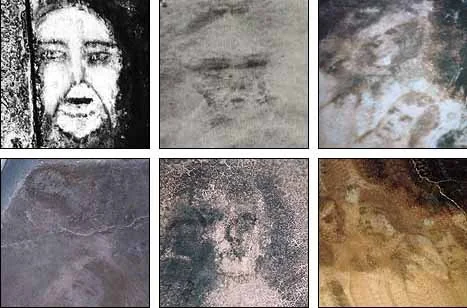
The Bélmez Faces Appearing In The Concrete Floor
Pictures of the various faces that appeared on the floor.
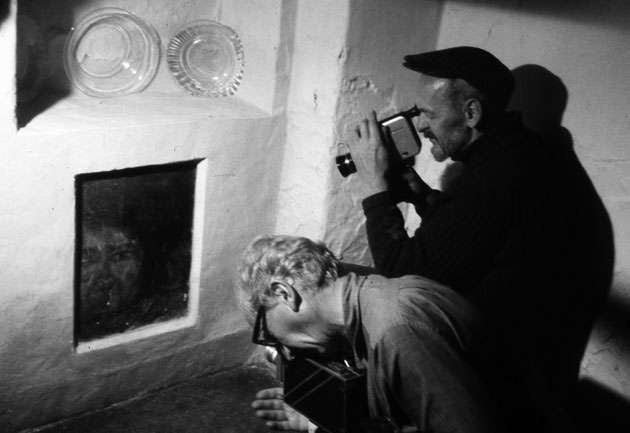
Belmez1602 Das Zweite Gesicht Von Belmez
Germán de Argumosa y Valdés (top) & Prof. Hans Bender investigating the faces, Apr 1972.
Further reading
Continue exploring — Wikipedia, documentaries, podcasts, museum pages. Not treated as proof, and not independently verified by this archive.
Investigation timeline
- 2026-09-26 — Historical file submitted.
- 2026-09-26 — Historical file accepted and published.
Assigned GG-2026-065
Research notes
Historical research: Chemical Alteration, Acid Etching, and Pareidolia
Skeptical researchers, chemists, and forensic analysts argue that the Bélmez faces are terrestrial, human-made fabrications created via chemical reaction or natural visual misinterpretation.
Investigators such as José Luis Jordán and Luis Ruiz-Noguez suggested that the images were forged using chemical oxidizers—such as nitric acid, sulfuric acid, or silver salts (including silver nitrate)—which darken gradually when exposed to ambient light and moisture. Critics highlight that lead, chromium, and zinc detected in later floor samples could reflect industrial paints, enamels, or chemical reagents. Furthermore, cognitive scientists emphasize the role of pareidolia—the human brain's evolutionary hardwiring to identify human faces in random, irregular stains, concrete moisture patterns, and soot deposits from cooking fires.
Historical research: Material Analysis, Thoughtography, and Teleplastic Manifestation
Parapsychologists and materials researchers evaluate the case as a potential instance of thoughtography (psychic imprinting) or RSPK (Recurrent Spontaneous Psychokinesis).
Lead parapsychologists Germán de Argumosa and Hans Bender conducted on-site field testing, recording anomalous acoustic events (audio voice phenomena) inside the sealed home. In the 1990s, samples of the concrete floor were submitted to Spain's National Research Council (Instituto de Cerámica y Vidrio / ICV). The resulting mineralogical and chemical reports found no evidence of superficial paint films or conventional brushwork on tested segments, noting that darker mineral concentrations resided within the cement matrix itself. Parapsychological hypotheses posit that María Gómez Cámara acted as an unwitting unconscious focal point, imprinting mental images onto the porous calcium silicate matrix of the floor.
Open research questions
A specific gap in the file. An accepted source, research note, or further-reading link closes it.
Trace the contemporary record for the Bélmez Faces from the August 1971 discovery through early investigations. Compare photographs, newspaper reports, chemical analyses, witness claims and controlled observations. Determine which alleged face changes or new appearances were documented under controlled conditions and which claims originate primarily in later paranormal or skeptical accounts.
Propose evidence & media, a source citation, further reading, a research note, a correction, a related case, or a series link. Staff review before anything is added. An accepted correction does not replace the file by itself.