GG-2026-068
Incident at Exeter
- Phenomenon UFOs/UAPs
- Documentation
Rating B
- A — Strong dossier: several independent sources plus primary evidence (original media, records, measurements) a researcher could use without interviewing anyone.
- B — Well documented: multiple independent witnesses with at least some contemporary primary material, or one witness with substantial primary corroboration (photos, recordings, contemporaneous notes, documents).
- C — Multi-source but soft: several witnesses or a long run of reports, but mostly testimony and after-the-fact secondary sources (newspapers, folklore collections, later interviews). Little or no primary physical evidence. Regional legend clusters such as the Bridgewater Triangle land here.
- D — Thin: single witness (or one household), little or no support beyond the account. Normal for a sincere personal experience.
- E — Incomplete or not yet assessed. Every new submission starts here until staff have read it.
- Evidence & media 4 items
- Status Historic
- Location Exeter, New Hampshire · approximate placement
- Occurred 3 September 1965
Approximate marker representing the Route 150 countryside in the Exeter-Kensington area associated with the September 3, 1965 encounter. Witnesses observed the lights from different positions, and this marker does not identify a verified object location or exact roadside viewing point.
Activity period
- Earliest claimed event 3 September 1965
- Earliest documented report 3 September 1965
- Latest documented report 3 September 1965
- Pattern Single event
Summary
In the early hours of September 3, 1965, 18-year-old Muscarello reported seeing five brilliant red lights moving low over fields near Exeter and Kensington, New Hampshire. After reaching the Exeter police station, Eugene Bertrand returned to the area with Muscarello and reported seeing the unusual lights as well. A second officer, David Hunt, arrived later and also observed them. The witnesses described intense red lights flashing sequentially, moving at low apparent altitude, illuminating the surrounding landscape, and producing little or no sound. The U.S. Air Force investigated through Project Blue Book, considered conventional aircraft activity among the explanations, but ultimately retained the case as unidentified because no specific aircraft could be matched to the sighting. No photograph, radar record, physical trace, or recovered material established what the witnesses observed.
Background
In the early morning of September 3, 1965, Muscarello was traveling along Route 150 in the Exeter-Kensington area of New Hampshire when he noticed five extremely bright red lights ahead of him. Muscarello later reported that the lights appeared relatively low, were arranged in a pattern, and flashed sequentially. They were bright enough to illuminate portions of the surrounding countryside.
Muscarello initially thought he might be seeing ordinary vehicle or emergency lights, but the reported movement and apparent position of the lights quickly convinced him that something unusual was occurring. He eventually reached the Exeter police station and reported the experience.
Muscarello was not the only person reporting unusual lights in the area that night. Earlier, patrolman Eugene Bertrand had encountered another motorist who reported being followed by a red-lighted object. Bertrand did not see anything unusual during that earlier stop, but the report provided additional context when Muscarello later arrived at the police station.
Bertrand returned to the reported location with Muscarello. There, both reported seeing the unusual red lights. Bertrand subsequently asked for assistance, and fellow patrolman David Hunt arrived in time to observe the phenomenon before it departed. The policemen later provided signed statements concerning what they had witnessed.
The witnesses described five intense red lights that appeared to move together and flash in sequence. The phenomenon seemed to travel at low altitude and produced little or no noticeable sound. Because of the brightness, determining the exact shape, distance, and therefore physical size of whatever carried or produced the lights was difficult. Contemporary statements are consequently more cautious than later versions describing a clearly visible metallic saucer of precise dimensions.
That distinction matters. Muscarello did estimate extraordinary apparent size and proximity, but without a measured distance or clearly resolved structure those estimates cannot establish the actual dimensions of an object. The strongest contemporary evidence is therefore the repeatedly observed pattern of five red lights, not a verified 80-foot metallic craft.
The sighting attracted the attention of the U.S. Air Force and became a Project Blue Book case. The surviving file is substantial and includes witness statements and official correspondence. Air Force personnel considered several possible conventional explanations, including stars seen under unusual atmospheric conditions and military aircraft operating during or around an exercise known as Operation Big Blast.
The military-aircraft possibility became particularly controversial. Bertrand and Hunt objected that the timing of their observation did not correspond with the exercise as initially suggested. Later Blue Book correspondence conceded that although conventional aircraft equipped with particular lighting arrangements might plausibly have produced something resembling the reported phenomenon, investigators could not identify a specific aircraft responsible for the Exeter sighting. The case was therefore retained administratively as unidentified.
That classification needs the usual Gothic.Black caution. In Project Blue Book, “unidentified” meant that investigators had not established a satisfactory identification from the available information. It did not mean that the Air Force had concluded that the witnesses encountered an extraterrestrial spacecraft.
The case became nationally famous through journalist John G. Fuller, whose 1966 book Incident at Exeter expanded the story beyond the September 3 encounter and placed it within the broader wave of UFO reports occurring in the region. Fuller's work became a major part of the case's later cultural reputation, but the contemporary police statements and Blue Book documentation remain more important when determining what the principal witnesses originally reported.
Exeter's evidentiary strength lies primarily in its witness sequence. Muscarello made his report before Bertrand returned with him to the scene. Bertrand then reported observing the phenomenon, and Hunt arrived separately and also saw the lights. Their statements subsequently entered an official Air Force investigation.
Its limitations are equally clear. There is no authenticated photograph or film of the object, no publicly available radar track associated with the encounter, no physical trace, and no measured distance from which the true size or altitude of the reported phenomenon can be calculated.
The Exeter incident therefore remains a strong historical UFO/UAP case for a fairly restrained reason: a civilian reported unusual lights, two police officers subsequently observed apparently similar lights at the location, and the Air Force investigated without identifying a specific source. That establishes a genuine unresolved observation. It does not require converting five brilliant lights into a clearly observed eighty-foot spacecraft.
Witness statement
No statement on file.
Evidence & media
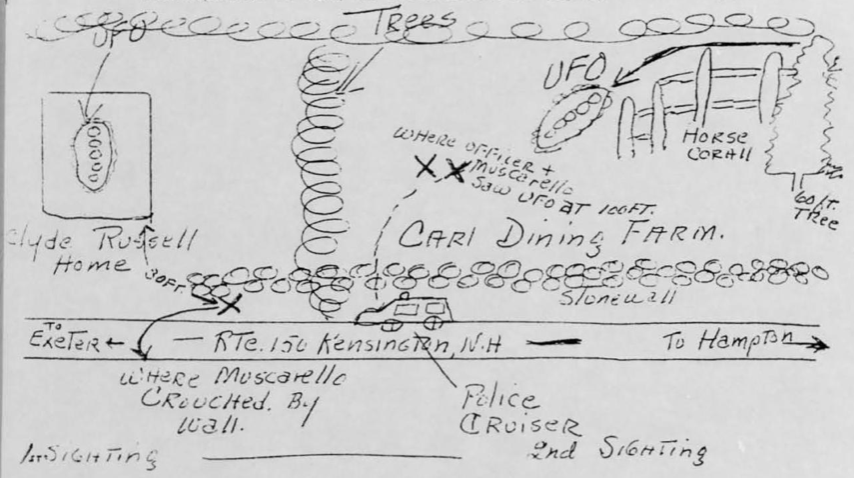
Incident At Exeter Map
Hand-drawn map in the Project Blue Book archives of the Incident at Exeter.
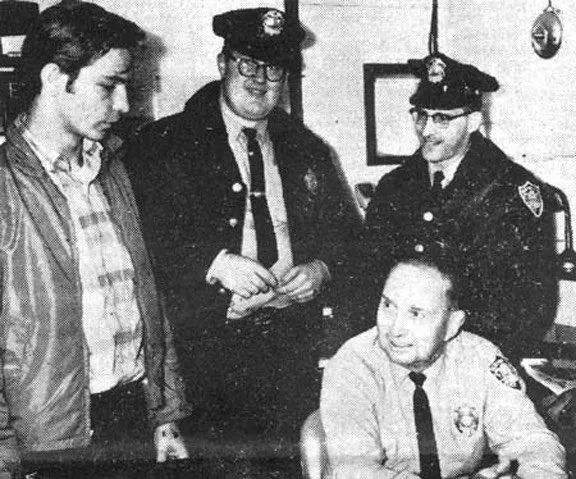
1e8f7a10-a24d-45a6-be9c-ecc0191e9d38-ufo0
Norman Muscarello with officers Hunt and Bertrand and dispatcher Toland. 1965
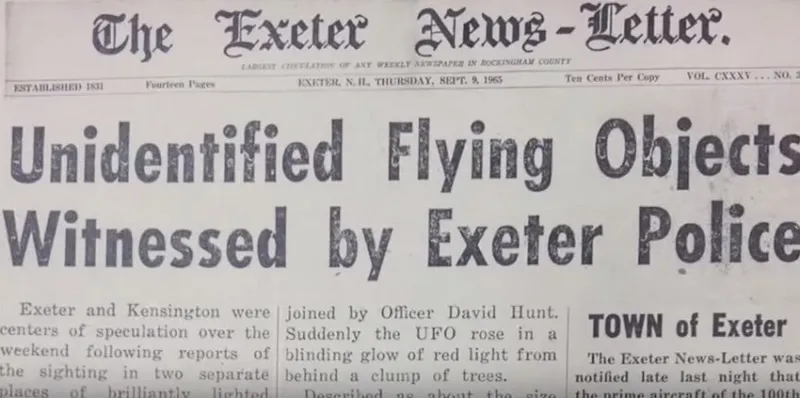
ExeterNewsLetterFront
Exeter News-Letter, Sept. 9, 1965
 Tom Muscarello and George Dufour on The Incident at Exeter
Further reading
Continue exploring — Wikipedia, documentaries, podcasts, museum pages. Not treated as proof, and not independently verified by this archive.
Investigation timeline
- 2026-09-27 — Historical file submitted.
- 2026-09-27 — Historical file accepted and published.
Assigned GG-2026-068
Research notes
Historical research: Atmospheric Refraction, Power Line Corona Discharge, and USAF Evaluation
In atmospheric physics and military aviation analysis, the Incident at Exeter is evaluated through electrical grid discharge, celestial optical illusions, and military training operations.
Initial responses from Pease Air Force Base personnel suggested that the witnesses observed a high-altitude strategic bomber exercise (Operation Big Blast) combined with an atmospheric thermal inversion that distorted starlight or aircraft running lights. Later physical analyses examined whether high-voltage electrical transmission lines running through the field caused a corona discharge—a localized plasma discharge occurring in moist night air near high-voltage cables. However, plasma discharges do not account for sustained, eighty-foot structured geometric outlines or multi-witness observational consistency across independent locations. Following official appeals by Exeter police officers, the U.S. Air Force Project Blue Book office formally amended its initial evaluation, reclassifying the Incident at Exeter in January 1966 from "military exercise" to "Unidentified."
Historical research: Structured Low-Altitude Maneuvers, Electromagnetic Interaction, and Multi-Witness Corroboration
Parapsychology and ufology evaluate the Exeter case as an exceptionally high-credibility close encounter characterized by physical interaction, acoustic absence, and animal distress.
Anomalistic researchers highlight four primary elements that complicate conventional explanations: simultaneous visual tracking by two trained law enforcement officers, complete absence of acoustic signature despite the object's low altitude and rapid acceleration, localized physical illumination recorded across the landscape, and acute behavioral reactions from farm livestock prior to visual acquisition. Research focuses on the craft's proximity to high-voltage transmission lines—a recurring pattern in UAP literature—raising questions regarding electromagnetic absorption, localized power grid interaction, or unclassified propulsion mechanisms operating without conventional atmospheric displacement or jet noise.
Open research questions
A specific gap in the file. An accepted source, research note, or further-reading link closes it.
Compare the original police statements and Project Blue Book file with later accounts of the Exeter incident. Trace claims concerning object size and shape, altitude, silence, ground illumination, animal reactions, earlier motorist reports and military aircraft activity. Identify which details appear in the 1965 record and which first emerge in later retellings.
Propose evidence & media, a source citation, further reading, a research note, a correction, a related case, or a series link. Staff review before anything is added. An accepted correction does not replace the file by itself.