GG-2026-070
The Howden Moors Incident
- Phenomenon UFOs/UAPs
- Documentation
Rating B
- A — Strong dossier: several independent sources plus primary evidence (original media, records, measurements) a researcher could use without interviewing anyone.
- B — Well documented: multiple independent witnesses with at least some contemporary primary material, or one witness with substantial primary corroboration (photos, recordings, contemporaneous notes, documents).
- C — Multi-source but soft: several witnesses or a long run of reports, but mostly testimony and after-the-fact secondary sources (newspapers, folklore collections, later interviews). Little or no primary physical evidence. Regional legend clusters such as the Bridgewater Triangle land here.
- D — Thin: single witness (or one household), little or no support beyond the account. Normal for a sincere personal experience.
- E — Incomplete or not yet assessed. Every new submission starts here until staff have read it.
- Evidence & media 2 items
- Status Historic
- Location Howden Moors, England
- Occurred 24 March 1997
Summary
On the night of March 24, 1997, hundreds of residents across Sheffield and the Peak District reported seeing a triangular, low-flying craft, followed by a bright flash, an explosion, and two distinct sonic booms over Howden Moor. Believing a plane had crashed, emergency services launched a massive, 150-person overnight search. Despite police helicopters, Mountain Rescue teams, and RAF assistance, no wreckage was found, creating a premier British UAP mystery.
Background
The Sightings and Reported Impact (19:40 – 22:15)
On the evening of Monday, March 24, 1997, multiple witnesses across South Yorkshire and Derbyshire observed unusual aerial phenomena moving over the Peak District National Park:
Initial Visual Tracks: Around 7:40 PM, a large, dark triangular craft was observed flying low over Sheffield railway station, heading west. Over the next two hours, independent witnesses near Dronfield and Bolsterstone reported a similar low-altitude object moving silently above the treeline.
The Explosion and Sonic Booms: At approximately 10:00 PM, residents across a 40-mile radius were startled by two massive, sequential acoustic detonations. Gamekeepers near Strines Reservoir and farmers in Bolsterstone reported seeing a low-flying aircraft disappear behind Mangarry Hill, followed immediately by a brilliant orange flash on the horizon and a plume of smoke.
Timeline of Key Events
├── March 24, 1997 (19:40) : Triangular object reported over Sheffield railway station.
├── March 24, 1997 (21:52) : First sonic boom recorded by the British Geological Survey at Leeds.
├── March 24, 1997 (22:06) : Second sonic boom recorded; farmers report flash/explosion on Howden Moor.
├── March 24, 1997 (23:00) : Major Search & Rescue activated; 141 Mountain Rescue volunteers deployed.
├── March 25, 1997 (07:00) : RAF establishes a 10-mile Danger Area/Air Exclusion Zone over the moors.
├── March 25, 1997 (14:00) : Search officially called off after 40 sq miles yield zero physical debris.
└── March 23, 1998 : Incident formally debated in the UK House of Commons by MP Helen Jackson.
The Search and Parliamentary Inquiry
Responding to a wave of emergency 999 calls, South Yorkshire Police initiated a full-scale air-and-ground search operation. The West Yorkshire Police helicopter and an RAF Sea King rescue helicopter swept the moors using thermal imaging, joined by 141 Mountain Rescue volunteers, search dogs, and fire crews.
At 7:00 AM on March 25, the RAF established a temporary 10-mile Air Exclusion Zone over Howden Reservoir to assist the search. By 2:00 PM, after combing 40 square miles of dense heather and peat bog, search commanders called off the operation without locating a single piece of wreckage, fuel residue, or impact crater. The mystery reached the highest levels of government on March 23, 1998, when MP Helen Jackson formally raised the "Howden Moor Incident" in the House of Commons.
Witness statement
No statement on file.
Evidence & media
 The Sheffield Star, 25 March 1997
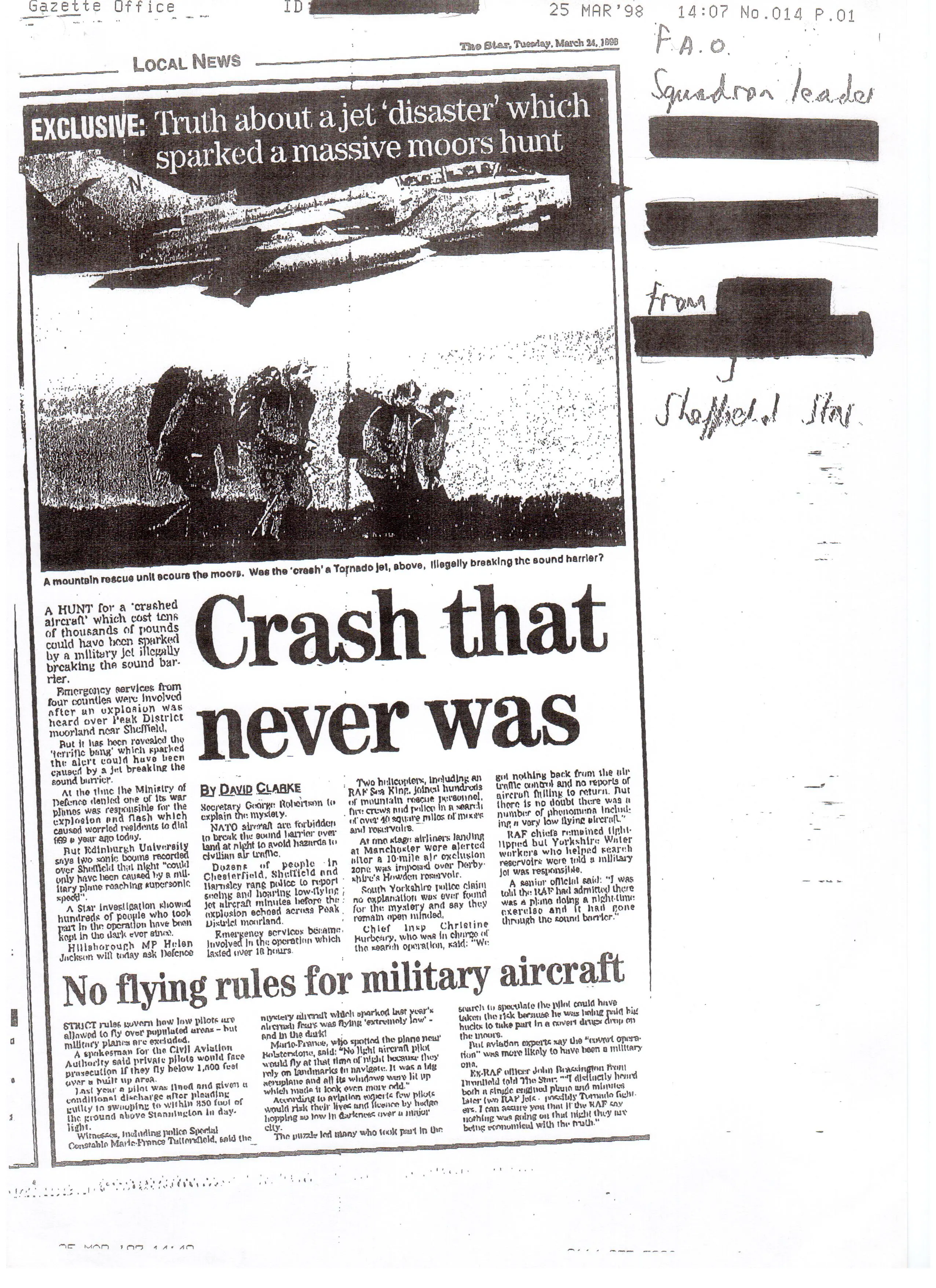 The Star, 24 March 1998, landed on the desk of the MoD’s UFO desk – revealed in files released in 2011
Investigation timeline
- 2026-09-27 — Historical file submitted.
- 2026-09-27 — Historical file accepted and published.
Research notes
Historical research: Seismological Detonation Tracking, Atmospheric Bolides, and Military Aviation Logistics
In physical geophysics and aviation forensics, the Sheffield incident is evaluated through seismic signal logs, bolide atmospheric entries, and unacknowledged military maneuvers.
Seismologists at the British Geological Survey (BGS) in Edinburgh recorded two distinct acoustic shockwaves at 21:52 and 22:06 UTC. Technical analysis confirmed that the shockwave signatures matched atmospheric pressure waves generated by objects exceeding Mach 1. While the Ministry of Defence (MoD) initially denied having supersonic aircraft over the Peak District—citing UK regulations strictly banning overland supersonic flight—aviation analysts suggest an unacknowledged low-flying military exercise or a rogue light aircraft involved in illicit transport. An alternative scientific explanation posits a small meteoroid or bolide entering the lower atmosphere, generating a double sonic boom and terminal flash over the moors without leaving a concentrated terrestrial crash site.
Historical research: Silent Low-Altitude Maneuvers, Interceptor Pursuits, and Exclusion Zone Protocol
Anomalistic researchers and UAP investigators analyze the event as a potential low-altitude UAP encounter accompanied by military interception.
Independent researchers, such as Dr. David Clarke, gathered accounts from civilian witnesses who reported seeing RAF Tornado jets actively pursuing a silent, triangular, illuminated craft shortly before the explosions. Proponents of the anomalistic hypothesis highlight contradictions in official statements: while military authorities claimed no combat jets were airborne, dozens of local residents recorded low-altitude jet engine noise following the initial triangular craft sightings. The rapid imposition of a 10-mile air exclusion zone—normally reserved for major military disasters—fuels hypotheses that an exotic craft or an interceptor aircraft was covertly recovered from the remote reservoirs before civilian mountain rescue teams reached the inner grid sectors.
Propose evidence & media, a source citation, further reading, a research note, a correction, a related case, or a series link. Staff review before anything is added. An accepted correction does not replace the file by itself.