GG-2026-073
Jersey Devil
- Phenomenon Cryptids & Unknown Zoology
- Documentation
Rating B
- A — Strong dossier: several independent sources plus primary evidence (original media, records, measurements) a researcher could use without interviewing anyone.
- B — Well documented: multiple independent witnesses with at least some contemporary primary material, or one witness with substantial primary corroboration (photos, recordings, contemporaneous notes, documents).
- C — Multi-source but soft: several witnesses or a long run of reports, but mostly testimony and after-the-fact secondary sources (newspapers, folklore collections, later interviews). Little or no primary physical evidence. Regional legend clusters such as the Bridgewater Triangle land here.
- D — Thin: single witness (or one household), little or no support beyond the account. Normal for a sincere personal experience.
- E — Incomplete or not yet assessed. Every new submission starts here until staff have read it.
- Evidence & media 3 items
- Status Active
- Location Various locations, New Jersey · regional placement
- Occurred 16 January 1909
Regional marker representing Leeds Point and the broader New Jersey Pine Barrens associated with the Jersey Devil tradition. Historical folklore and reported sightings involve numerous locations throughout South Jersey. This marker does not identify a verified birthplace, den or creature encounter site.
This file is placed as a region or body of water, not a single exact event location.
Activity period
- Earliest claimed event 1735
- Earliest documented report Unknown
- Latest documented report Ongoing
- Pattern Recurring
Summary
The Jersey Devil is a legendary creature associated with the Pine Barrens of southern New Jersey. Its most famous period of activity came during a wave of reports in January 1909, when newspapers across New Jersey and eastern Pennsylvania published accounts of strange tracks, unusual animals, and sightings of a winged creature. Witnesses included residents, police officers, and public officials. No creature was captured or identified. The 1909 reports are well documented in contemporary newspapers, while the creature's origin story belongs to the region's older folklore tradition.
Background
The Jersey Devil is one of the oldest and most famous creatures in American folklore. The legend is closely associated with the Pine Barrens of southern New Jersey, where reports of an unusual winged animal have circulated for more than two centuries.
The creature's traditional appearance varies, but witnesses commonly describe a horse-like head, wings, hooved feet, and an unusual cry or scream. No single description has ever become definitive, and reports have differed significantly across time and location.
The best-known origin story is the "Leeds Devil" legend. According to later folklore, a woman known as Mother Leeds, living in the Pine Barrens during the colonial period, cursed her unborn thirteenth child. The child was said to have transformed into a monstrous winged creature and flown into the surrounding wilderness. Historians generally regard the story as folklore rather than a documented historical event. Research into the Leeds family has also suggested that political, religious, and publishing disputes involving Daniel Leeds may have contributed to the development of the legend.
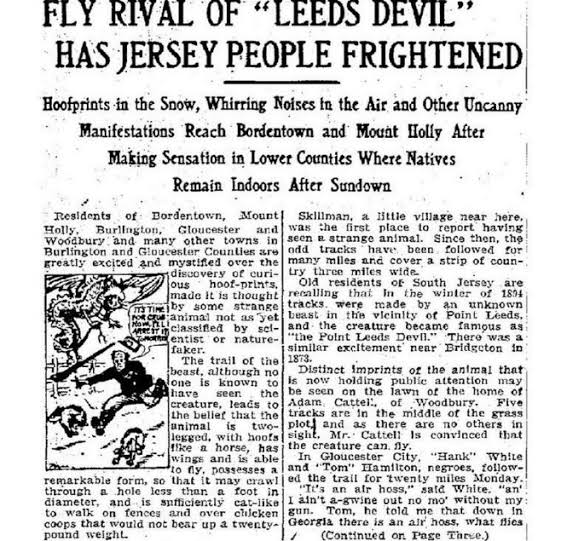
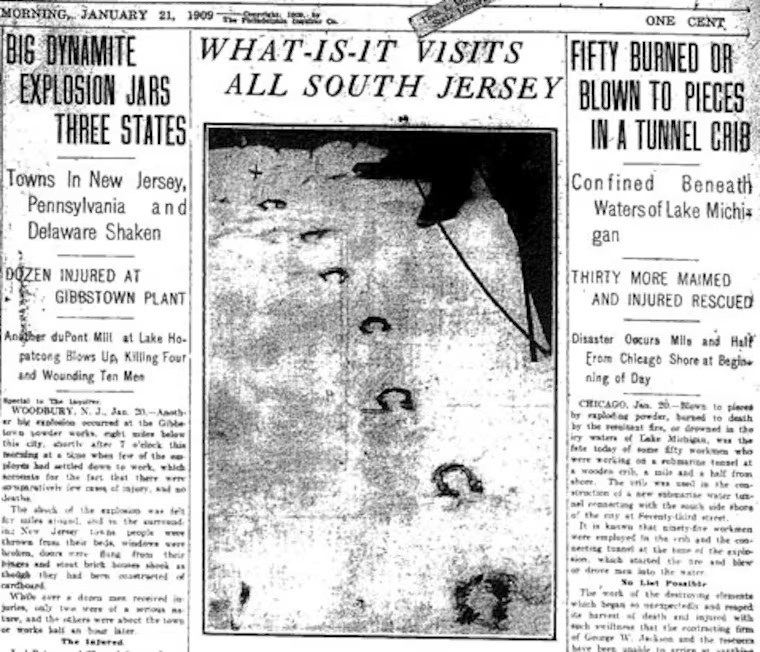
The event most responsible for transforming the Jersey Devil from local folklore into a regional sensation occurred in January 1909. During a period of roughly one week, newspapers across New Jersey and eastern Pennsylvania published numerous reports describing strange tracks, unusual animals, and sightings of a winged creature. Witnesses included residents, police officers, public officials, and railroad employees.
Descriptions varied from report to report, but many accounts referred to a creature with wings, hoof-like feet, and an animal-like head. Reports came from dozens of communities across southern New Jersey and nearby portions of Pennsylvania. Newspapers documented sightings, alleged tracks in snow, and widespread public interest in the mystery.
The 1909 wave generated significant excitement. Search parties were organized, schools reportedly closed in some communities, and newspapers devoted extensive coverage to the story. A reward was offered by the Philadelphia Zoo for the capture of the creature, though no animal matching witness descriptions was ever produced.
The wave gradually faded during the closing days of January 1909. No specimen was captured, no body was recovered, and no explanation gained universal acceptance. Proposed explanations included misidentified animals, hoaxes, exaggerated reporting, and genuine encounters with an unknown creature.
The Jersey Devil continued to appear in occasional reports throughout the twentieth and twenty-first centuries. Modern sightings are typically isolated and vary widely in quality and detail. Numerous photographs, videos, and eyewitness accounts have circulated online, though none has produced conclusive evidence for the creature's existence.
Today, the Jersey Devil occupies a unique place in American folklore. The Leeds legend, the 1909 sighting wave, and the creature's enduring presence in regional culture are all well documented. Whether the reports reflect misidentified animals, hoaxes, folklore-shaped perception, or an unknown phenomenon remains unresolved. The result is one of North America's longest-lasting and most influential cryptid traditions.
Witness statement
No statement on file.
Evidence & media
images
Newspaper articles from 1909 on the Devil.
Untitled Newspaper
Newspaper articles from 1909 on the Devil.
21380911-standard
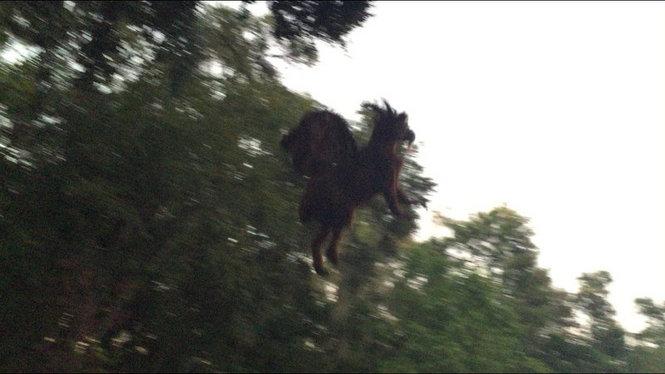
Dave Black of Little Egg Harbor captured this photo in Galloway Township, Oct 2015. He believes it could be the Jersey Devil.
Further reading
Continue exploring — Wikipedia, documentaries, podcasts, museum pages. Not treated as proof, and not independently verified by this archive.
Investigation timeline
- 2026-09-27 — Historical file submitted.
- 2026-09-27 — Historical file accepted and published.
Assigned GG-2026-073
Research notes
Historical research: Avian Misidentification, Colonial Political Slander, and Mass Hysteria
From ecological, historical, and sociological perspectives, the Jersey Devil phenomenon represents a synthesis of colonial political propaganda, misidentified regional fauna, and mass social panic.
Historians such as Brian Regal demonstrate that the 18th-century "Leeds Devil" narrative began as a partisan smear campaign orchestrated by rival Quakers against Daniel Leeds, an occult-leaning almanac publisher in Burlington. Zoologically, researchers analyzing the 1909 sighting wave evaluate the misidentification of large non-native or rare native birds, such as the sandhill crane (Antigone canadensis) or the great blue heron (Ardea herodias). The sandhill crane stands over four feet tall, possesses a six-foot wingspan, utters harsh, squawking vocalizations, and leaves distinct three-toed tracks that can appear hoof-like in melting snow. When combined with sensationalist headlines produced by competitive Philadelphia newspapers during a slow news week, standard wildlife sightings rapidly escalated into a textbook example of collective mass hysteria.
Historical research: High-Density Multi-County Tracking, Rooftop Morphological Anomalies, and Cryptid Clustering
Anomalistic researchers and cryptozoologists evaluate the 1909 wave as an exceptionally dense, high-credibility cryptid event marked by physical trace evidence and professional witness consistency.
Investigation focuses on the geographic distribution and speed of the January 1909 reports, which spanned dozens of miles within narrow time windows that exceed the capabilities of simple hoaxes or localized animal misidentifications. Cryptozoologists emphasize the physical tracking data recorded by law enforcement and municipal surveyors: continuous lines of un-split, cloven prints pressed into deep snow atop six-foot fences, high house roofs, and narrow window ledges without disrupting surrounding drifts. The consistency of visual reports—describing a bipedal, ungulate-headed creature featuring functional dorsal wings—across hundreds of unacquainted witnesses in separate cities remains a central puzzle in American anomalistic literature.
Open research questions
A specific gap in the file. An accepted source, research note, or further-reading link closes it.
Trace the earliest surviving documentary sources for the Jersey Devil tradition and determine when the Mother Leeds thirteenth-child story, specific creature descriptions and claimed 1735 origin first appear in print. Separate the documented Leeds family history from later folklore, and compare pre-1909 material with the newspaper-driven sighting wave of January 1909.
Propose evidence & media, a source citation, further reading, a research note, a correction, a related case, or a series link. Staff review before anything is added. An accepted correction does not replace the file by itself.