GG-2026-075
Jewett City Vampire
- Phenomenon Folklore & Cultural Encounters
- Documentation
Rating B
- A — Strong dossier: several independent sources plus primary evidence (original media, records, measurements) a researcher could use without interviewing anyone.
- B — Well documented: multiple independent witnesses with at least some contemporary primary material, or one witness with substantial primary corroboration (photos, recordings, contemporaneous notes, documents).
- C — Multi-source but soft: several witnesses or a long run of reports, but mostly testimony and after-the-fact secondary sources (newspapers, folklore collections, later interviews). Little or no primary physical evidence. Regional legend clusters such as the Bridgewater Triangle land here.
- D — Thin: single witness (or one household), little or no support beyond the account. Normal for a sincere personal experience.
- E — Incomplete or not yet assessed. Every new submission starts here until staff have read it.
- Evidence & media 2 items
- Status Historic
- Location Jewett City, Connecticut
- Occurred 8 May 1854
Exact marker for Jewett City Cemetery, where the Ray family members associated with the 1854 vampire panic are buried and where the reported exhumation ritual occurred. The marker identifies the historic cemetery and does not represent the precise location within the grounds where the ritual took place.
Activity period
- Earliest claimed event 8 May 1854
- Earliest documented report 24 May 1854
- Latest documented report 8 May 1854
- Pattern Single event
Summary
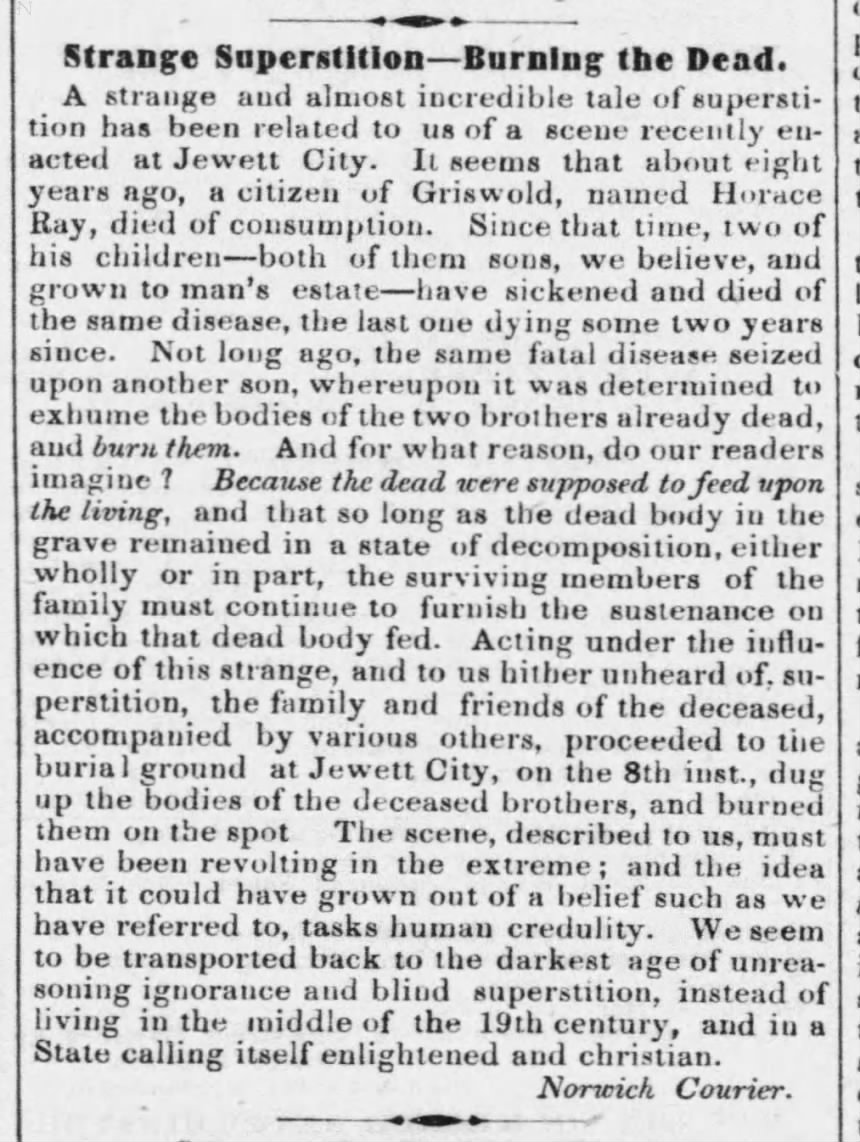
In May 1854, the Ray family of Jewett City, Connecticut, suffered multiple deaths from tuberculosis (consumption). Convinced an undead family member was leeching the life force of the surviving brothers, relatives exhumed the bodies of two deceased sons, Henry and Lemuel, and burned their heart and liver tissues on a public bonfire in Jewett City Cemetery to stop the contagion.
Background
In the mid-nineteenth century, tuberculosis, then commonly called "consumption," was one of the leading causes of death in New England. Before the acceptance of germ theory, families often struggled to understand why multiple relatives would become ill and die over a period of years. In some communities, a folk belief developed that a deceased family member might be draining the vitality of the living from beyond the grave.
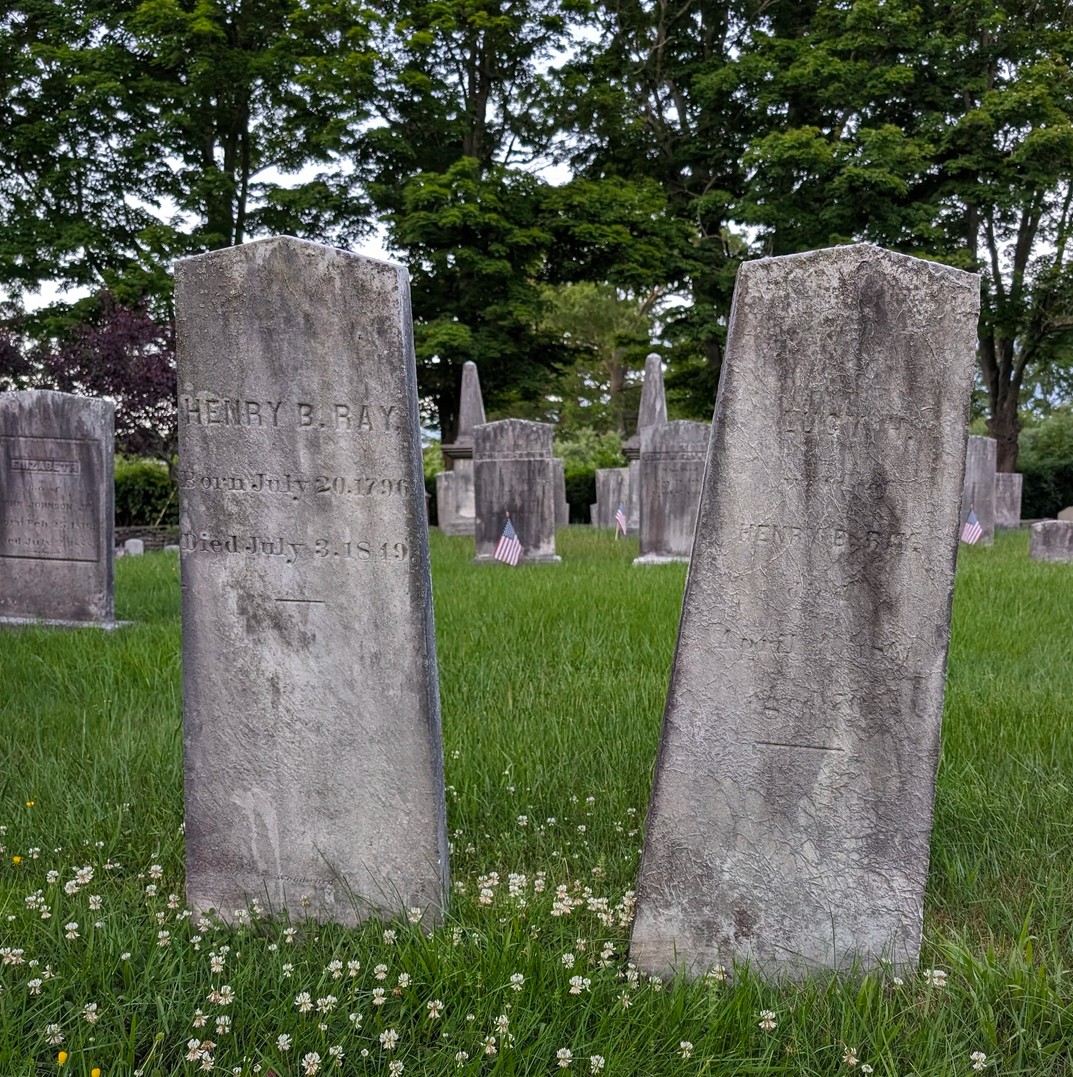
The Ray family of Jewett City, Connecticut, suffered a devastating series of losses attributed to consumption. Horace Ray died in 1845, followed by his son Horace Jr. in 1846. Two additional sons, Lemuel Ray and Henry B. Ray, died in 1849 and 1851 respectively.
By 1854, two surviving brothers, Elisha Ray and another family member, were reportedly showing symptoms of the disease. As their condition worsened, relatives became convinced that one of the deceased family members was responsible. This belief reflected a wider New England folk practice sometimes called the "vampire panic," in which communities exhumed recently deceased relatives in an attempt to halt the spread of illness within a family.
On May 8, 1854, family members and local residents opened the graves of Lemuel Ray and Henry B. Ray in Jewett City Cemetery. Contemporary accounts reported that portions of the heart and liver remained intact. To those present, this was interpreted as evidence that the dead were continuing to affect the living.
Following local custom, the organs were removed and burned on a fire built near the graves. The ashes were part of a ritual intended to break the alleged influence of the deceased and restore the health of surviving family members.
The ritual did not have the desired effect. Elisha Ray died of consumption later in 1854, and Martha Ray, the family matriarch, died the following year.
The Ray family case became one of the best-documented examples of Connecticut's participation in the broader New England vampire tradition. Like the later and more famous Mercy Brown case in Rhode Island, it illustrates how communities attempted to explain and combat tuberculosis before the disease was scientifically understood.
In 1990, archaeologists excavating a nineteenth-century cemetery in nearby Griswold, Connecticut, discovered the remains of a man later identified as John Barber (often referred to as JB-55). The burial showed signs of a postmortem anti-vampire ritual, including the rearrangement of bones after exhumation. While unrelated to the Ray family directly, the discovery provided archaeological evidence that such practices were genuinely carried out in New England communities during the nineteenth century.
Today, the Ray family exhumation is regarded as a historical response to a poorly understood disease rather than evidence of supernatural activity. The deaths, exhumation, and organ-burning ritual are documented historical events. Whether participants sincerely believed they were combating an undead threat or viewed the practice as a broader folk remedy cannot be known with certainty, but the case remains one of the clearest records of New England's vampire-panic tradition.
Witness statement
No statement on file.
Evidence & media
img
Hartford Courant · Hartford, CT 24 May 1854
Screenshot 2026-09-27 204547
Headstones of Henry & Lucy Ray.
Further reading
Continue exploring — Wikipedia, documentaries, podcasts, museum pages. Not treated as proof, and not independently verified by this archive.
Investigation timeline
- 2026-09-28 — Historical file submitted.
- 2026-09-28 — Historical file accepted and published.
Assigned GG-2026-075
Research notes
Historical research: Tuberculosis Pathophysiology, Pre-Germ Theory Folk Medicine, and Bioarchaeology
From medical history, epidemiology, and bioarchaeology perspectives, the Jewett City case is a canonical example of the 19th-century New England "Vampire Panic."
Epidemiologists note that tuberculosis bacteria thrive in close household environments. Because consumption causes slow, agonizing wasting where the patient appears "consumed" from within, pre-germ theory populations constructed folk-medical explanations to rationalize the pattern of household contagion. Anthropologists—such as Dr. Nicholas Bellantoni, who investigated the nearby Griswold "JB-55" vampire exhumation in 1990—demonstrate that New England "vampirism" was not rooted in Gothic fiction or blood-drinking monsters, but in therapeutic folk magic aimed at destroying the internal biological organ believed to hold the infectious link between the dead and the living.
Historical research: Contagion Sympathetic Magic, Ritual Exhumation Mechanics, and Mass Psycho-Spiritual Trauma
Anomalistic researchers and folklorists analyze the Jewett City incident within the framework of sympathetic magic, apotropaic ritual behavior, and mass community trauma response.
Parapsychology and folklore studies examine the underlying belief structure: the conviction that an energetic or astral tether persisted between deceased and living kin. The specific ritual protocol—exhuming the body, evaluating the state of decomposition (interpreting liquid blood or preserved organs as "proof" of undead feeding), and using fire as a purging agent—mirrors Eastern European vampire panics, brought to New England through early transatlantic cultural transmission. Researchers analyze how intense grief and community helplessness in the face of an invisible, unstoppable mortality agent drove rational, church-going Yankee farmers to perform public desecration rituals.
Open research questions
A specific gap in the file. An accepted source, research note, or further-reading link closes it.
Locate the full May 24, 1854 Hartford Courant account and any earlier contemporary coverage of the Ray-family exhumations. Establish whether May 8 can be independently documented as the ritual date, which family members were actually exhumed or burned, and which vampire-related beliefs were stated at the time rather than added through later folklore.
Propose evidence & media, a source citation, further reading, a research note, a correction, a related case, or a series link. Staff review before anything is added. An accepted correction does not replace the file by itself.