GG-2026-078
Lake Memphremagog
- Phenomenon Cryptids & Unknown Zoology
- Documentation
Rating C
- A — Strong dossier: several independent sources plus primary evidence (original media, records, measurements) a researcher could use without interviewing anyone.
- B — Well documented: multiple independent witnesses with at least some contemporary primary material, or one witness with substantial primary corroboration (photos, recordings, contemporaneous notes, documents).
- C — Multi-source but soft: several witnesses or a long run of reports, but mostly testimony and after-the-fact secondary sources (newspapers, folklore collections, later interviews). Little or no primary physical evidence. Regional legend clusters such as the Bridgewater Triangle land here.
- D — Thin: single witness (or one household), little or no support beyond the account. Normal for a sincere personal experience.
- E — Incomplete or not yet assessed. Every new submission starts here until staff have read it.
- Evidence & media 2 items
- Status Historic
- Location Vermont and Quebec
- Occurred 1816
Summary
For over two centuries, witnesses along the glacial waters of Lake Memphremagog—straddling Newport, Vermont, and Quebec, Canada—have reported encounters with a massive, serpentine aquatic creature affectionately known as "Memphre." First recorded in European settler logs in 1816 following centuries of Abenaki indigenous oral traditions, the creature is typically described as a dark, 30-to-50-foot animal featuring multiple dorsal humps, a snake-like head, and high-speed swimming capabilities. With hundreds of documented sightings by boaters, border officials, and local residents, Memphre remains one of North America's most persistent lake monster phenomena.
Background
Indigenous Traditions and Early European Reports (Pre-1800s–1816)
Long before European colonization, the native Abenaki nation maintained oral traditions regarding a giant, horned sea-serpent inhabiting the deep waters of Lake Memphremagog (derived from the Abenaki word meaning "where there is a big expanse of water"). Abenaki hunters reportedly refused to swim in or venture into certain deep channels of the lake out of respect and caution for the aquatic entity.
First Documented Settler Encounter (1816): The earliest written record by European settlers occurred in 1816, when local farmer Ralph Merry reported seeing a huge, dark, serpentine creature rising out of the water near Owls Head mountain.
The 1871 Sighting Wave: Sighting activity intensified throughout the 1870s as commercial steamship traffic expanded across the international border. On a single afternoon in 1871, multiple passengers aboard the steamer Lady of the Lake observed a 40-foot creature swimming parallel to the vessel before diving vertically into deep water.
Timeline of Key Events
├── Pre-1800s : Abenaki oral traditions record a giant aquatic entity in the lake.
├── 1816 : Ralph Merry logs the first documented European settler sighting.
├── 1871 : Passengers aboard steamer 'Lady of the Lake' observe 40-foot creature.
├── 1986 : Researcher Barbara Malloy establishes official sightings log registry.
├── 2005 : High-profile multi-witness sighting recorded near Magog, Quebec.
└── 2011–Pres. : Municipal protections enacted by Magog and Newport city councils.
Modern Sightings and Civic Recognition
Throughout the 20th and 21st centuries, reports of Memphre continued steadily from commercial fishermen, recreational boaters, and shore observers:
Physical Characteristics: Modern sighting logs compiled by local cryptozoology researcher Barbara Malloy contain over 250 documented encounters. Witnesses consistently describe a dark gray, brown, or black creature ranging from 30 to 50 feet in length, moving at speeds up to 25 miles per hour, and leaving behind a distinctive heavy wake even on calm water.
Official Recognition: Unlike many cryptozoological subjects that face local ridicule, Memphre is officially recognized by municipal authorities. The city of Magog, Quebec, and the town of Newport, Vermont, have passed symbolic protective resolutions for the creature, and the Canadian Royal Mint issued a commemorative coin honoring Memphre in 2011.
Witness statement
No statement on file.
Evidence & media
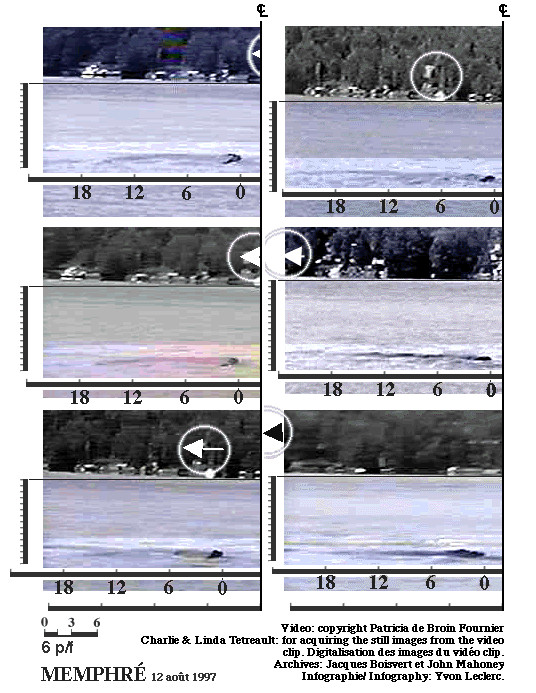 Claimed picture of the creature taken on August 12, 1997 by Patricia de Broin near the island “Les Trois Soeurs”
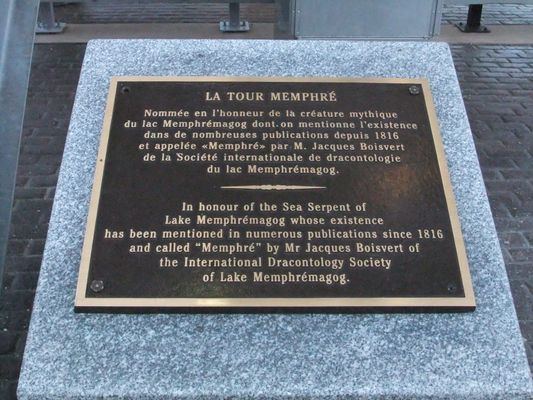 Plaque near the lake.
Investigation timeline
- 2026-09-28 — Historical file submitted.
- 2026-09-28 — Historical file accepted and published.
Research notes
Historical research: Limnological Optics, Sub-Surface Temperature Inversions, and Sturgeon Misidentification
From limnology, optics, and ichthyology perspectives, the Memphremagog reports represent a combination of atmospheric refraction, aquatic wave mechanics, and misidentified relict fish species.
Limnologists studying Lake Memphremagog—a deep, fjord-like glacial lake reaching depths over 350 feet—note that thermal stratification creates severe optical illusions known as Fata Morgana or atmospheric mirages. Under specific temperature inversion conditions, floating logs, boat wakes, or flocking waterfowl swimming in a line appear stretched, magnified, and elevated above the water line, mimicking undulating dorsal humps. Biologists also point to rogue lake sturgeon (Acipenser fulvescens), which can reach lengths over seven feet, live for more than a century, possess armor-like dorsal scutes, and occasionally leap entirely out of the water.
Historical research: Relict Marine Reptile Hypotheses, Deep-Trench Habitats, and Aquatic Cryptid Clustering
Anomalistic researchers and cryptozoologists evaluate the Memphremagog phenomena within the broader context of North American post-glacial lake cryptid systems (alongside Lake Champlain's "Champ").
Cryptozoological hypotheses focus on the possibility of a surviving population of relict marine reptiles—such as long-necked plesiosaurs or primitive zeuglodon whales—that adapted to freshwater conditions following the retreat of the Champlain Sea approximately 10,000 years ago. Field researchers emphasize the high geographic density of bathymetric trenches along the US-Canada underwater border, which feature extensive subterranean cavern networks capable of sheltering large aquatic animals from standard sonar detection.
Propose evidence & media, a source citation, further reading, a research note, a correction, a related case, or a series link. Staff review before anything is added. An accepted correction does not replace the file by itself.