GG-2026-079
Gloucester Sea Serpent
- Phenomenon Cryptids & Unknown Zoology
- Documentation
Rating C
- A — Strong dossier: several independent sources plus primary evidence (original media, records, measurements) a researcher could use without interviewing anyone.
- B — Well documented: multiple independent witnesses with at least some contemporary primary material, or one witness with substantial primary corroboration (photos, recordings, contemporaneous notes, documents).
- C — Multi-source but soft: several witnesses or a long run of reports, but mostly testimony and after-the-fact secondary sources (newspapers, folklore collections, later interviews). Little or no primary physical evidence. Regional legend clusters such as the Bridgewater Triangle land here.
- D — Thin: single witness (or one household), little or no support beyond the account. Normal for a sincere personal experience.
- E — Incomplete or not yet assessed. Every new submission starts here until staff have read it.
- Evidence & media 2 items
- Status Active
- Location Gloucester, Massachusetts
- Occurred 26 June 1638
Summary
Spanning nearly four centuries of New England maritime history, the Gloucester Sea Serpent remains one of America’s oldest, best-documented, and most culturally impactful cryptid cases. While offshore serpent reports in the Atlantic date back as early as June 1638, the phenomenon reached a historic peak during the summer of August 1817 in Gloucester Harbor, Massachusetts. Scores of reliable witnesses—including fishermen, ship captains, merchants, and local officials—reported a massive, dark, serpent-like creature measuring 40 to 100 feet in length, featuring multiple visible humps and moving with extraordinary speed. The case made history when the Linnaean Society of New England launched one of the first formal scientific investigations into a cryptid, though their ultimate endorsement was severely tarnished by the misidentification of a mutated black snake as a "baby serpent." Despite scientific skepticism and natural explanations ranging from oarfish and basking sharks to string-swimming porpoises, sightings have persisted into the modern era.
Background
arly Traditions and the 1817 Sighting Wave
Maritime accounts of unknown marine giants off the New England coast were documented long before the famous 1817 surge. John Josselyn recorded the earliest known report off Cape Ann on June 26, 1638. However, the 1817 Gloucester flap distinguished itself by generating an unprecedented density of sworn, contemporary eyewitness statements published directly in newspapers as events unfolded:
Eyewitness Consistency: Observers from shore and vessels described a creature 40–100 feet long, dark brown or black, with a horse-like or reptilian head elevated above the water.
Locomotion and Humps: Witnesses repeatedly noted vertical undulations or a series of 10 to 30 visible "humps" along its back, moving through Gloucester Harbor at estimated speeds up to 20–30 knots.
Prominent Observers: Sworn depositions were taken by Justice of the Peace Lonson Nash from prominent citizens, including sea captains and military officers, lending the reports unusual credibility.
Timeline of Key Events
├── June 26, 1638 : Earliest recorded sighting off Cape Ann recorded by John Josselyn.
├── August 1817 : Major sighting flap in Gloucester Harbor; dozens of sworn depositions taken.
├── October 1817 : Linnaean Society of New England publishes formal report validating the creature.
├── Late 1817 : "Scoliophis atlanticus" specimen proven to be a deformed black snake; report discredited.
├── 1819–1899 : Subsequent sighting waves reported off Nahant, Plymouth, and Cape Cod.
└── Present : Occasional modern reports maintain the longest-running cryptid tradition in North America.
The Linnaean Society Investigation and "Baby Serpent" Debacle
The Gloucester case attracted the direct involvement of the scientific establishment through the Linnaean Society of New England:
Formal Scientific Inquiry (October 1817): Society members collected sworn depositions and concluded that the testimonies described an unknown species of giant marine reptile, which they named Scoliophis atlanticus.
The "Baby Serpent" Specimen: Credibility collapsed when a local resident presented a 3-foot deformed snake with humped vertebrae found on a beach. The Society hastily declared it a juvenile of the giant serpent. Subsequent anatomical examination by naturalists (including French anatomist Henri Marie Ducrotay de Blainville) proved the specimen was simply a common deformed black snake (Coluber constrictor), delivering a major blow to the investigation's authority.
Witness statement
No statement on file.
Evidence & media
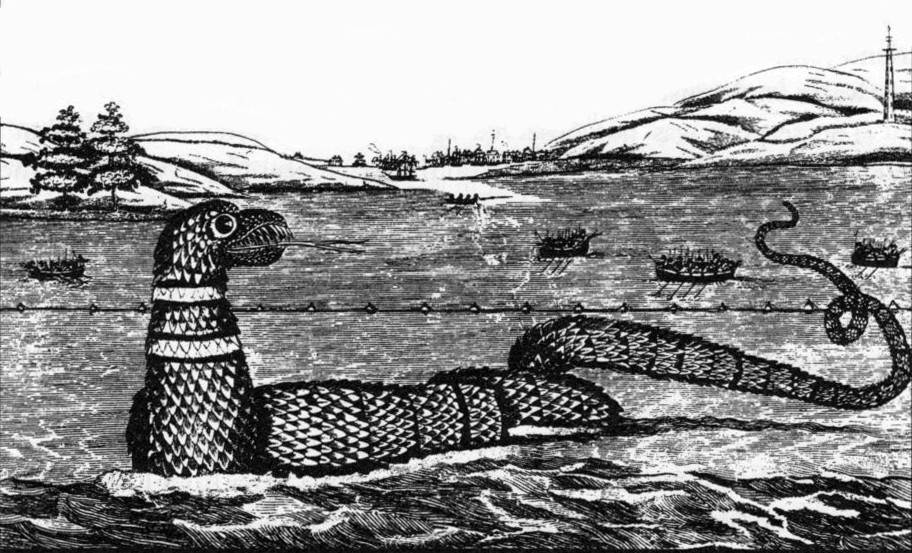 The Gloucester Sea Serpent of 1817
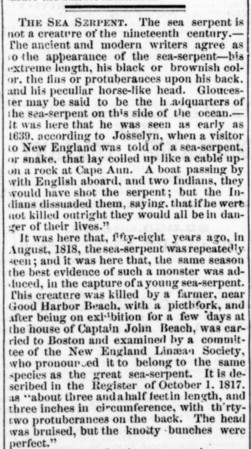 Article about the sea serpent published in the Maine Farmer on August 28, 1875
Investigation timeline
- 2026-09-28 — Historical file submitted.
- 2026-09-28 — Historical file accepted and published.
Research notes
Historical research: One of America's Earliest Large-Scale Cryptid Cases
The Gloucester Sea Serpent occupies a unique position in paranormal history because it sits at the intersection of folklore, journalism, and early science. Unlike many cryptid cases that emerged through modern television or internet culture, the 1817 sightings attracted significant contemporary attention and prompted formal investigation by the Linnaean Society of New England. The existence of the sighting wave itself is well documented.
The central mystery remains unresolved. Numerous witnesses claimed to observe something extraordinary, and the reports became one of the most famous sea-serpent episodes in American history. However, no physical evidence ever confirmed the existence of a giant unknown marine animal. Under Gothic.Black standards, the strongest conclusion is that the 1817 witness events are historical facts, while the identity of what was observed remains unknown.
Earliest Documented Paranormal Claim
The earliest major documented wave of sightings occurred in 1817 off Gloucester, Massachusetts.
Earliest Located Major Documentation
Contemporary newspaper accounts and the investigations conducted by the Linnaean Society of New England provide the earliest surviving documentation.
Historical research: Early Cryptozoological Methodology, Mass Observation Flaps, and Cultural Archetypes
In anomalistic studies and folkloristics, the Gloucester Sea Serpent serves as the foundational prototype for North American cryptid flaps.
Unlike localized folklore that develops retroactively, the 1817 event represents an early historical nexus of real-time mass observation, media coverage, and formal scientific evaluation. Anomalistic researchers note the remarkable consistency in morphology described across independent witness groups during August 1817, including vertical undulation—a physical motion characteristic of marine mammals rather than typical aquatic reptiles. The case established the cultural template for later American monster traditions, including Lake Champlain's Champ, Lake Memphremagog's Memphré, and Scotland's Nessie.
Propose evidence & media, a source citation, further reading, a research note, a correction, a related case, or a series link. Staff review before anything is added. An accepted correction does not replace the file by itself.